Thursday, September 3, 2026



News and Views from the Global South

Women Recycle for Income and Environment
- The recovery of recyclable waste now sustains a group of women who live along the salty Laguna de Tacarigua, a slice of biodiversity along Venezuela's Caribbean coast.
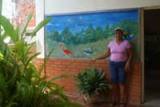
Eduarda Román next to a mural of the Laguna de Tacarigua at her house. - Humberto Márquez/IPS
Tacarigua is a long coastal lagoon covering 9,200 hectares along Venezuela's Caribbean coast, a three-hour drive east of Caracas.
The lagoon has areas where freshwater meets saltwater, but most of it is separated from the sea by a sandy strip 28 kilometers long and about 300 meters wide.
“Here, we women organized ourselves in a small company to collect what we used to see as garbage,” María Auxiliadora Uriepero, who has six children and 11 grandchildren, told Tierramérica. She stood in the doorway of her half-built house, with its cinder-block walls and zinc roof, and which currently serves as a warehouse for her sacks of discarded bottles.
Lacking interior dividing walls, many houses like this can be found in Tacarigua de la Laguna, a town on the edge of the national park of the same name. Some 5,000 residents, here and in neighboring Belén, make their living from fishing and tourism on the nearby beaches. But unemployment is rampant.
Uriepero went over the numbers: “I need to collect about 58,000 bottles in order to fix up my house. Wherever I see a bottle, I pick it up. My whole family does the same. We already have 90 sacks full,” weighing 20 kilograms each, with plastic and glass bottles that are sold to recycling companies.
She doesn't rely solely on this source of income. She also sews and makes ragdolls, bakes cakes and other sweets, sells refreshments and candy, and weaves hammocks. “Now, with a group, we set up a company for separation at the site of origin. We call it 'Flor del Mangle' (Flower of the Mangrove)',” Uriepero said.
The red mangrove (Rhizophora mangle) forest forms the lagoon's main ecosystem, extending over 4,000 hectares, but there are also other mangrove varieties: the white (Laguncularia racemosa), black (Avicennia germinans) and buttonwood (Conacarpus erectus).
The national park, created by decree in 1974, has 39,100 hectares that include the lagoon and shoreline, and the sandbar that separates it from the sea. In 1991, 20,000 hectares of adjacent sea were added. It is one of the sites protected under the Ramsar Convention on Wetlands of International Importance, named for the Iranian city where the pact was signed in 1971.
On a narrow street, in the shade of mango trees, and just a few meters from one arm of the lagoon, Vilma Gutiérrez removes dirt and labels from 1.5-liter plastic soda bottles. “Each day we walk several kilometers along the beach and collect and separate out glass, plastic and aluminum,” she said.
“I'm no longer ashamed that they are going to see us and say 'that garbage lady.' The people in the government (of the northern state of Miranda) have taught us that it isn't garbage, it's secondary raw material, which we can use to operate our association, 'Corocora Mar y Sol',” Gutiérrez said.
The “corocora roja” (scarlet ibis, or Eudocimus ruber), is a plentiful bird in Tacarigua, an area where more than 250 bird species have been recorded.
Four kinds of sea turtles lay eggs in the park, among them the green turtle (Chelonia mydas) and the loggerhead turtle (Caretta caretta), both globally endangered. The park is also home to the coastal American crocodile (Crocodylus acutus).
The maritime and lagoon areas are habitat for fish species that are on demand in the local food market, like the common snook (Centropomus undecimalis) and the white mullet (Mugil curema).
Among the 20 mammals of the local fauna are the red brocket deer (Mazama americana), the capuchin monkey (Cebus olivaceus) and the endangered ocelot, or painted leopard (Leopardus pardales).
Flor del Mangle and Corocora Mar y Sol are two recycling microenterprises, the former is incorporated and the latter is registered as a partnership. The Miranda state government is promoting the creation of more such entities.
“We are developing this project to help conservation of the park as a biodiversity preserve and for food security, while we are also supporting vulnerable groups of citizens and creating ecological awareness in the zone,” Evelyn Pallota, the state government's environmental director, told Tierramérica.
Corocora Mar y Sol, where “we started with nine and now we have five partners left,” said Gutiérrez, proposed acquiring baskets appropriate for collecting materials, as well as uniforms, gloves and facemasks. “And – why not? – perhaps a small truck.”
The candidate for driver is her husband, who is unemployed. “So far we have all been women partners, but with the volume of material we want to achieve, men are going to be needed to work,” said Gutiérrez.
“One of the partners has filled three barrels with glass. She told me she already feels like a small entrepreneur and wants to apply for a microcredit at some official organization and for health insurance for everyone in the group,” Milagro Liberón, a local schoolteacher and project supporter, told Tierramérica.
Liberón is setting up a location that will serve as a collection center and will provide training and logistical and legal support to the groups of collectors. Working with her is Eduarda Román, whose patio faces an arm of the lagoon, where she feeds the iguanas, turtles and herons that come by.
Nothing is wasted at Román's house. Leftover food scraps go to the compost bin to help her grow papayas and mandarin oranges. Her neighbors “have begun to separate the solid waste in their homes and then they call so that the collectors come buy to pick up a bag of this or that,” she told Tierramérica.
Liberón works with papier mâché and teaches others how to make artisanry. Which means that “beyond the collection enterprise, we can take the next step, which is eco-design: making artistic and utilitarian items with some of the collected materials,” said Pallota, the state government official.
In addition to support from the state government, the British Embassy in Caracas has donated scales to weigh the materials, and the U.S. glass bottle manufacturer Owens-Illinois provided a glass grinder, assists the groups and purchases their output.
“We pay them 300 bolívares (140 dollars) per ton, and we are happy to support the groups that organize to improve their lives and the environment,” Marycarmen Polanco, director of Owens-Illinois in Venezuela, told Tierramérica.
“For our factories, the recycled material totals about 100,000 tons annually, or 30 percent of the raw material,” she added.
The Tacarigua area includes Barlovento, a fertile plain of some 4,600 square km, irrigated by the Tuy River and its tributaries. In colonial times it was filled with cocoa plantations worked by African slaves.
“It remains a corner of poverty, with low economic activity and high unemployment. Forty-seven percent of the population reports basic necessities unmet, according to government statistics. There is a lack of schools and the young people emigrate,” said Pallota.
“We launched projects like Tacarigua to raise awareness, train environmentally responsible citizens, prevent pollution of the lagoon, beaches and fields, and to generate jobs that allow people to take the first step up and out of poverty and vulnerability,” she said.
 Print
|
Print
|