Monday, October 19, 2026



News and Views from the Global South
G8 SUMMIT: "Nukes Are Afraid of Protesters"
Stefania Milan
- Some 2,000 people began gathering in the area surrounding the Faslane Royal Navy nuclear submarine base in Scotland early Monday morning to “shut it down for the day” as part of the protests leading up to the Group of Eight summit this week.
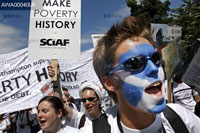
Demonstrators taking part in the Make Poverty History march through the centre of Edinburgh. Credit: Aubrey Wade / panos pictures
“Nukes are afraid of protesters,” said one activist.
“It is a big success, the biggest march ever here in Faslane,” Kate Hudson from the UK Campaign for Nuclear Disarmament (CND) told IPS. “We are giving a strong message to the G8 leaders: to put an end to their nuclear hypocrisy and disarm nuclear weapons.”
About 200 nuclear bombs are stored in Scotland, at Faslane and Coulport military bases, on the banks of River Clyde. Most are on four Trident submarines operated from the Faslane base, 60 km away from Glasgow, according to the Scottish Campaign for Nuclear Disarmament.
There, the river widens and looks like a calm lake surrounded by beautiful green hills and posh houses. But since 1964, when the small military base was expanded to store the British nuclear submarines, activists have been trying to blockade the military activities by almost any means.
Each Trident submarine holds 16 nuclear missiles: they have the destructive power of 1,000 times the atomic bombs dropped on Hiroshima in 1945, according the British anti-nuclear movement Trident Ploughshares, which organised the demonstration to “highlight the links between poverty and war, militarism and destructive globalisation.”
Protesters locked themselves in a human chain, with their arms inside plastic pipes. Normally this makes it difficult for the police to separate them, and would take hours to clear the entrance to the base. But not today. The police stayed away from the protesters. Because the base was already shut down, no criminal offence was committed.
“We want to tell the G8 leaders that if they want to resolve the issue of poverty they have to end the criminal waste of arms-spending and re-route towards meeting people’s real needs,” Hudson said.
Several countries in the world have confirmed that they have nuclear bombs: Britain, United States, China, India, France, Russia and Pakistan. Others, like Iran and North Korea and Israel, are suspected to be working on building their nuclear capabilities.
“We are busy telling Iran that it should not have nuclear weapons. If we are not prepared to get rid of our nukes, we have no moral authority to say that to any other country in the world,” CND activist Isabelle Linday told IPS.
Four of the G8 countries – France, Britain, United States and Russia – have these “weapons of mass destruction.” Russia has the most, but the U.S. bombs are modern and can be used from Trident submarines and aircraft and land-based missiles.
The remaining four of the G8 nations – Canada, Germany, Italy and Japan – are not “nuclear states.” The summit is being held at the golf resort of Gleneagles, Scotland, July 6-8.
“(U.S. President George W.) Bush says the U.S. is going to double aid to Africa in the next two years. Even if it does, which is doubtful, it will be the equivalent of two days of American defence expenditures,” Linday said. “That puts into perspective the G8 talk about helping the poor countries, while the priorities are still on defence.”
The blockade turned into a pacific demonstration, full of music, drums and street theatre, featuring activists from anti-nuclear campaigns, parliamentarians and church leaders and campaigners involved with the Dissent! network.
One protester, who managed to climb the fences and get into the base, was arrested. Another one remained sitting on top of the fences for several hours before returning to the street.
The clowns of the Clandestine Insurgent Rebel Clown Army performed in front of the base’s main gate. About 15 people done up as clowns built up hilarious street theatre momentum in front of the police guarding the gate.
“We are here along with all the other protesters, against this place and the G8 summit. In a tense situation like this, we come to give everybody a laugh and a smile. We always create major panic and general alarms,” Jamie, known as the Salt and Pepper clown, told IPS.
Meanwhile, a street parade known as the “Carnival of Full Enjoyment,” organised by temporary and precarious workers, took place in the city centre of the Scottish capital, Edinburgh. Thirty people were arrested.
 Print
|
Print
|