
Sunday, September 20, 2026



News and Views from the Global South
INDIGENOUS PEOPLES DAY: With Violent Greetings
Sanjay Suri
- Indonesian soldiers cut the face and body of Petto Wenda with a razor and a knife before pouring petrol on his head and setting him on fire. Petto was attacked when the soldiers overran Pyramid village of the Lani tribe in the Papuan highlands in July. He is not expected to survive.
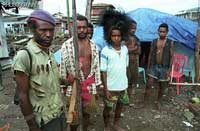
Papua independence fighters in their post in the centre of Nabire, with the Morning Star Flag of Free Papua flying Credit: Rob Huibers / panos pictures
In Brazil, a Guaraní man was shot dead on Jun. 26 by gunmen hired by ranchers, only hours after he and his people had moved back onto the land from which they were evicted 30 years ago. Two Truká Indians were shot dead on Jun. 30 by a police ”death squad”, and an old Guajajara leader was shot dead on Jun. 10 by assassins believed to be working for the soybean farmers invading his land.
As the United Nations celebrates International Day of the World’s Indigenous People on Aug. 9, the world’s tribes have been rocked by a wave of violent attacks and killings, Survival International says.
"Indigenous people are often particularly vulnerable because they have no voice," Sophie Greek from Survival told IPS. "The national society often does not come to their protection; in fact they are more often interested in grabbing their land."
In many countries indigenous people are treated like animals with no rights, "and this allows people to perpetrate acts of violence against them," Greek said. These people are often the victims of an unrecognised racism, she said.
Media often fail to highlight their difficulties, and in fact only add to them by use of words like ”primitive” and ”stone-age” people to describe them, she said. "They think that indigenous people are less modern than we are. But they are just as modern, they are only living in a different way," Greek said.
Tribal people are often treated worse than indigenous people, she said. Indigenous people are usually thought of as those who were "first there," while tribal people are those among them who have remained connected to their land, Greek said. There are an estimated 150 million indigenous people around the world.
The UN has long recognised that these people have particular difficulties, but little remedy has resulted. "Sadly the United Nations system works very slowly," Greek said. During the UN decade of indigenous people, from 1995 to 2004, "nothing much happened, and the UN recognised that by their decision to continue it," with another decade. "The silent attacks on indigenous people must be brought to world attention."
Some of the most severe difficulties have been reported in African countries. In Botswana, Survival says seven Gana and Gwi Bushmen were tortured in June by government wildlife officials – as punishment for hunting. The Gana and Gwi rely on hunting to feed their families, but the government has evicted them from their land in the Kalahari and has banned them from hunting there, says the organisation.
Survival quotes Letshwao Nagayame as saying: "They beat us up badly. I think they wanted to kill us…The officials pulled my testicles and penis, beat me up, and kicked me, while one man smashed my knuckles on the hard floor."
Survival director Stephen Corry said: "These acts of horrific violence are being perpetrated against the world’s most vulnerable people, whose existence is already threatened by theft of their land and destruction of their way of life. All too often, those responsible for violence against tribal peoples are not brought to justice. Survival is calling today for an end to these crimes."
 Print
|
Print
|
INDIGENOUS PEOPLES DAY: With Violent Greetings
Sanjay Suri
- Indonesian soldiers cut the face and body of Petto Wenda with a razor and a knife before pouring petrol on his head and setting him on fire. Petto was attacked when the soldiers overran Pyramid village of the Lani tribe in the Papuan highlands in July. He is not expected to survive.
(more…)
Print
|




