Sunday, September 13, 2026



News and Views from the Global South
Environment
Delegates Push for Greater Accountability, Community Inclusion as GEF Crosses Major Environmental Milestones
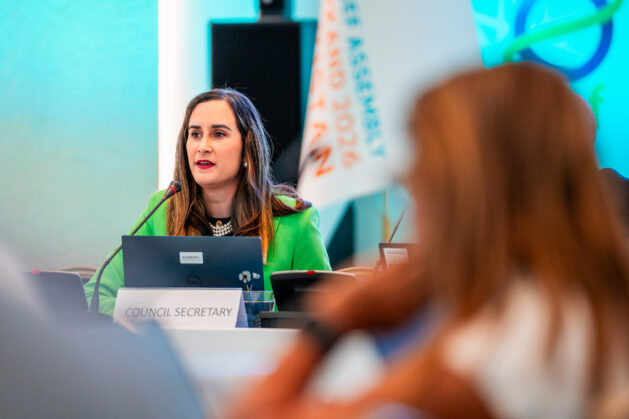
Noemi Hernandez Rodriguez Borjas at the first of the 71st GEF Council Meeting. Credit: IISD/ENB/Danny Skilton
- While the Global Environment Facility (GEF) said its eighth replenishment cycle (GEF-8) was about to exceed environmental targets for biodiversity protection, marine conservation, ecosystem restoration, and reducing greenhouse gas emissions, governments and civil society groups called for stronger safeguards to ensure that local communities, Indigenous Peoples, and smaller implementing agencies are not left behind as funding mechanisms become more complex.
The 71st GEF Council Meeting is taking place at the Congress Center in the ancient city of Samarkand, Uzbekistan.
Amid the optimism, delegates cautioned that billions of dollars flowing into efforts to restore forests, protect oceans and combat climate change must also deliver accountability and earn the trust of the communities whose livelihoods are affected.
The delegates endorsed the final work programme under GEF-8, which is expected to bring overall programming to 97 percent of available resources before the four-year cycle ends.
Officials described the programme as politically significant, marking it as the final package of projects before negotiations on the ninth replenishment cycle (GEF-9), which will guide billions of dollars in environmental financing over the coming years.
“We see good progress, and we know that programming is anticipated to be 97 percent by the end of the GEF-8 cycle,” Dr Dawda Badgie, a council member from The Gambia, said, noting that several environmental indicators had surpassed their targets.
Fred Boltz, the GEF’s Head of Programming, said resources across most funding windows would be fully committed by the end of the current four-year cycle.
“In all focal areas, integrated programmes, blended finance, the small grants programme and efforts by indigenous peoples and local communities will yield extraordinary results from GEF-8 investment, achieving or greatly surpassing six of ten GEF-8 outcome targets,” Boltz told delegates.
According to GEF officials, investments under GEF-8 are expected to place well over hundreds of millions of hectares of land and sea under improved biodiversity management, restore more than 10 million hectares of ecosystems, improve management of 59 transboundary water systems and benefit more than 32 million people worldwide.
Boltz said climate investments alone are expected to deliver more than 2.2 billion metric tonnes of greenhouse gas emissions reductions, while marine conservation efforts will contribute to the creation or improved management of more than 1.9 billion hectares of marine protected areas – equivalent to more than five percent of the world’s oceans.
He said targets related to marine protected areas, ecosystem restoration, emissions reductions, shared water ecosystems and sustainable fisheries management are expected to be significantly exceeded by the end of the cycle.
Among the highlighted initiatives was a conservation financing mechanism in Madagascar that combines blended finance resources with climate adaptation funding to support an outcome-payment bond for biodiversity conservation, including the protection of the island’s iconic lemurs.
Boltz said land degradation funding would also be fully utilised, helping restore more than 10 million hectares of land and ecosystems worldwide.
Key projects include support for the Great Green Wall initiative across the Sahel and a water-land management programme in Central Asia covering two river basins that support about 80 percent of the population in Kazakhstan, Kyrgyzstan, Tajikistan, Turkmenistan and Uzbekistan.
The chemicals and waste portfolio, expected to reach 95 percent utilisation, is projected to eliminate more than 260,000 metric tonnes of hazardous chemicals and waste through programmes reducing pollution and promoting cleaner industrial production.
One initiative seeks to eliminate mercury use in the non-ferrous metals sector, including copper and aluminium production, industries experiencing growth due to increasing demand from electric vehicles and renewable energy technologies.
The international waters portfolio is expected to be 99 percent committed by the end of GEF-8.
The fund is supporting implementation of the Biodiversity Beyond National Jurisdiction (BBNJ) agreement in more than 60 countries and has helped improve management of 59 shared water systems globally.
Blended finance resources under GEF-8 are expected to be fully deployed, supporting initiatives such as debt-for-nature swaps in Latin America and the Caribbean and renewable energy investments in small island states.
“The Latin America and Caribbean Debt for Nature Conversion Facility helps countries address debt burdens and support biodiversity conservation at the same time,” he said.
The GEF’s Small Grants Programme, which supports conservation efforts at the community level, is also expected to fully use its allocation.
Boltz said local civil society organisations would help place nearly seven million hectares of landscapes and 300,000 hectares of marine habitats under improved management practices, benefiting around 870,000 people, half of whom are women.
“He added that support for Indigenous Peoples and Local Communities (IPLCs) would expand under GEF-9.”
It is expected that the GEF will announce support for 10 Indigenous-led initiatives, including 5 Indigenous-led funds, by the end of 2026.
The fund has invested in youth leadership through the 10-million-dollar Fonseca Leadership Programme, which has supported 250 fellows from 52 countries, 42 percent of whom are young women.
Mohamed Bakarr, who oversees the GEF’s integrated programmes, said that all 11 integrated initiatives approved under GEF-8 were fully programmed.
Together, they deploy USD 1.65 billion in GEF resources and mobilise an additional USD 11.2 billion in co-financing across 98 countries.
“The integrated programmes mobilise 45 percent more co-financing per project on average,” Bakarr said, adding that governments were contributing significantly higher shares of funding than in previous replenishment cycles.
The June 2026 work programme includes 16 projects requiring USD 129.5 million in GEF financing and US$11.9 million in agency fees, for a total allocation of USD 141.3 million.
The projects are expected to leverage USD 828 million in co-financing, resulting in a co-financing ratio of 6.4 to one.
The work programme will support environmental initiatives in more than 19 countries, including seven least-developed countries and four small island developing states.
Delegates hailed a renewable energy initiative in Uzbekistan, which they expect will mobilise more than USD 1 billion in private investment.
Japan’s representative, Yoko Yamoto, described the project as an icon for GEF presence in Central Asia.
“We welcome the development of the NGI project in Uzbekistan, the host country for this session, and especially raising the GEF’s presence in Central Asia,” Yamoto said.
However, the same project attracted criticism.
Representing the GEF Civil Society Organisation Network, Sagar Aryal argued that civil society organisations and affected communities had not been consulted during the project’s design phase.
The criticism reflected broader concerns that GEF’s financial instruments may advance faster than mechanisms designed to ensure transparency, accountability, and community participation.
“The Stakeholder Engagement Plan is promised only before CEO endorsement, not before this Council takes a decision today,” Aryal said. “As GEF scales up blended finance, this question matters more, not less. We ask that community engagement and consultations be required before Council approval and not deferred after it.”
Civil society groups also praised greater support for community-led conservation.
Aryal highlighted continued support for the Critical Ecosystem Partnership Fund and a new Global Flyways Grant Mechanism focused on the East Asian-Australasian Flyway.
“Together, these two projects represent close to 20% of this work programme going to or directly through civil society,” he said. “This is the highest share we have seen… it shows what is possible.”
“As GEF-9 begins, we ask, can this be the floor and not the ceiling?” he added.
Delegates also criticised the concentration of projects among implementing agencies, noting that almost two-thirds of projects were submitted by just Conservation International and the United Nations Development Programme (UNDP).
In response to the criticism, Boltz affirmed that, despite the concerns, overall allocations stayed within limits.
“UNDP share presently is at 29.8 percent for GEF-8 overall,” he said, noting that medium-sized projects and enabling activities involving other agencies would help improve diversification.
The Secretariat also defended the programme’s performance, stating that GEF8 was on track to meet or exceed several core environmental targets.
Boltz said six of ten core indicators were on track and that terrestrial and marine conservation areas supported under GEF-8 had surpassed 2 billion hectares, up from 1.5 billion hectares in GEF-7.
As the meeting moved toward endorsing the final work programme, consensus emerged that GEF-8 is ending as one of the institution’s most successful replenishment cycles in environmental results, programming and co-financing. But delegates said success alone would not shield the institution from growing demands for greater inclusion, transparency and institutional diversity.
Note: The Eighth Global Environment Facility Assembly is underway until June 6, 2026, in Samarkand, Uzbekistan.
This feature is published with the support of the GEF. IPS is solely responsible for the editorial content, and it does not necessarily reflect the views of the GEF.
IPS UN Bureau Report


 Print
|
Print
|