
Monday, November 16, 2026



News and Views from the Global South
Opinion
The Legal Path to Autocracy
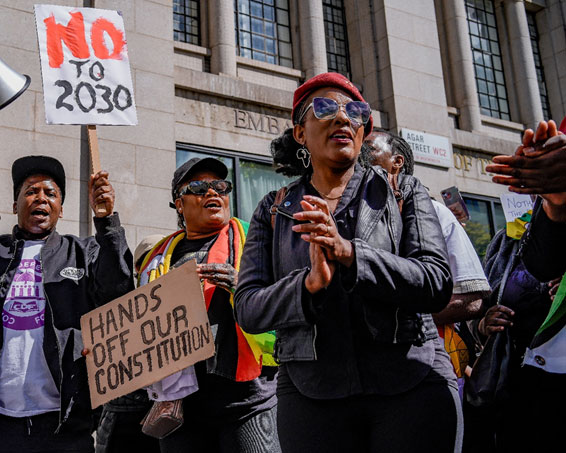
UK-based Zimbabweans protest against the Constitution of Zimbabwe Amendment (No. 3) Bill outside the Zimbabwe Embassy in London, UK, on 18 April 2026. Credit: Maynard Manyowa/News Images/NurPhoto via AFP
- Zimbabwe’s President Emmerson Mnangagwa, who took over when a miliary coup ended Robert Mugabe’s 37 years in power, has made clear he has no intention of limiting himself to a decade at the top. In July, he signed a constitutional amendment that lengthened the terms of the sitting president and parliament from five to seven years and pushed the next general election back from 2028 to 2030.
Zimbabwe is not alone. In several African countries and beyond, presidents are using constitutional amendments, courts and parliaments to stay in power beyond the original limits. They are extending terms, abolishing term and age limits, writing rivals out of the race and, in the boldest cases, removing voters from the equation altogether, while repressing those who stand up for democracy. These moves can achieve much the same outcome as a coup, but their legal veneer spares those behind them the consequences. A military takeover can get a country suspended from the African Union (AU), while presidents who rewrite the rules have so far faced no penalties at all.
Limits erased
In Djibouti, President Ismaïl Omar Guelleh has ruled since 1999. In October 2025, parliament voted unanimously to scrap the presidential age limit of 75, which Guelleh had already exceeded. In April 2026, he claimed a sixth term on an implausible 97.8 per cent in an election most opposition parties boycotted.
In Chad, where Mahamat Idriss Déby took power in 2021 after his father’s death and won a disputed election in 2024, parliament abolished presidential term limits in October 2025 and lengthened terms from five to seven years. The Republic of the Congo shows where this road leads. A decade after a referendum removed term and age limits that would have stopped Denis Sassou Nguesso running again, the 82-year-old claimed a fifth term in March 2026, on an official 94.82 per cent.
The Democratic Republic of the Congo (DRC) may be next. President Félix Tshisekedi is constitutionally barred from a third term, but he has floated a constitutional revision and a possible delay to the 2028 election. On 23 October, the National Assembly passed a law allowing a referendum to be triggered by a ‘major dysfunction’ of state institutions and sent it to the Senate. The constitution still forbids any change to term limits, but civil society and the opposition see this law as a step towards indefinite rule.
Africa has no monopoly on this tactic. In El Salvador, Nayib Bukele used his party’s supermajority to purge the Supreme Court’s Constitutional Chamber, whose new judges reinterpreted the constitutional ban on consecutive re-election to clear his way to a second term in 2024. In July 2025, the Legislative Assembly abolished presidential term limits altogether.
Rivals off the ballot
Once limits are out of the way, rivals are next. In Côte d’Ivoire, President Alassane Ouattara argued that the 2016 constitution had reset his term count to zero. The Constitutional Council agreed, clearing him for a fourth term at 83, and struck several challengers off the ballot seven weeks before the October 2025 vote. With no viable contenders left, he won with around 90 per cent.
In Nicaragua, Daniel Ortega jailed every viable challenger ahead of the 2021 election. In July, he declared that the country would hold no more elections, and now he’s writing political exclusion into the constitution. An amendment approved on first reading in September, pending a second vote in January 2027, would permanently bar anyone accused of being a ‘traitor to the homeland’ or of supporting foreign sanctions from standing for public office.
Voters written out
The ultimate way to entrench power is to deprive voters of their say. Once Zimbabwe’s amendment has kept the 84-year-old Mnangagwa in office until 2030, a parliament his party dominates could renew his mandate indefinitely, without voters having any say.
In Cameroon, President Paul Biya, 93 and in power since 1982, claimed an eighth term in October 2025. In April, parliament voted 200 to 18 to reintroduce the vice-presidency, a post the president appoints and dismisses, whose holder would serve out any unfinished term, even though the constitution requires a fresh election. The law effectively hands Biya the power to choose his own successor. Opposition leader Maurice Kamto called it a ‘constitutional coup’.
Ongoing repression
Legal manipulation relies on repression. In Zimbabwe, police shut down the inaugural meeting of the Constitutional Defenders Forum and Human Rights Watch documented seven attacks on student leaders campaigning against the amendment, some of whom were abducted, tortured and handed to police. Ruling-party loyalists trapped journalists covering parliamentary hearings and forced them to delete footage of violence against activists.
In Chad, opposition leader Succès Masra was sentenced to 20 years in prison two months before term limits were removed. In Côte d’Ivoire, authorities banned protests and public meetings other than campaign events. In the DRC, police fired teargas at people marching against the referendum law and arrested dozens, and clashes in Kinshasa left an opposition politician dead.
An outdated rulebook
When soldiers removed Gabon’s president in August 2023, the AU suspended the country the next day. None of the presidents rewriting the rules to stay in power have faced anything comparable. The AU has the tools. Its African Charter on Democracy, Elections and Governance provides for sanctions when governments amend constitutions or legal instruments to stay in power, just as it does for a coup.
Yet the AU has only ever suspended states after military takeovers or, as in Côte d’Ivoire in 2010, when a defeated incumbent refused to leave, and never for rewriting a constitution. It did not even suspend Chad in 2021, when the army installed the younger Déby in breach of succession rules, the first step in a process that ended with the abolition of term limits.
Each manoeuvre that goes unanswered lowers the cost of the next one. As long as rewriting the rules brings no consequences, presidents determined to stay will keep doing it, and those who resist will keep paying the price.
Inés M. Pousadela is CIVICUS Head of Research and Analysis, co-director and writer for CIVICUS Lens and co-author of the State of Civil Society Report. She is also a Professor of Comparative Politics at Universidad ORT Uruguay.
For interviews or more information, please contact research@civicus.org.



 Print
|




