
Wednesday, October 14, 2026



News and Views from the Global South
CLIMATE CHANGE-CARIBBEAN: Uniting Against Future Adversity
Patricia Grogg
- Adapting to climate change in the island nations of the Caribbean, a region particularly vulnerable to rising sea levels, requires strengthening collective responses based on exchange and cooperation.
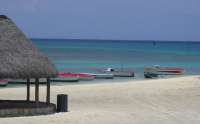
Rising seas threaten Caribbean island coastlines. Credit: morgueFile.com
The main challenge is to adapt to forthcoming changes, but the difficulty for science is identifying what adaptations will be necessary. “One country on its own cannot face this challenge,” said Abel Centella, assistant science director of the Cuban Institute of Meteorology, in support of climate change cooperation programmes.
As an example of a joint effort, the expert described the PRECIS Caribbean Project, a regional initiative to share experiences, human resources, information technology and financial resources, scientific results and useful information.
PRECIS (Providing Regional Climates for Impacts Studies), is a regional climate modelling system developed by the Hadley Centre, part of Britain’s Met Office for environmental and weather-related services.
The PRECIS Caribbean Internet page allows online access to climate change scenarios developed by the Cuban Institute of Meteorology, based on simulations run on the Hadley Centre system. “The tools exist, and several countries have joined together to pool resources and experiences,” Centella said.
In addition to Cuba, PRECIS participants include Jamaica, Barbados, Belize and the Caribbean Climate Change Centre (CCCC). “We are all trying to bring other countries to join in,” said the expert, in whose view adaptation to climate change is urgently needed to ensure survival.
Centella and other experts attending an international congress on environment and development, which ended on Jul. 6 in Havana, thought it was essential to be able to predict how much temperatures and sea levels will rise, how tropical cyclones are likely to behave and how much rainfall will increase or decrease because of global warming.
The scientific community in the region has long been warning that temperatures in the Caribbean may increase by at least five degrees Celsius by 2080, if industrialised countries continue to emit greenhouse gases.
CCCC experts have also forecast that Cuba, the Cayman Islands and Central America will experience sharp seasonal contrasts, with hot, dry periods alternating with torrential rains.
According to estimates, by the middle of this century the water resources of many small islands in the Caribbean and the Pacific Ocean will have dwindled to the point that they will be insufficient to satisfy demand in the dry season.
One of the most fearsome consequences of climate change is a rise in sea level. “For our small island states, it is a very serious problem,” the Dominican Republic’s vice-minister of Environment and Natural Resources, Zoila González de Gutiérrez, told IPS.
With respect to the agreement signed this Tuesday by Santo Domingo, Port-au-Prince and Havana, creating the Caribbean Biological Corridor, González de Gutiérrez pointed out that her country and Haiti share the same island, which means they are “managing the same natural resources, mountains and rivers.”
“Whatever happens in one country has an impact on the other,” she said. The Dominican Republic and Haiti share the island of Hispaniola, or Quisqueya, its pre-Columbian name, which was the first European colony in the Americas.
The tripartite agreement aims to help Haiti to improve and preserve its environment, at the same time as poverty is being fought in the country, said Ricardo Sánchez, Latin American and Caribbean regional director of the United Nations Environment Programme (UNEP).
Sánchez described the Biological Corridor as a defined geographical space which links landscapes, ecosystems and natural or modified habitats, all of which create the conditions for maintaining biological diversity, essential ecological processes, and the benefits they generate.
The agreement will contribute to the rehabilitation of the Artibonito river basin, in the Haitian province of the same name, which produces electricity for Port-au-Prince.
It also provides for educational programmes for children and young people, and environment-related technological training, in order to improve living conditions in many communities in Haiti, the poorest country in Latin America and the Caribbean.
The Dominican Republic has a programme for adaptation to climate change which, according to González de Gutiérrez, has so far been able to assess management of water resources and the drought in the border area, and measure temperature increases and a potential rise in sea level of up to 20 centimetres in some cases.
“We have bilateral cooperation with Cuba, and in many cases we rely on the support of Cuban scientists. They have been very helpful to our researchers, who have learned to use the models and make predictions,” she said.
Expert reports have warned that higher temperatures in the Caribbean region will cause more droughts, forest fires, and storms which in turn will cause more damage to the beaches and to endangered species.
The region must also prepare to deal with certain diseases, such as dengue fever and malaria, in countries where they have so far been unknown. Another danger factor is salinisation in areas under irrigation.
The entire United Nations system has “concentrated its efforts on achieving an agreement for mitigating and adapting to climate change, especially on practical issues such as financing and technology transfer,” Achim Steiner, UNEP executive director, told journalists.
Steiner said this subject is a priority for UN Secretary-General Ban Ki-moon. Ban has called a world summit on Sept. 24 to seek consensus in order to make progress on negotiations for a convention on climate change.
Steiner attended the Sixth International Convention on Environment and Development, in which more than 750 experts from 23 countries met for four days in Havana.
 Print
|
Print
|




