Wednesday, June 24, 2026



News and Views from the Global South
AFGHANISTAN: Training Cops Not To Be Robbers
Fawzia Sheikh*
- In a mud-walled village on the outskirts of the provincial capital of Qalat, police checkpoint commander Abdul Rasool complains he is tired of his country's six-year war and longs for peace.
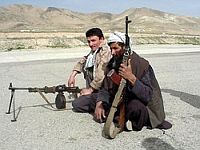
On Afghan highways police may be complicit with the Taliban Credit: IRIN
Standing nearby, U.S. army Capt. Dave Perry points out that trucks are being "destroyed" close to the checkpoint the Afghan commander supervises. Perry mentors the Afghan police and is the project officer for a checkpoint consolidation plan which aims to clean up police crime in southern Afghanistan's Zabul province.
Rasool, a slight, sun-weathered man appearing older than his 27 years, seems oblivious to the veiled accusation. "Maybe the situation is getting bad because we have a lot of checkpoints now, so more Taliban come," he responded.
And the Taliban have been known to turn up at any time. Minutes before IPS spoke with him, rattled Afghan police officers returned from a firefight with the Taliban to brief their commander at a nearby checkpoint on Highway 1, the province's main thoroughfare. The police are the insurgency's number-one target, according to U.S. military commanders.
But even as the Taliban attack the police force as an instrument of the perceived U.S.-controlled Afghan government, on other occasions the insurgent group conspires with them against Afghan civilians.
In the second scenario, the Taliban commonly find a "complicitous" checkpoint commander allowing them to raise illegal checkpoints on the highway to facilitate stealing from local Afghans and attacking civilian convoys, senior officers tell IPS. Highway 1 is renowned for such activity.
"In effect they've created a toll road," Perry said. The Taliban have complete autonomy because the police do nothing to stop drug trafficking or the movement of weapons and personnel, he explained. Afghan police compliance with the Taliban is partly due to the fact "they are not paid in a very timely manner," he went on to say. "There's a lot of corruption with the pay process … These guys are (in) a desperate state of affairs right now and they're trying to feed families."
This is why the U.S. military took over charge from the U.S. state department the responsibility of coaching Afghan officers and pushing an anti-corruption campaign to improve public perceptions of the police. Prior to that this was the responsibility of the German government.
The international community has long pressured President Hamid Karzai to fight bribery rackets affecting other parts of the government and which have dented ordinary Afghans' faith in the system.
The U.S. also aims to revamp police training ahead of the Taliban's anticipated spring offensive. The urgency to remake the police force stems from the fact that its officers are less equipped and trained than those in the army, giving the average cop the dubious distinction of holding one of the most dangerous jobs in Afghanistan, according to U.S. officers.
Under new American and Afghan government plans, police salaries and ranks will be reformed to be more in line with those of the army. The lowest-ranking police officer, a second patrolman, will go from a monthly salary of 70 US dollars to 100 dollars. Higher ranked officers will see a bigger jump in their income.
"What we can't have here is 8,000 ticked off policemen who are going to be joining the insurgency," Maj. Gen. Robert Cone, commanding general of the U.S. Combined Security Transition Command-Afghanistan, told IPS in a Kabul interview. The command is responsible for training and equipping the Afghan security forces.
Nonetheless the risks still exist, according to U.S. army Col. Ed Kornish, a police mentor working with 16 training teams that offer coaching in the southern region. "Financially there's a bigger incentive to join the Taliban," he said. "In our area, the going price that the Taliban will pay one of the local Afghans to work for them is about 250 dollars a month now," a figure that was previously 100 dollars, he noted.
The highway checkpoint consolidation plan in Zabul is another centrepiece of the effort to battle rampant corruption. Under the strategy, the term 'police station' will replace 'checkpoint', a word viewed negatively by Afghans, said Perry, the police mentor. Six revamped police stations will then be opened along the roughly 150km stretch that is Highway 1. The current 27 poorly manned checkpoints, easy prey for the Taliban, will be scrapped.
The objective is to create stronger police stations manned by 30 officers and thus allow citizens to report complaints directly, Perry said. The police's role will also include supporting the army in various operations, he added.
In Zabul province, checkpoints are synonymous with drug trafficking – another incentive to fix the checkpoint problem. In an interview at his office, police commander Col. Mohammed Yacoub complained that his region's drug troubles will persist until the police are reformed, and spoke of futile attempts to dispatch an officer to monitor a checkpoint based in his area. "They're looking to steal so I cannot trust anybody," he lamented. "When they arrest (people transporting) the drug, they keep it for themselves."
The American military and men like Yacoub can make a dent in the country's police corruption if they eradicate the problem in Zabul, which is located strategically between Kabul and Kandahar, two of the most important regions in Afghanistan, Perry predicted. "If we can create a deterring effect in the centre … if we can secure this piece of highway here, we force the enemy into an area he doesn't want to go."
Efforts to clean up the system and confront anti-government insurgents often do not go unnoticed in Afghanistan, though. Since assuming his job a few months ago, Yacoub has jailed four corrupt police officials now sitting in a Kabul jail. He has overturned a scam involving 40 police officers who divided salaries among themselves meant to pay 140 men. Because of this resolve, the U.S. military has received "credible intel reports to assassinate Col. Yacoub," noted American police mentor, Capt. James Smith. These are not second-hand tips, he said, adding that "You get it from the Taliban specifically."
To that end, large groups of district police will enroll in eight weeks of comprehensive training featuring ethics in Kandahar this fall, while a combination of army soldiers and other police temporarily replaces them. The training will also cover literacy and leadership skills.
Moreover, instructors will teach officers to shoot weapons, defend checkpoints, move as a group without shooting one another, react to ambushes or checkpoint attacks and dismantle roadside bombs, among other skills, said Kornish in an interview at his forward-operating base, a small facility of troops just outside the main base of Kandahar airfield.
Until the United States took control of police training a few months ago, Afghan officers were taught to deal only with traditional police issues like domestic violence or bank robberies. Now the strategy is to give the police "survival skills," said Kornish.
While some may describe the new training as military in nature, American forces refer to it as reality training. "Until the security situation in this country improves radically, police here are not going to be the police on the block back home – because if they try to do that they're going to die," he warned.
Apart from holding classes at Kandahar's regional police training center, American troops also provide short-term training at Afghan police checkpoints "we can stop (at) without people shooting at us," he continued. Americans also work with coalition members and are poised to approve a standardised training programme in a few months, he said.
The U.S. is investing billions of dollars in police facilities, police districts, border-control facilities and army garrisons as part of its plan to stand up the Afghan police, Maj. Gen. Cone, head of Afghan security forces' training, said.
Significant expenditures are being made in radio communication systems, riot-control gear, bullet-proof vests and heavy trucks – everything that a competent police force needs," Cone said
As for weapons, he added, the Afghan police chose to stick with small arms like Soviet-made AK-47s because the less-complex gun suited their needs. "Hopefully we'll be at a point where the police aren't using their weapons a whole lot in the near future," he said.
(*Fawzia Sheikh was recently embedded with U.S. troops in Afghanistan)
 Print
|
Print
|