
Tuesday, July 14, 2026



News and Views from the Global South
ENVIRONMENT: Beavers Returning From The Dead
Tarjei Kidd Olsen
- Scotland and Wales look set to import a bunch of beavers from Norway 400 years after the rodent was hunted to extinction. This will be the first ever official reintroduction of a native mammal to the United Kingdom.
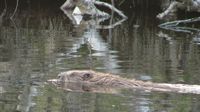
A Beaver at at Songli in central Norway. Credit: Robert Jones Parry
Scotland has announced that four Norwegian beaver families will be released in Argyll in spring 2009 on a trial basis, while a group of Welsh experts visited Norway last week as part of a process that it is hoped will result in a similar reintroduction to Wales later on.
The Scottish decision follows 15 years of research and preparations that included a trip to Norway in March 2007. Similarly, a group of Welsh experts from the country's six Wildlife Trusts headed out to the rivers and forests of central Norway last week to observe beavers in their natural habitat.
"We have been looking at a good selection of beaver sites, varying from very good quality habitat to very poor quality habitat, and at places where the beaver population is still growing and places where the population is completely saturated with as many beavers as there can be," said leading beaver expert Duncan Halley at the Norwegian Institute for Nature Research.
In the past beavers were common across most of Europe and Asia. They were eventually hunted almost to extinction for their skins and for the chemical excretion castoreum, which was popular in traditional medicine. This is believed to be linked to the fact that beavers' castoreum glands are a repository for acetylsalicylic acid from the Willow tree, one of their favourite foods. This acid is also known as aspirin.
"Castoreum was used for all sorts of things. I remember a source which states that the castoreum glands of beavers in Norway in the 19th Century were worth more than a farm hand's annual wages," Halley told IPS.
While beavers in Scotland were hunted to extinction in the 1600s, Welsh beavers disappeared in the 12th century. By the end of the 1900s only eight small populations totalling at most 1,200 beavers were left across the entire Europe and Asia.
In Western Europe there were three surviving populations – in Germany, France and Norway. Since 1922 the 100 or so surviving Norwegian beavers have been used to reintroduce the species to the other Scandinavian countries. In 1999 Denmark became the last Scandinavian country to reintroduce the beaver – after a 2,000 year absence.
In a dramatic turn of events for the fortunes of the beaver, Britain is in fact the last area to reintroduce the rodent in Europe. "Beavers are robust animals, and can adapt to quite different circumstances. I know of over 200 reintroductions of beavers that have been done across Europe in the last century, and most of them really just consisted of putting a few beavers of unknown sex together in the water in a place that looked good," Halley remarked.
He explains that there are several reasons for their popularity today – and luckily none are related to castoreum.
"Beavers tend to thin out the woodlands around lakes, streams, and rivers, meaning more light gets down to the ground, producing more flowers and herbs and other plants that are of interest. There is also what I call amenity reasons. People like looking at beavers, they're really rather interesting to see compared to most mammals. In a number of places they have been reintroduced partly for that purpose.
"In Scotland and Wales one of the explicit motives would be tourism. In Scotland at least one of the beaver family groups will be used for guided tours, and that will generate money for the local economy, because you pay to see them and use the facilities, and because most people will be staying overnight, as beavers come out in the evening," he says.
The Welsh expert group must now locate five potential sites that can be examined in more detail together with Halley. After that recommendations will be made to the Countryside Council of Wales.
Among the issues that will be covered in the recommendations is the degree of biological suitability of the five sites for the beavers, as opposed to how suitable they might be for tourism. The council will then decide whether to take the project further, and discuss it with the general public and with interest groups.
If the reintroduction goes ahead, this will be announced by the environment minister of the Welsh parliament. This is what happened in Scotland with their environment minister on May 25. The Scots are due to pick up their Norwegian beavers as early as this autumn.
"You can't go ahead and reintroduce beavers just because we think it's a good idea. It has to be a decision of the whole society," Halley pointed out.
"In Scotland there will be a reintroduction to a limited area from which the beavers are unlikely to spread out. Here they can be watched for five years to see what happens. We know in great detail what's likely to happen from other countries, but the idea is that the people of Scotland can have a site where they can see beavers for themselves and see what the effects are, and that may lead to a more general reintroduction later."
The Scottish site has also been chosen because it is an area where beavers are unlikely to come into conflict with humans. Halley says that beavers are not likely to cause trouble as long as their populations are controlled.
"Sometimes beavers do things that get in the way of what modern humans like. An extreme example would be a beaver cutting down a tree that falls down on top of your summer house. You may not be very happy about it, but it's true of virtually any mammal that they do things that are against the interests of some humans – but possibly not others," he said.
While the beavers for the Scottish reintroduction are being obtained by Frank Rosell, a specialist at the University College of Telemark in southern Norway, Halley has been unofficially advising the Scots as well as officially helping the Welsh. He is currently also involved with the reintroduction of sea eagles to Scotland and Ireland.
"It's nice to be doing something that's optimistic. In biology you tend to spend your time trying to save things, but here we're actually trying to make things better rather than just slow the damage," he said.
 Print
|
Print
|



Pictures for this story
This story includes downloadable print-quality images -- Copyright IPS, to be used exclusively with this story.


