Languages
Tuesday, September 15, 2026



News and Views from the Global South
CHILE: Alternative Media Have Their Network
The recently created People's Media Network of Chile seeks to forge links that will strengthen newspapers, web sites and radio and TV stations that give a voice to those who are basically ignored by the mainstream media.
CHILE: When Being a Woman is a “Health Risk”
As a woman of childbearing age, "I pay more than double what a man my age pays for the same health plan," 27-year-old Carolina Leyton told IPS.SOUTH AMERICA: Anti-Nuclear Activists to Form Common Front
Environmental organisations in Chile plan to revive the anti-nuclear movement in the Southern Cone of South America, in response to vigorous lobbying by corporations and politicians in favour of nuclear energy in the region.CHILE: Festival to Showcase Films on Native Peoples
Thanks to the growing number of films by and about indigenous peoples, over 90 movies, mainly from Latin America, will be screened and voted on by spectators at the First Chilean Indigenous Peoples' Film Festival in the Pacific port city of Valparaíso.CHILE: Mixed Reception for Indigenous Protection Code
Although it is still in the process of being drafted, a "code of responsible conduct" promoted by the Chilean government to regulate public and private investment in indigenous areas has already drawn resistance.CHILE: Prisons "Inhuman, Degrading and Cruel" – Supreme Court Report
The Chilean prison system has again been described as being in crisis, this time by a Supreme Court report which pointed to serious problems related to overcrowding, rehabilitation, food distribution, hours spent in lockdown, punishment procedures and deaths of inmates.CHILE: Goodbye to the Gender Wage Gap?
Gabriela, 32, is delighted with Chile’s new law establishing equal wages for men and women doing the same work. But the discrimination she has experienced in the workplace makes her wary of premature optimism.RIGHTS-CHILE: Ex-Soldier Arrested for Victor Jara Murder
A judge in Chile has charged a former soldier in the 1973 murder of internationally renowned Chilean folk singer Víctor Jara. Up to now, the only person prosecuted in the case was the commanding officer at the temporary prison camp where the songwriter was killed shortly after the Sept. 11, 1973 coup led by General Augusto Pinochet.CHILE: Study Shows How Leading Paper Colluded with Dictatorship
The coverage of human rights violations cases by the powerful conservative Chilean newspaper El Mercurio during the country’s 17-year dictatorship was the focus of a meticulous study by five young reporters.ENVIRONMENT-CHILE: Activists Try to Block Start of Pascua Lama Mine
As Canadian mining giant Barrick Gold gets ready to start construction at the Pascua Lama mine, straddling the Argentine-Chilean border, activists in Chile are scrambling to block the ambitious mining project while calling for an investigation of supposed irregularities committed in the approval process.LATIN AMERICA: Nuclear Disarmament Back on the Agenda
Over the last few days, the Chilean capital has hosted two very different activities that, however, had a common objective: promoting global nuclear non-proliferation and disarmament.CHILE: Scientist Warns of Threats to Rock Glaciers
A new government policy on glaciers adopted by Chile "is a step forward, but it doesn’t resolve all of the problems," German geographer Alexander Brenning, who blames mining companies for threats to this South American country’s rock glaciers, told IPS.Q&A: “Quota Laws Have Been Very Successful” in Latin America
Electoral quota laws that set a minimum threshold for women on candidate lists have enabled more women to be elected, contributed to gender empowerment and driven cultural changes, says Marcela Ríos, the Chilean editor of a book that carries out an in-depth analysis of the impact of such laws.CHILE: Transparency Law Opens Access to Information
The Law on Transparency and Access to Public Information came into force in Chile on Monday. Although experts say there is room for improvement, and they foresee some difficulties in its implementation, they do not hesitate to describe it as a useful step forward.CHILE: Images of Exile
Painful images of the exile suffered by thousands of Chileans during the dictatorship of General Augusto Pinochet and of the expressions of solidarity from the countries that took them in are presented in a new book with a prologue by internationally renowned writer Ariel Dorfman.CHILE: Portrait of Community Leaders in Slums
Over 70 percent of community leaders in Chilean shanty towns are women. Their average age is 42, and most of them do not identify with any political party. Forty-five percent believe that the prevailing economic system makes the rich get richer and the poor get poorer.CHILE: Teachers and Students Fight New Education Law
Teachers and students marched in protest against a new education law passed by the Chilean parliament nearly three years after the so-called "penguin revolution," named for the uniforms of the secondary school students who led it.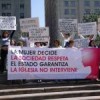
CHILE: Therapeutic Abortion – Hot Election Issue
The debate on the decriminalisation of therapeutic abortion has been revived ahead of the December presidential elections in Chile, one of the few countries in the world where abortion is illegal even under extreme circumstances, such as risk to the mother's life or a severely deformed foetus.
POLITICS: "People Come First" Say Progressive Leaders
Countries must put people first if they are to prevent the economic recession from becoming a social recession, concluded the two-day gathering of self-styled progressive world leaders that ended Saturday in this Chilean resort city.AMERICAS: Backsliding on Summit Promises
With less than a month to go to the Fifth Summit of the Americas in Trinidad and Tobago, social organisations complain that governments have not fulfilled commitments assumed at earlier editions of the summit, on questions like access to information, freedom of expression, decentralisation and participation by civil society.
ENVIRONMENT-CHILE: Nobody Is Predicting Cleaner Air for Santiago
Olivia González has been a schoolteacher for 30 years in Cerro Navia, one of the districts in the Chilean capital with the highest concentration of air pollution between April and August. A first-hand witness to its effects on health, she is pessimistic about the air she'll breathe this coming southern hemisphere winter.« Previous Page — Next Page »


The Week with IPS

NEXT STOP - SDGs
Tracking global progress towards a sustainable world
Tracking global progress towards a sustainable world
