Languages
Thursday, November 19, 2026



News and Views from the Global South
Active Citizens
RUSSIA: I’m In Charge Here, Says Yeltsin, Coughing Loudly
The return of president Boris Yeltsin to the Kremlin and the reappearance of his smiling face on live TV here has not eased speculation that he is too ill to rule Russia, if not now, then certainly soon.RUSSIA: Moscow Leads the Field in Arms Sales to Developing World
Russian arms sales to the developing world grew by 62 percent in 1995 and reached six billion dollars, outpacing the United States, which sold 3.8 billion dollars in weapons, according to the U.S. Congressional Research Service.RUSSIA: Miners Ready For All-Out Indefinite Strike Aug. 25
Even as the Kremlin wrestles with the Chechen fiasco, a new political crisis brews that could prove to be just as disruptive -- a nationwide miners' strike threatened to start on Sunday, Aug. 25, Russia's traditional Miners' Day.RUSSIA-CHECHNYA: Lebed Asks – Who’s In Charge Here?
Russian national security chief Alexander Lebed left Moscow Wednesday to talk peace with Chechen rebels just hours before a scheduled Russian military blitz on the breakaway region, highlighting the conflict of policy surrounding the crisis.RUSSIA: Far East Faces Major Energy Crisis And Power Rationing
With energy shortages reaching catastrophic levels and an all-out miners' strike expected in a few days, Moscow officials have publicly reprimanded the governor of Russia's far eastern territory and given him a deadline to put things right.ENVIRONMENT-RUSSIA: Yeltsin’s Ecology Adviser Threatens To Resign
Alexei Yablokov, chairman of a top Russian presidential commission on ecological safety, has threatened to resign, alleging that environmental matters are being sidelined by the new administration and its all-powerful Security Council.RUSSIA-CHECHNYA: Lebed Takes Charge – Yeltsin Takes Holiday
Alexander Lebed's authority over talks with Chechen separatists was underlined Monday not only their rapid results but also by news that president Boris Yeltsin is to go on holiday shortly, leaving the ex-general in sole charge.RUSSIA-CHECHNYA: No Desire To Resolve Conflict By Political Means
As the recent outbreak of fighting in Chechnya shows, the Russian elections may be over, but the war is not and will not be any time soon.RUSSIA: All-Out Miners’ Strike Still Planned Despite Far East Deals
A general coal miners' strike will begin on Aug. 25 -- Miners' Day in Russia -- unless unpaid salaries from as long ago as last January are paid in full, says Russian Independent Miners' Union Chairman Vitaly Budko.RUSSIA: A New Nationalism For A New Russia
This Friday the 12th century bells of Moscow's Spassky Tower will once more ring out to herald a Russian leader. But this time they will play a new tune for re-elected president Boris Yeltsin.RUSSIA: Scientific ‘Brain Drain’ Now Running East To Asia
Russian scientists are heading east to Asia in search of better pay, taking their ideas and new product concepts with them -- and possibly giving Asian business a headstart in the commercial race for technological innovation.RUSSIA: Crime Spreads ‘Limitless Chaos’ In The New Russia
Nowhere in Europe is the border between 'terrorism' and 'ordinary' crime more blurred than in Russia, where police and public alike interlink the two, and where powerful security forces pay little regard to civil rights.RUSSIA: Moscow Expects IMF To Forgive And Forget Busted SAP Targets
Russia expects the International Monetary Fund to relax economic targets set it by a 10 billion dollar loan deal -- even though the Fund held up the last tranche as warning against budget-busting overspending and slack tax collection.DISARMAMENT: Russian Support For CTBT Suddenly Looking Shaky
Russian officials say they are working on contingency plans to change their nuclear weapons policy in the event that India's refusal to sign a test ban treaty leads to a renewed nuclear weapons race -- particularly in China.RUSSIA: Caring For Russia’s Tens Of Thousands Of Deprived Children
Russian president Boris Yeltsin's election pledge to assure 'a normal way of life for every person, for every family' will be harder to keep than it sounds -- not least when reaching out to the country's vulnerable and neglected children.UKRAINE: Chernobyl Workers Strike as Money Runs Short
Construction workers at Chernobyl's nuclear power plant, their pockets empty and patience exhausted, have gone on strike, according to reports here.GEORGIA-ABKHAZIA: Breakaway Region Keeps Uneasy Peace
Four years ago, when the Union of Soviet Socialist Republics (USSR) began disintegrating into its component parts, Abkhazia erupted.RUSSIA: Elections Over, The Russian Army Is Back To Blitz Chechnya
Less than a week after his election triumph Russian president Boris Yeltsin's chief campaign pledge is in tatters. War has not only continued in breakaway Chechnya, it has intensified and its death and destruction is now reaching Moscow.TAJIKISTAN: All Eyes On Latest Round Of Peace Talks
Tajik government and Islamic rebels Monday began a sixth round of U.N.-mediated peace talks in Ashkabat, Turkmenistan, under the mediation of the United Nations and the wary gaze of a rack of regional and international powers.KAZAKHSTAN: Uranium Industry Comes Out of the Doldrums
This year should see a change of fortune for Kazakhstan's uranium industry, says Victor Yazikov, president of the national stock company Katep.DAGESTAN: Key Player On Sidelines of Russo-Chechen Crisis
The Republic of Dagestan, one of the 89 constituent parts of the Russian Federation, is in a strategically important position in the North Caucasus on the shores of the Caspian Sea.« Previous Page — Next Page »


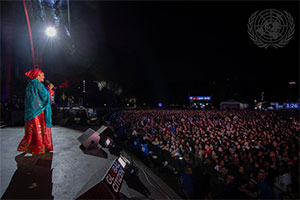 Global Citizen Festival in New York. Credit: UN Photo/Eskinder Debebe
Active citizens are committed to social change because they know that it is achievable. However, major political challenges face active citizens across the world. For example, in authoritarian regimes in Latin America where the hegemonic party has been in power for decades on end, protestors and human rights activists face enormous repression and struggle to materialize their advocacy into concrete results. The same can be said for Africans, where a shift towards elected government in recent decades has yet to translate into an effective voice in decision-making. Now, the Strengthening Citizen Demand for Good Governance, which uses evidence-based approaches – funded by DFID's Governance and Transparency Fund – seeks to raise their voices.
In 2025, the CIVICUS Monitor’s People Power Under Attack report revealed that civic freedoms are severely limited in 122 of 198 countries and territories, and only 7.2% of the global population now lives in countries where civic space is open. Through partnership with the Overseas Development Institute (ODI) and CIVICUS, IPS reporters across the continent will seek to define the extent and limits of state capability, government accountability and the responsiveness of leaders to the needs of citizens.

The Week with IPS

NEXT STOP - SDGs
Tracking global progress towards a sustainable world
Tracking global progress towards a sustainable world
