Languages
Thursday, November 19, 2026



News and Views from the Global South
Active Citizens
RUSSIA: The Morning After The Celebration Night Before
Boris Yeltsin's presidential campaign triumph was clear, but plenty of people have been pointing out that their willingness to give him their vote does not imply automatic support for all he has done in the past -- or all he may do in the future.RUSSIA: Victorious Yeltsin Leaves Door Open For Opposition
Russian president Boris Yeltsin greeted confirmation of his clear election win with a plea Thursday for national reconciliation and suggested that there could be a place in his new government for some of his defeated opponents.RUSSIA: Lower Than Expected Turnout Leaves Poll A Close Run Thing
The disillusionment with politics that fed a lower than expected estimated voter turnout in Wednesday's Russian presidential elections did not prevent some lively comment outside the polling stations.RUSSIA: Last Day Of Voting A Test Of Yeltsin’s Health
President Boris Yeltsin's final pledge in the election campaign, which closed Monday in advance of Wednesday's presidential run-off vote, could be his hardest to keep -- that he is physically fit enough to run Russia.ENVIRONMENT: Illegal Tiger Hunting Continues in Russian Far East
Endangered big cats are being killed by poachers in Russia's Far East despite the best efforts of conservationists.NAGORNO-KARABAKH: The Media Myths Of War
Now that media interest in the war in Nagorno-Karabakh has waned, it is a good moment to begin to evaluate how the issue has been treated in the press.RUSSIA: World’s First Floating Nuclear Plant Under Construction
Construction of the world's first floating nuclear power plant is underway in Russia, ready to start operating by 2001 -- a prospect that fills environmentalists with horror but has Russian engineers looking South for potential buyers.ENVIRONMENT-CENTRAL ASIA: Aral Sea Receives European Funding
The European Union, through its TACIS programme, is drawing up several schemes to help improve the environmental situation around the Aral Sea in the Central Asian Republics.RUSSIA-ENVIRONMENT: Trials of a Waste Disposal Company
Life goes on in Russia. While politicians jockey for advantage ahead of the July 3 runoff for the presidency, scarcity of funds is causing sharp deterioration in some public concerns, adding to the pile of problems any new administration will have to confront.RUSSIA-TECHNOLOGY: Space Research Goes for the Big Bucks
The winner of next month's runoff presidential election in Russia is expected to accelerate a space programme that is becoming increasingly commercial.RUSSIA-ELECTIONS: Kingmaker Lebed Closes in on Throne
Its horse-trading time in Russia.RUSSIA-ELECTIONS: Media Set for Key Role in Runoff
There were 11 candidates in the race for President of Russia that culminated in Sunday's vote: sometimes the media made it seem there was only one.RUSSIA-ELECTIONS: Gains, Pains of The Market Will Determine Vote
The mood of the Russian electorate ahead of Sunday's presidential election is largely determined by the gains and pains of the post-communist era.RUSSIA-ELECTIONS: ‘Others’ Also Run for President
Scanning the Russian media just three days ahead of the June 16 presidential ballot, it would seem that only two candidates are in the contest.RUSSIA: Brain Drain in Science Causes Considerable Strain
Russia is being robbed of some of its best brains as an increasing number of scientists and researchers yield to the lure of lucrative offers from disparate parts of the globe.RUSSIA-ENVIRONMENT: Russia Faces Worst Ever Forest Fires
More than 20 people have died so far this year in forest fires which have swept uncontrollably through vast areas of Russia, destroying tracts of valuable timber and wildlife habitat and leaving large areas of land open to erosion from the weather.RUSSIA-LATIN AMERICA: Primakov Trip Shows Strong Interest in Region
With a six-day visit last week to three strategically important Caribbean Basin nations, Russia's foreign minister Evgeny Primakov was on a mission of discovery in a region long ignored by Moscow.RUSSIA: Yeltsin Vows To Veto Land Code
President Boris Yeltsin and the Federation Council (parliamentary upper house) are both expected this week to veto a new Land Code which was adopted by the Duma (lower house) on May 22 by a vote of 288-18.BALTIC STATES: Growling Russian Bear Makes Baltics Nervous
As presidential elections draw close in Russia, the independent Baltic states have found themselves unwilling subjects of attention in the angry campaigning surrounding the vote.INFORMATION-VIETNAM: Hanoi Proceeds Warily Along Internet Highway
The take-off of the information superhighway in Vietnam is being delayed, say observers, by an increasingly cautious bureaucracy in the lead up to next month's eighth Congress of the country's Communist Party.CIS-RUSSIA: A Summit In The Shadow Of Elections
When the 12 members of the Commonwealth of Independent States (CIS) meet here this weekend for a summit, their deliberations will both be feeding into, and be influenced by, the presidential election campaign heating up in Russia.« Previous Page — Next Page »


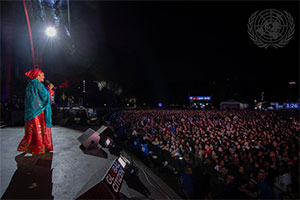 Global Citizen Festival in New York. Credit: UN Photo/Eskinder Debebe
Active citizens are committed to social change because they know that it is achievable. However, major political challenges face active citizens across the world. For example, in authoritarian regimes in Latin America where the hegemonic party has been in power for decades on end, protestors and human rights activists face enormous repression and struggle to materialize their advocacy into concrete results. The same can be said for Africans, where a shift towards elected government in recent decades has yet to translate into an effective voice in decision-making. Now, the Strengthening Citizen Demand for Good Governance, which uses evidence-based approaches – funded by DFID's Governance and Transparency Fund – seeks to raise their voices.
In 2025, the CIVICUS Monitor’s People Power Under Attack report revealed that civic freedoms are severely limited in 122 of 198 countries and territories, and only 7.2% of the global population now lives in countries where civic space is open. Through partnership with the Overseas Development Institute (ODI) and CIVICUS, IPS reporters across the continent will seek to define the extent and limits of state capability, government accountability and the responsiveness of leaders to the needs of citizens.

The Week with IPS

NEXT STOP - SDGs
Tracking global progress towards a sustainable world
Tracking global progress towards a sustainable world
