Languages
Monday, October 12, 2026



News and Views from the Global South
Financial Crisis
ECONOMY-CHINA: National Interest First – Wen Jiabao
While much hope is focused on China as the one bright spot in the current financial gloom, Chinese leaders are drawing a line on global expectations, reminding the world that their country’s priorities come first.POLITICS: Obama Sets New Course at the U.N.
After nearly a decade of an often tense and estranged relationship with the United Nations, Washington appears to be taking a much more conciliatory and multilateral approach to the world body.
Q&A: "Women Need a Bigger Voice at the G20 Summit"
Activists are calling for an economic bailout plan for women and demanding that their voices be heard at the decision-making table ahead of the G20 summit of the world's biggest economies in London on Apr. 2.POLITICS-JAPAN: Thinking Big in Crisis Time
Japan has entered a season of grand strategising. Government commissions, business associations, leading foundations, and academic working groups are all developing blueprints for a new, 21st-century Japanese role in the world.FINANCE: Major Banks Grease Wheels for Corrupt Regimes
Some of the world's leading banks facilitate corruption in the poorest countries, charges a new report by Global Witness, an independent watchdog group.CORRUPTION-US: Homeowner Rip-Offs Spark Scores of Lawsuits
Many of the biggest mortgage lenders in the U.S. have engaged in widespread, systematic schemes that ripped off hundreds of thousands of families seeking to buy a home, refinance or foreclose, according to lawsuits filed on behalf of consumers.POLITICS-CHINA: Row Over Tibet Escalates
China has sealed off Tibet with troops and demanded that the international community recognise the legitimacy of Beijing's historical claims over the Himalayan plateau, escalating a row over its policies there.U.S.: Bush-Era Bureaucracy Lingers Amid Lengthy Vetting Process
The meticulous vetting process that potential appointees for senior State Department and other posts must undergo is delaying full staffing of U.S. President Barack Obama's administration, even as it faces ever-more urgent crises both at home and abroad.ECONOMY-SRI LANKA: Return of the IMF
Sri Lanka is going on bended knee to the International Monetary Fund (IMF) - an institution it chased away two years ago - for a bailout package worth 1.9 billion US dollars, as authorities scrape the barrel for foreign exchange.ECONOMY: Left Vindicated, but Offers no Replacement
'Post-neo-liberalism' - that mouthful of a word was making the rounds at an international congress on the economic turmoil in Berlin last weekend. Just another buzzword, as some participants thought, or something necessary to describe the world past the now exposed economics of neo-liberalism?ECONOMY: Poor Countries to Need Up to 700 Billion Dollars
In the latest in a series of increasingly dire predictions, the World Bank Sunday warned that developing countries may need up to 700 billion dollars in external financing this year due to the squeeze in global credit markets which has seen a dramatic plunge in private investment.LABOUR-THAILAND: Meltdown Leaves Women in Dire Straits
"Please help me find a way to have some money for milk," pleaded Benjawan Marongthong, mother of two young boys and former worker in a garments factory.ECONOMY-CHINA: Human Rights Critics Silenced by Meltdown
If the global economic downturn is a crisis with a silver lining for cash-rich Chinese companies intent on bargain deals, it is equally so the image-conscious government whose human right critics have been silenced by the need to cooperate with Beijing on overcoming the recession.CARIBBEAN: Bank Scandals Add to Region’s Economic Woes
Caribbean leaders emerged from a one-day special summit on Wednesday night to announce new mechanisms to deal with some of the problems plaguing the region's financial sectors, occasioned not only by the ongoing global crisis, but by several homegrown scandals as well.HAITI: Stability May Rest in Donors’ Pockets
A series of crises in 2008 have pushed more Haitians into poverty and increased the potential for serious instability in the Caribbean nation of nearly 9 million, said the latest update briefing from the International Crisis Group (ICG).ECONOMY: Trickle Down Misery
The world's poorest people had nothing to do with the financial gimmickry that has brought the global economy to its knees but they are paying a heavy price for it and relief seems a long way off.SPAIN: Economic Renaissance Over
At one of the busiest unemployment offices in central Madrid, people have been standing in line since six in the morning.ECONOMY: A Fair Way to Beat the Gloom
The economic depression unfolding around the world has not touched trade in products from developing countries that certify respect for social and labour fairness, human rights and environmental standards, according to groups engaged in fair trade.CORRUPTION-US: How Wall Street Paid For Its Own Funeral
A new report says that Wall Street has only itself to blame for the misguided deregulation that led to the current deepening financial crisis.LABOUR-PHILIPPINES: Meltdown – Women Most Vulnerable
Shaynar Bacon was working as a cashier in a shopping mall in Mindanao, southern Philippines, when she learned that an electronics manufacturing firm in Taiwan was looking for workers.DEVELOPMENT: Financial Crisis Threatens Women’s Meagre Gains
The spreading global financial crisis - which has taken a heavy toll of international bankers, investors and speculators - is also having a devastating impact on some of the most vulnerable and marginalised groups in society, including women and children.« Previous Page — Next Page »





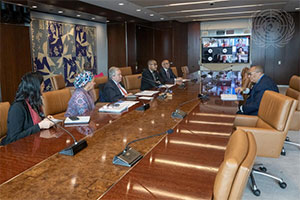 Secretary-General Meets with Members of Debt Expert Group. Credit: UN Photo/Eskinder Debeb
Financial crises are often defined by banking panics, recession, loss of market value, and deflation. Various financial crises at the turn of the 20th century, such as the Asian Crisis of 1997-1998 and the 2007-2008 Global Financial Crisis, have had immense impacts on the world economy. The COVID-19 pandemic also caused a financial crisis when mass lockdowns triggered staggering unemployment rates, a stagnation of economic growth, and led to the 2020 stock market crash. With the Russian invasion of Ukraine, the world has also witnessed a global energy crisis with shortages and increased prices in oil, gas, and electricity markets. According to UNCTAD’s World of Debt 2025, global public debt surpassed $100 trillion in 2024, with developing country debt growing twice as fast as developed economies since 2010. Burdens of debt servicing come with economic slowdowns and demands of austerity from lenders, with some economists arguing that this will lead to a new “lost decade” for the Global South. IPS brings you worldwide coverage of these financial developments and how we should manage these crises.

The Week with IPS

NEXT STOP - SDGs
Tracking global progress towards a sustainable world
Tracking global progress towards a sustainable world
