Languages
Friday, November 27, 2026



News and Views from the Global South
Global Geopolitics
POLITICS: New U.N. Chief to Disclose Financial Assets
The U.N.'s new Secretary-General Ban Ki-moon has moved swiftly to hold himself up as a model international civil servant by voluntarily declaring his financial assets to the newly-created Ethics Office.ENVIRONMENT: ExxonMobil Accused of Disinformation on Warming
Like the tobacco industry that for decades denied a link between smoking and lung cancer, ExxonMobil has waged a "sophisticated and successful disinformation campaign" to mislead the public about global warming, according to a major new report by the U.S.-based Union of Concerned Scientists (UCS).POLITICS: Hussein’s Execution May Trigger U.N. Backlash
The swirling controversy over the execution of former Iraqi President Saddam Hussein is threatening to trigger a backlash at the United Nations.COMMUNICATIONS: Developing Countries Set the Standards
Developing countries led by India, China, Brazil are now taking the lead in setting global standards in the rapidly transforming telecommunications sector due to convergence of hitherto separate communications and entertainment services, says Hamadoun Toure, the new secretary general of the Geneva-based International Telecommunications Union.MEDIA-US: Networks’ Foreign News Coverage Focused on Iraq
For the fourth straight year, Iraq dominated foreign affairs coverage by the three major U.S. commercial television network evening news broadcasts during 2006, according to the latest annual review by the authoritative Tyndall Report.POLITICS: New U.N. Chief Ambiguous on Death Penalty
As he walked into a group of waiting reporters on his first day at the United Nations, the newly-anointed Secretary-General Ban Ki-moon refused to express his personal views on the death penalty - in contrast to his predecessor Kofi Annan who publicly opposed capital punishment.POLITICS: Annan Leaves a Mixed Legacy
When Kofi Annan completed his 10-year tenure as U.N. secretary-general on Dec. 31, he left behind a mixed political legacy: his acknowledged successes in promoting peace, development, gender empowerment and human rights, and his self-admitted failures in reining in a sprawling U.N. bureaucracy facing charges of mismanagement.POLITICS-US: If Bush Wants Bipartisan Policy, It’s Out There
If U.S. President George W. Bush is serious about pursuing a foreign policy that can command bipartisan support, the basic elements of one already exists, according to a new analysis of seven comprehensive polls on foreign policy attitudes taken over the past nine months.CHALLENGES 2006-2007: One Hand Launders the Other
This month, Siemens, the Germany-based global engineering and electronics company, informed the U.S. Securities and Exchange Commission that prosecutors investigating the company for corruption have seized bank accounts in Switzerland and Liechtenstein, two leading "offshore" banking centres.POLITICS: U.N. Remains Paralysed Over Fighting in Somalia
When the United Nations failed to take immediate action during the month-long Israeli attacks on Lebanon last July, the Security Council was accused of deliberately dragging its feet to provide more time for a decisive military victory by the Jewish state.ENVIRONMENT: Hungry Whaling Ships Set Sail
Japan's controversial whaling fleet has arrived in the Southern Ocean, around Antarctica, and anti-whaling activists are promising to ram and sink any vessels attempting to kill whales.CHALLENGES 2006-2007: Nuclear Disarmament Gets Critical
If prospects for nuclear weapons reduction took a turn for the worse in 2006 the New Year holds out little hope for containing proliferation.POLITICS: U.N. Sizes Up New War in Horn of Africa
Less than a week before he steps down as U.N. Secretary-General, Kofi Annan has a growing new political and humanitarian crisis on his hands: a war between Ethiopia and Somalia in the volatile Horn of Africa.POLITICS: Five U.N. Powers Reach Compromise to Penalise Iran
Tensions between Iran and Western powers rose to new heights Saturday as the United Nations Security Council passed a resolution imposing sanctions on the Islamic Republic for its nuclear activities.CHALLENGES 2006-2007: A Bad Year for Empire
For those who believed that the precise and overwhelming demonstration of U.S. military power in Afghanistan and Iran would "shock and awe" the rest of the world - and particularly Washington's foes and aspiring rivals - into accepting its benevolent hegemony, 2006 was not a good year.JAPAN: Determined on Seat in UN Security Council
Half a century ago Japan, defeated by Western allied forces at the end of World War ll in 1945, was admitted to the United Nations, marking an end to its violent past and beginning anew in world politics with a clean slate.ENVIRONMENT: Oceans Warming and Rising
Ocean levels will rise faster than expected if greenhouse gas emissions continue to rise, a leading German researcher warns.DEVELOPMENT: Official Details Bank’s New Green Focus
In recent months, the World Bank, the largest public lender, launched a significant overhaul of its organisational structure, merging its infrastructure investment network with the department that oversees compliance with environmental and social standards.DEVELOPMENT: South-South Trade Boom Reshapes Global Order
The world's new economic powerhouses, including India, Brazil, South Africa and China, are largely responsible for a dramatic surge in trade and investments among the 132 developing nations in the global South.SPAIN: Messages of Peace, Clusters of Bombs
Spain's socialist government supports peace processes around the world, but at the same time allows Spanish companies to continue manufacturing cluster bombs, one of the weapons with the greatest impact on the civilian population in conflict zones.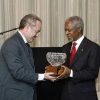
MEDIA: IPS Honours Annan’s Four Decades of Service
When Kofi Annan leaves the United Nations next week after an eventful 10-year tenure as secretary-general, there will be one prized possession he says he will virtually hand-carry: the Inter Press Service (IPS) International Achievement Award 2006.« Previous Page — Next Page »


Is the world dominated by three great empires -- the U.S.A, China and the European Union? How much power do the great behemoths of the south -- India, Brazil, and South Africa -- wield? And where does Russia fit in that equation? Are we in the middle of a new Cold War? What are the implications of the armed conflict with Georgia? What about the new axis: Venezuela-Russia? And what role does Turkey play? What about issues like Climate Change and other global forces like the food crisis and the high energy prices? How is all this reshaping the world's forces? IPS looks for some answers.

The Week with IPS

NEXT STOP - SDGs
Tracking global progress towards a sustainable world
