Languages
Sunday, November 8, 2026



News and Views from the Global South

Ecobreves – PERU: President Blocks Environmental Law
Peruvian President Alejandro Toledo's rejection of the new General Law on the Environment, approved by Congress, has opened a debate on the priorities of the population's quality of life and the conditions that most benefit economic growth.
Mercury, Another Threat to the Amazon
Informal gold mining has led to more than 2,000 tons of the dangerous metal mercury being dumped into the Brazilian environment. The eight countries of the Amazon Basin will present a plan of action to protect the region in September.Ecobreves – ARGENTINA: A Move for Responsible Forest Management
The international Forest Stewardship Council and the Argentine Fundación Vida Silvestre (Wildlife Foundation) are calling on government and non-governmental organizations to draft standards for managing forests.Ecobreves – GUATEMALA: Looking for Energy in the Trash
Municipal authorities in the Guatemalan capital began tests to calculate the amount of gas emanating from the city's landfill, with hopes of using it as an energy source for nearby residents.
Hunting Out of Control
Some 7,000 foreign hunters visit Argentina each year, setting their crosshairs on deer, antelope or puma. Controls for protected species are scarce.
The Earth Trembles in Cuba Too
Santiago, Cuba, founded in 1515, is one of the cities at greatest seismic risk on this Caribbean island. Quake-proof standards guide the construction of new housing.Ecobreves – BRAZIL: Whale Watching on the Rise
The July-November whale watching season has begun in Brazil, a tourist activity that is in its nascent stages but quickly growing. This year the northeastern state of Bahia will increase the number of embarkation points from three to five, in hopes of doubling the number of people going out in boats to see whales like the humpback (Megaptera novaeangliae), which gather there to reproduce.Ecobreves – CHILE: Police Protect Biodiversity
The Chilean National Environment Commission, CONAMA, is training the militarized police, known here as Carabineros, to protect the country's biodiversity.Ecobreves – CUBA: Turtles the New Attraction
A development plan in the village of Cocodrilo, on the southwestern Cuban Isla de la Juventud (Isle of Youth), aims to draw ecotourists to one of the most important projects for hawksbill turtle (Eretmochelys imbricata) management in the Caribbean.Ecobreves – GUATEMALA: The Capital Turns into a Dump
In the Guatemalan capital some 2,300 tons arrive each day at one huge central dump, according to a study conducted for the city government by the company Guatemalan Environmental Engineering Services.Ecobreves – HONDURAS: Women Build Eco-Housing
With no need for iron bars for reinforcement, or cement, women in the village of Campo Cielo, in the outskirts of the Honduran capital, began four months ago to build ecological houses with sand, soil and plastic bottles -- and they are proud of what they have accomplished.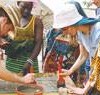
Tourism with a Social Conscience Gains Popularity
Some 15,000 people travel from Italy each year to experience first-hand the realities of communities in the developing South or in Eastern Europe.Ecobreves – ARGENTINA: Town Says No to Pesticide Storage
Residents of the town of Bouwer, in the central Argentine province of Córdoba, are staging street protests against a temporary storage site for 12 tons of DDC (dichloro diphenyl trichloroethane) and other highly toxic pesticides.
Scientist Condemns Mexico's Environmental “Double Standard”
It is easy to be the first to ratify international environmental treaties. It is quite another thing to effectively control air pollution, says Mexican scientist Luis Roberto Acosta.Ecobreves – BRAZIL: Amazon Deforestation on Decline
A sharp decline in deforestation in the Brazilian Amazon in June -- 95 percent in comparison with the same month in 2004 (plummeting from 10,017 to 531 square km) -- is raising hopes for success in fighting the phenomenon.Ecobreves – PERU: Critics Target Inter-Ocean Highway
The construction of a highway that would connect Brazil's Atlantic coast with Peru's Pacific shores is coming under fire for its cost and environmental impacts.Ecobreves – COLOMBIA: Congress to Debate Water Management
The Colombian Congress will discuss in its sessions, begun July 20, the bill on Integrated Management of Hydric Resources, also known as the Water Law, which seeks to ensure distribution and supply of the essential liquid.Ecobreves – BRAZIL: Hydroelectric Dam Looms Over Endangered Species
The construction of the Barra Grande hydroelectric facility on the border of Brazil's Santa Catarina and Rio Grande do Sul states threatens two plant species that are on the verge of extinction, say environmental groups.
Crackdown Not Enough to Stop Deforestation
Entrepreneurs and activists are challenging the results of Operation Curupira, which in June struck at the mafias behind destruction of the Amazon forest. They charge that the government's sting operation also paralyzed the legal lumber industry.Ecobreves – BRAZIL: WTO to Hear Used Tire Dispute
Brazil is getting ready to defend its ban on imports of used tires from the European Union before an arbitration committee of the World Trade Organization (WTO) on July 20 in Geneva, Switzerland.Ecobreves – CHILE: Solar Energy for Rural Families
More than 3,000 families isolated in rural villages of Chile's Fourth Region, some 500 km north of the capital, will soon be supplied by energy from photovoltaic systems, in a project financed in part by the Inter-American Development Bank, with support from the United Nations Development Program (UNDP).« Previous Page — Next Page »





Tierramérica is the main communications platform on sustainable development and the environment in Latin America and the Caribbean. It is produced by IPS Noticias, the agency’s Spanish-language service, which created it jointly with the United Nations Development Programme (UNDP) and the United Nations Environment Programme (UNEP), with later support from the World Bank. The weekly editions of Tierramérica are published in Spanish, Portuguese and English and are picked up and printed by dozens of media outlets in the region. Follow us on Facebook and Twitter.

From the Frontline of Environment
Supported by

Tierramérica en Español

Terramérica em Portuguese

