Languages
Tuesday, November 17, 2026



News and Views from the Global South
Education
EDUCATION-ARGENTINA: TV or Reforms to Blame for Poor Performance?
Teachers and analysts in Argentina spurned remarks by Minister of Education Susana Decibe, who blamed TV for poor student performance.SOUTH AFRICA-EDUCATION: Violent Crime Begins in the Classroom
A group of gangsters regularly drive, tyres screeching, into the yard of a Pretoria school, where burglaries are frequent and nightwatchmen are shot at.EDUCATION-CHILE: University Boom no Guarantee of Quality
While university tuition and attendance have been on the rise in Chile, the quality of higher education has been questioned by both local authorities and international experts.EDUCATION: Economic Crisis Sends Asian Students Home
The loss suffered by many universities in the United States, Britain and Australia may yet be Malaysia's gain, if the South-east Asian nation's plans work out.EDUCATION: Nicaragua Wants all Children in School
The Nicaraguan government has begun a drive to reverse the country's lamentable education record of allowing nearly more than one million children to remain out of the school system.EDUCATION: Re-think Needed for Latin American Education Systems
Education systems in southern Latin American countries need to to be overhauled because current programmes to reduce the number of pupils repeating a grade have resulted in a general lowering of standards, according to educators.EDUCATION-ZAMBIA: Teen Mothers Shy Away From School
Although the Zambian government is one of the few in the region with a progressive policy allowing teen mothers to return to school, girls have not been quick to take up the offer.EDUCATION-INDIA: Primary Education Still a Secondary Issue
As Indian politicians tilt quixotically over the building of a temple at a disputed site or banning cow slaughter, the dismal state of primary education remains a secondary issue in elections next month.EDUCATION-KENYA: Shortage of Schools Bites Hard
Basic education in Kenya seems to be steadily evolving into a privilege reserved for those who can afford it, rather than a right for all.EDUCATION-LATIN AMERICA: Universities Redefine Operations
Faced with an increasing lack of government assistance, and the need to adapt to the changes in society's demands, public universities in Latin America are redefining their operations in order to survive.DEVELOPMENT-BANGLADESH: They are Reading Again in Villages
A dozen villagers, basking in the winter sun, listen intently as a man reads from a newspaper in a Bangladesh village, some 100-km north of the capital city Dhaka.EDUCATION-BRAZIL: State, Private Cooperation Boosts Schooling
Recognition that education in Brazil is in a precarious state and that education plays a key role in the increasingly-competitive world of today has created a real thirst for knowledge in this country.HONG KONG: Row Worsens Over English vs Chinese Teaching
The long-running and often bitter battle over English versus Chinese teaching in Hong Kong schools took a new turn this month, after officials announced which schools would be allowed to continue teaching in English.BRAZIL: Situation of Children Improves but Unevenly
The young make up 38 percent of the Brazilian population but account for a mere 12.4 percent of the government social budget. However, new information published Monday showed they are better off than ever before.HUMAN-RIGHTS: Disabled Held Back By Discrimination
Jean Baptiste Angaman successfully passed the entrance exam to the elite Ivoirian School of Administration but, when he turned up for an interview, he was refused admission because of his physical disability.CHINA-US: School Chums Cement Sino-American Relations
While Chinese President Jiang Zemin and his U.S. counterpart Bill Clinton talk politics and business during their summit meeting in Washington this week, Sino-American relations could not be better in this port city on the Yangtze River.KENYA-EDUCATION: Teachers Blamed For Girls’ Poor Performance
Josephine Onunga, 21, had wanted to become a medical doctor after finishing her education. Now, instead of practicing in a hospital, she sits in the corner of a small shabby office with heaps of paperwork on her wooden desk.CHINA: Education Begins to Pay Off in the Workers’ State
After decades of persecution of Chinese intellectuals, the government is slowly recognising the value of higher education, while economic reforms have thrown many state workers onto the streets, ending the halcyon days of the worker state.PERU-EDUCATION: Market Reforms Come at a Cost to Education
After 13-years-old Gerardo repeated his third and fifth grade, his mother took him out of the public school he attened in a Lima shantytown and this year he has worked as a poorly-paid bus conductor.BURMA: Junta Gets Failing Marks in Educating Youth
Nearly 10 months after the Burmese junta closed down all universities and colleges because of campus unrest, thousands of students have been left with little prospect of completing their formal education.TRINIDAD AND TOBAGO: Education Minister Under Fire //REPEATING//
The country's embattled education minister, Adesh Nanan, held on for dear political life Monday as fiasco after fiasco continued to dog his brief tenure in what has always been a troublesome ministerial portfolio.« Previous Page — Next Page »


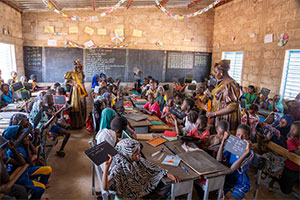 Two teachers work in a classroom in Forces Vives School in Dori, Burkina Faso. Credit: UNICEF/UNI978361
Safe and uninterrupted education is a fundamental right for all children. Education is paramount to global development, as it has been proven that investing in education – especially for girls and children – contributes significantly to economic growth and prosperity. Although more than 1 billion children go to school, many are subjected to conditions that are not conducive to a proper learning environment, including makeshift facilities, a lack of supplies, violence in classrooms, inadequate sanitation, untrained instructors, and widespread school closures. Since 2015, there have been immense gains in education with an increase of 109 million children in school. However, as of 2023, 272 million children are still out of school.
High poverty levels in developing countries also impede children’s access to a proper education. For example, from the early to mid 2000s, Sub-Saharan African nations witnessed a dramatic decline in trained teachers due to inadequate funding in the education sector. Furthermore, major cuts to United States international aid threaten an estimated 23 million additional children's access to education, as USAID‑funded school programmes across Africa and Asia face closure.
Various other factors contribute to the decline of education, notably hunger, which has increased as conflict and climate change interfere with global food production and dissemination. Meanwhile, certain social and cultural practices also impede children’s access to education, with gender inequality, discrimination, child labour, and child marriages preventing millions of children from attending school. Economic conditions such as the inaccessibility of higher education also affect disenfranchised communities across the world. In extreme situations, such as warfare where educational facilities are destroyed in their totality, notably in Gaza and Sudan, entire generations of children might grow up without access to education. Rebuilding educational infrastructure is a long and arduous process, especially when violence persists across generations, and this significantly stunts the development of societal prosperity and stability.
IPS is dedicated to telling the shocking truths about worldwide education through impassioned opinion pieces and comprehensive articles, highlighting global issues that impede worldwide education and the courses of action being taken by organizations such as UNICEF and Education Cannot Wait.

The Week with IPS

NEXT STOP - SDGs
Tracking global progress towards a sustainable world
Tracking global progress towards a sustainable world
