Languages
Wednesday, November 18, 2026



News and Views from the Global South
Education
JAPAN: Ethnic Koreans Set Up Schools to Preserve Identity
Tucked in the poor side of this bustling industrial port is the Osaka Chosen High School, a symbol of ethnic Koreans' struggle to keep their identity in a country that prides itself on being homogeneous.JAPAN: Ethnic Koreans Set Up Schools to Preserve Identity
Tucked in the poor side of this bustling industrial port is the Osaka Chosen High School, a symbol of ethnic Koreans' struggle to keep their identity in a country that prides itself on being homogeneous.LATIN AMERICA-EDUCATION: Schooling, Salaries, Investment
Salaries for unskilled workers in Latin America and the Caribbean will grow by 58 percent by 2010 if the most favorable scenario for regional investment and schooling comes to fruition, a World Bank study concludes.U.S.-AFRICA: Charges of Racism Dog Africa Scholars Group
When hundreds of Africa scholars assemble in the United States for the annual Africa Studies Association (ASA) in November, it is usually to discuss the continent's economies, politics and history.COTE D’IVOIRE-EDUCATION: Many Fail to Find Places in Schools
Thousands of children are being shut out of Cote d'Ivoire's schools as investment in education fails to keep pace with population growth.COTE D’IVOIRE-EDUCATION: Many Fail to Find Places in Schools
Thousands of children are being shut out of Cote d'Ivoire's schools as investment in education fails to keep pace with population growth.COTE D’IVOIRE-EDUCATION: Many Fail to Find Places in Schools
Thousands of children are being shut out of Cote d'Ivoire's schools as investment in education fails to keep pace with population growth.EDUCATION-SOUTH ASIA: Privileged Flaunt Old School Ties
The spectators cheer as the batsman drives the ball past the fielder's outstretched hands and over the boundary of the field where a school cricket match is on in this small north Indian town.EDUCATION-SOUTH ASIA: Privileged Flaunt Old School Ties
The spectators cheer as the batsman drives the ball past the fielder's outstretched hands and over the boundary of the field where a school cricket match is on in this small north Indian town.PERU-EDUCATION: Knowledge Is Worth Nothing
Peru leads most Latin American countries in its number of universities, but the university-educated population is disproportionately low and professionals have no assurance that they will find work in their chosen field.INDIA-EDUCATION: Earn As You Learn Helps Combat Illiteracy
Both Munna, 10, and his parents would like him to go to school. But if he stops working as a sweeper at the local landlord's house, there will not be enough to feed him and his four younger siblings, his parents feel.INDIA-EDUCATION: Earn As You Learn Helps Combat Illiteracy
Both Munna, 10, and his parents would like him to go to school. But if he stops working as a sweeper at the local landlord's house, there will not be enough to feed him and his four younger siblings, his parents feel.MEXICO-DEVELOPMENT: Lagging Education Darkens Prospects
Development perspectives for Mexico look gloomy given evidence of backwardness in the educational system and in the level of scientific research, experts here say.MEXICO-DEVELOPMENT: Lagging Education Darkens Prospects
Development perspectives for Mexico look gloomy given evidence of backwardness in the educational system and in the level of scientific research, experts here say.HONG KONG: Mandarin Becomes a Must as Hand-over Date Nears
One sure sign that Britain is finally getting down to the business of assuring Hong Kong's smooth transition to Chinese rule, is a new thrust to make mandarin the working language in the British colony.HONG KONG: Mandarin Becomes a Must as Hand-over Date Nears
One sure sign that Britain is finally getting down to the business of assuring Hong Kong's smooth transition to Chinese rule, is a new thrust to make mandarin the working language in the British colony.EDUCATION-PERU: SEX EDUCATION PLANS DISTURB RELIGIOUS GROUPS
The heads of Church schools are opposing a new law that from January 1996 requires all schools in Peru to provide pupils with sex education classes as part of their primary education. "There will be no talk of sex in my school. I don't care what the students say or do 58 meters from the door, but in my school we will not touch it," said Irene Villegas, principal of a Catholic high school in Lima. The stand by Villegas, whose school is located in the working class Las Flores district, was typical of the reaction among other teachers in church-run schools. But the law says that, beginning next year, children as young as three and four will receive answers to their questions on how they came into the world. Villegas has turned to the Association of Catholic High Schools in search of instructions on how to resolve the conflict between her religious and educational convictions on the one hand and the reform of the school program on the other. Father Adriano Tomassi, the president of the Association, to which 873 Peruvian Catholic high schools are affiliated, does not appear able to give any clear and definitive help to the principal of the Sacred Heart High School. Tomassi said that he was waiting for promised orientations from the Catholic hierarchy and noted that Bishop Miguel Irizar declared last September that the government has no right to impose educational programs that go against Christian faith. As an alternative, he proposed giving classes relating to sex matters to parents, so that the could then teach their children, a solution that would allow priests and nuns who serve as teachers to evade the issue. The students want to speak freely about sex, according to a poll carried out among adolescent students by the non-governmental organization Radda Barnan. The study was prompted by the parliamentary and media debate on the new population law, which includes promoting birth control methods among secondary school students and including basic sex education from early years. The poll revealed that virtually all adolescents want serious and systematic information on sex matters and are worried about AIDS and veneral diseases.EDUCATION-PERU: SEX EDUCATION PLANS DISTURB RELIGIOUS GROUPS
The heads of Church schools are opposing a new law that from January 1996 requires all schools in Peru to provide pupils with sex education classes as part of their primary education. "There will be no talk of sex in my school. I don't care what the students say or do 58 meters from the door, but in my school we will not touch it," said Irene Villegas, principal of a Catholic high school in Lima. The stand by Villegas, whose school is located in the working class Las Flores district, was typical of the reaction among other teachers in church-run schools. But the law says that, beginning next year, children as young as three and four will receive answers to their questions on how they came into the world. Villegas has turned to the Association of Catholic High Schools in search of instructions on how to resolve the conflict between her religious and educational convictions on the one hand and the reform of the school program on the other. Father Adriano Tomassi, the president of the Association, to which 873 Peruvian Catholic high schools are affiliated, does not appear able to give any clear and definitive help to the principal of the Sacred Heart High School. Tomassi said that he was waiting for promised orientations from the Catholic hierarchy and noted that Bishop Miguel Irizar declared last September that the government has no right to impose educational programs that go against Christian faith. As an alternative, he proposed giving classes relating to sex matters to parents, so that the could then teach their children, a solution that would allow priests and nuns who serve as teachers to evade the issue. The students want to speak freely about sex, according to a poll carried out among adolescent students by the non-governmental organization Radda Barnan. The study was prompted by the parliamentary and media debate on the new population law, which includes promoting birth control methods among secondary school students and including basic sex education from early years. The poll revealed that virtually all adolescents want serious and systematic information on sex matters and are worried about AIDS and veneral diseases.CARIBBEAN-EDUCATION: Stress Begins Early For Region’s Students
Each year thousands of hopeful 11 year olds all across the Caribbean stride into examination rooms with yellow pencils sharpened wickedly and apply themselves to sheaves of paper assessing their comprehension, writing and calculating abilities.EDUCATION-HEALTH: World Bank sees major role for private sector
The World Bank plans to advise governments in developing countries to increase the private sector's role in the provision of social services, particularly in education and health.TURKEY-EDUCATION: Students Ready, The System Waits
School's out in Turkey. Changes in the system used for grading secondary school students have caused a two-week postponement to the start of classes for the new year as teachers struggle to come to terms with their altered roles.« Previous Page — Next Page »


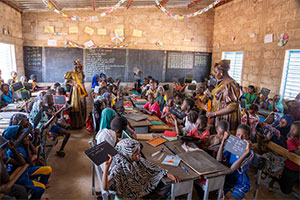 Two teachers work in a classroom in Forces Vives School in Dori, Burkina Faso. Credit: UNICEF/UNI978361
Safe and uninterrupted education is a fundamental right for all children. Education is paramount to global development, as it has been proven that investing in education – especially for girls and children – contributes significantly to economic growth and prosperity. Although more than 1 billion children go to school, many are subjected to conditions that are not conducive to a proper learning environment, including makeshift facilities, a lack of supplies, violence in classrooms, inadequate sanitation, untrained instructors, and widespread school closures. Since 2015, there have been immense gains in education with an increase of 109 million children in school. However, as of 2023, 272 million children are still out of school.
High poverty levels in developing countries also impede children’s access to a proper education. For example, from the early to mid 2000s, Sub-Saharan African nations witnessed a dramatic decline in trained teachers due to inadequate funding in the education sector. Furthermore, major cuts to United States international aid threaten an estimated 23 million additional children's access to education, as USAID‑funded school programmes across Africa and Asia face closure.
Various other factors contribute to the decline of education, notably hunger, which has increased as conflict and climate change interfere with global food production and dissemination. Meanwhile, certain social and cultural practices also impede children’s access to education, with gender inequality, discrimination, child labour, and child marriages preventing millions of children from attending school. Economic conditions such as the inaccessibility of higher education also affect disenfranchised communities across the world. In extreme situations, such as warfare where educational facilities are destroyed in their totality, notably in Gaza and Sudan, entire generations of children might grow up without access to education. Rebuilding educational infrastructure is a long and arduous process, especially when violence persists across generations, and this significantly stunts the development of societal prosperity and stability.
IPS is dedicated to telling the shocking truths about worldwide education through impassioned opinion pieces and comprehensive articles, highlighting global issues that impede worldwide education and the courses of action being taken by organizations such as UNICEF and Education Cannot Wait.

The Week with IPS

NEXT STOP - SDGs
Tracking global progress towards a sustainable world
Tracking global progress towards a sustainable world
