Languages
Tuesday, October 13, 2026



News and Views from the Global South
Other Voices
News and Views from our Content Partners

GGGI joined Ethiopia Green Legacy Campaign to plant 200 million tree seedlings in a day
In 2019, the Ethiopia government, led by Prime Minster Dr. Abiy Ahmed, launched the ambitious Green Legacy campaign that set a milestone to plant 200 million tree seedlings within 12 hours as integral part of an annual target to plant 4 billion tree seedlings.
The Geneva Centre and the UAE Permanent Mission to the UN in Geneva co-organized a panel debate on the rights of the child on 18 September
A panel debate was organized by the Geneva Centre for Human Rights Advancement and Global Dialogue (The Geneva Centre) and the Permanent Mission of the United Arab Emirates (UAE) to the UN in Geneva on the enhancement of access to justice for children in the UAE and the implementation of the Convention on the Rights of the Child (CRC). It was held on the margins of the 42nd regular session of the Human Rights Council.
Driving the grassroots green economy
Sonika Manandhar, Aeloi Technologies’ co-founder, knows the Kathmandu public transportation system inside out. Her family has been running micros (vans that operate as buses) as a business for over twenty years. She also insists on taking public transportation every day, although most of her peers in the technology industry rather save up and buy a motorbike. “Buses are just safer and more environmentally friendly,” says Sonika. “Unfortunately, all the buses, micros, and tempos stop after 8 pm. Then taxis or motorcycle hailing apps are the only options. I don’t feel safe with either, so I often miss out on networking opportunities or professional meetings over dinner,” she adds.
Plaswood: Plastic waste crunched into pieces becomes ply-plastic
Environment always becomes my first concern. Plastic wastes and deforestations are the major issues that I have involved with. The story behind the business concept occurred when I was running a small construction project to build a room in the apartment which I needed to buy plywood to build that room. At that time, I realized that the plywood is totally made from woodchips. I then got an idea of ply-plastic by crunching the plastic into pieces and transforming them to ply-plastic.
Before Bangalore city goes dry – Let’s close the loop
Shiva, 38 years, staying in a pent-house facing the Bellandur lake paid a bomb for this view 10 years back. But in 2019, often he wakes up to snow-flaked froth and smog and even shockingly fire over the lake. It has become a regular sight for him to watch water tankers filling the underground sump.G5 Sahel Summit: African Development Bank, partners, commit to light up and power the Sahel with the Desert to Power initiative
Dr. Akinwumi Adesina, president of the African Development Bank, has arrived in Ouagadougou, capital of Burkina Faso, ahead of the G5 Sahel Summit, and was received by Burkina Faso’s president, Mark Roch Christian Kaboré.
Three Questions to Wale Shonibare, Acting VP, Power, Energy, Climate & Green Growth
The Desert to Power initiative is an ambitious and innovative partnership-driven initiative of the African Development Bank to transform the Sahel and Sahara region through the deployment of solar technologies, at scale, in eleven countries: Burkina Faso, Chad, Djibouti, Ethiopia, Eritrea, Mali, Mauritania, Niger, Nigeria, Senegal, and Sudan.
Ministers Call for Coalition to scale up land restoration massively worldwide
1. On the road to the Climate Action Summit, the Minister of Environment, Forest and Climate Change of India and President of COP14, His Excellency Mr. Prakash Javedkar, and the United Nations Deputy Secretary-General, Her Excellency Ms. Amina J. Mohammed, hosted a high-level luncheon on land and climate on 9 September 2019, on the margins of the UNCCD Fourteenth Session of the Conference of the Parties (COP14). The event was co-facilitated by the United Nations Convention to Combat Desertification (UNCCD) and the United Nations Environment Programme (UNEP).
The Geneva Centre to organize on 18 September a panel debate on the rights of the child
(Geneva Centre) - A panel debate will be organized by the Geneva Centre for Human Rights Advancement and Global Dialogue and the Permanent Mission of the United Arab Emirates (UAE) to the UN in Geneva on the enhancement of access to justice for children in the UAE and the implementation of the Convention on the Rights of the Child (CRC).
World leaders call for global action to restore degraded land
Prime Minister Narendra Modi has called on the international community to set up a global water action agenda as the central theme to achieve land degradation neutrality. He announced that India will restore an additional 5 million hectares of degraded land by 2030, raising the land to be restored in India to 26 million hectares.Uniting for Zero Leprosy in Manila
World Health Organization’s (WHO) Goodwill Ambassador for Leprosy Elimination and recipient of the 2019 Order of the Rising Sun as well as the 2018 Gandhi Peace Prize, Mr. Yohei Sasakawa, is in the Philippines to call on academics, medical stakeholders and those affected by the disease to unite towards “Zero Leprosy”.
Domestic violence: Still a formidable challenge
After a week’s absence, Nazma entered the house with a lacklustre expression spread across her normally cheerful demeanour, with the slack of her sari pulled low over her face. When questioned in regards to her absence, while hesitant at first, she later revealed that she had been repeatedly threatened, forced to have sexual intercourse, and consequently suffered a miscarriage.
Microbes are paving the way to sustainable wastewater treatment
One morning Namitha awoke to a frantic call, “He can’t breathe. When he inhales, his ribs ache”, said Panchi. Panchi was one of the young mothers of the community that she was volunteering with and is just one among the thousands who use polluted water from the Yamuna River for her daily needs. Her son never fully recovered just like many other villagers who have been struck with epidemics of bone deformities, fluoride poisoning and water-borne diseases due to the rising water pollution in India.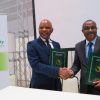
African Risk Capacity and Africa CDC Sign Partnership Agreement to Strengthen Disease Outbreak Preparedness
The African Risk Capacity (ARC) and the Africa Centre for Disease Control (Africa CDC) have signed a Partnership Agreement to establish a collaborative framework to help African Union Member States strengthen preparedness and emergency response against infectious diseases, of epidemic nature.
TICAD7: PM Shinzo Abe says Japan will help double Africa’s rice production by 2030
The Sasakawa Association will work with the Japan International Cooperation Agency (JICA), to help double rice production to 50 million tonnes by 2030. Japanese Prime Minister Shinzo Abe made the announcement at the Sasakawa Africa Association (SAA) symposium held on Wednesday during TICAD7.« Previous Page — Next Page »





The Week with IPS

NEXT STOP - SDGs
Tracking global progress towards a sustainable world
Tracking global progress towards a sustainable world
