Languages
Tuesday, October 20, 2026



News and Views from the Global South
East Africa
HEALTH-KENYA: Contraceptives? You’re Lucky if You Get Them
Kenya's government has again been criticised for its failure to provide enough contraceptives for its citizens - this at a two-day conference on maternal deaths and unsafe abortions that was held in the capital, Nairobi.U.S. ELECTION: Africa Expects a "Business as Usual" Approach From Bush
While the American presidential contest was nail-biting, there appears to be little suspense amongst analysts about what George W. Bush’s re-election as head of state means for Africa.EDUCATION-KENYA: Free Schooling – Good, but not Enough
By any measure, the enrolment of over a million extra children in Kenya’s primary school system over the past two years is a success story. Enrolment figures in the East African country burgeoned after President Mwai Kibaki introduced free primary education in 2003, when he took over as head of state from Daniel arap Moi.RIGHTS: A New Constitution Remains Distant Dream for Kenyans
Kenyans are fed up of waiting for a new constitution which seems to be dragging on indefinitely.POLITICS-KENYA: Slow Progress in War on Graft
Concerned about the slow progress in the war on corruption in Kenya, the United Nations has urged the government of Mwai Kibaki to double its efforts to contain the vice.SPECIAL REPORT-MEDIA: Alternative and Influential?
When you hear "alternative media," it is often alongside such words as "collective," "citizen-oriented," and "public." But what does it have to do with journalism? And how influential are groups like Indymedia, which recently had some of its computers seized?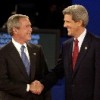
U.S. ELECTION: Africa Barely on the Candidates’ Radars
With U.S. voters anxiously contemplating the body count arising from the United States' deployment in Iraq - as well as the associated threat of terrorism - it was probably to be expected that Africa would get little "face time" in the presidential election.ENVIRONMENT-UGANDA: A Rough Passage for Lake Victoria
Lake Victoria has long been a name to conjure with. The world's second-largest fresh water lake, and the largest in Africa, it stretches out endlessly - rippled by the breeze that characteristically blows over the lake.POLITICS-SOMALIA: The President Without a Capital
When Abdullahi Yusuf Ahmed was sworn in as Somalia’s new president earlier this month in Kenya, cautious optimism was expressed at the fact that a new chapter appeared to be opening for the embattled East African country.
DEVELOPMENT: An Ambitious Agenda for the Helsinki Process
Their typical day starts at five in the morning or earlier. Balancing a pot on their heads – and sometimes with a baby strapped to their backs – women in rural Africa may walk up to 12 kilometres a day to fetch water.CORRUPTION-KENYA: A Ray of Hope in the Fight Against Graft
Kenya pulled off what some might view as an unexpected feat this week by improving its standing in Transparency International's annual Corruption Perceptions Index.POLITICS-BURUNDI: The Long Road to Peace
Motivated by the success in resolving Somalia’s conflict, African leaders have stepped up efforts to end the civil war in the tiny central African nation of Burundi where more than 300,000 people have been killed since 1993.RIGHTS: Inmate Deaths Worry Kenyans
A campaign to revamp Kenya’s dilapidated prisons has ignored the pressing problems of congestion and lack of training of prison warders to respect the rights of inmates, human rights groups say.EDUCATION-KENYA: Mastering the ABCs is Not Always Child’s Play
Discussions about improving the level of education in Kenya often focus on the challenge of achieving universal primary education - or ensuring that girls are not discriminated against when it comes to schooling.POLITICS-KENYA: Women Hail Nobel Peace Prize Winner
More than 140 environmentalists from 60 countries have showed accolades on Wangari Maathai, Kenya’s assistant minister for environment, for scooping this year’s Nobel Peace Prize.POLITICS-SOMALIA: A Herculean Task Faces New President
Political observers have welcomed the election of a new president for Somalia - but warned that stiff challenges lie ahead for the war-torn East African country.HEALTH-BURKINA FASO: Activism Clashes With Tradition
Government and civil society representatives from around the world met in Kenya recently to debate how best to end female genital mutilation - a laudable effort. However, a case in Burkina Faso has exposed the limitations of their campaign.HEALTH: UNICEF Urges Greater Commitment to Reducing Child Mortality
First, the good news: while nearly one in five children was dying before the age of five in the early 1960s, this figure had dropped to less than one in 12 by 2002.POLITICS-SUDAN: Persistent Insecurity in Darfur, Despite Global Pressure
Saleh Mahmood Osman chooses his words carefully. The human rights lawyer makes it clear that, although he comes from strife-torn Darfur, he does not bear ill will towards the Sudanese diplomats who have come to listen to his address in the South African capital, Pretoria.DEVELOPMENT-KENYA: The Challenge of Going from Slum to Suburb
It is a task that would make all but the most stout-hearted quake: transforming a slum containing some 500,000 inhabitants into an area where people can live with dignity.CULTURE-SUDAN: The Fall and Rise of English
Crumbling masonry, peeling paint and dusty patches where once were manicured lawns...The University of Khartoum has worn poorly under the searing Sudanese sun – as much as the language that the buttoned-up colonialists who built it came to spread.« Previous Page — Next Page »





The Week with IPS

NEXT STOP - SDGs
Tracking global progress towards a sustainable world
Tracking global progress towards a sustainable world
