Languages
Saturday, June 13, 2026



News and Views from the Global South
G20
G20: Where Is the Money, and Who Is the Moneylender
It seemed like a lot of money at the time. The leaders of the group of eight richest countries, the G8, met in Gleneagles in Scotland and announced 50 billion dollars in new aid, half of that for Africa and half for the rest of the world.G20: Give or Take a Trillion or Two
The ease with which leaders spoke of trillions of dollars at the G20 summit in London Thursday was no doubt intended to signal to the world just how serious leaders are about getting the economy right again. That these fabulous figures may never add up is another matter.POLITICS: Arab-Latin American Ties Hailed
Latin American leaders have underscored the importance of economic and political ties with the Arab world in a summit meeting with their Arab counterparts in Qatar. Tuesday's meeting, the second Arab-Latin American summit, in Doha, the Qatari capital, followed the conclusion of the Arab League conference in the city.G20: One Size Does Not Fit All
There is on the face of it a fairness in the language hanging over the G20 summit that is quite seductive. "A global crisis requires a global solution," everyone who matters seems to be saying, at least towards the richer end of the G20 spectrum. Such talk is getting louder by the day as heads of state and government head for a meeting in London Thursday to address the global economic crisis.AFRICA: ‘‘G20 Should Use Crisis as Opportunity to Fix Inequity’’
The daunting task of making Africa the centre of attention awaits Ethiopia’s Prime Minister Meles Zenawi when the Group of 20 (G20) rich and emerging economies meet in London tomorrow.ECONOMY: Global Public Backs Major Reforms
The international economic system needs a broad overhaul, said a strong majority of 70 percent of respondents to a global poll.G20: Next Time, Perhaps…
If the draft declaration of the G20 meeting in London is anything to go by, the most specific outcome of this summit is that there will be another one later in the year.G20: Japan Carries African Concerns To London
Japan, the world's second largest economy, is calling for global initiatives to reactivate financial flows to Africa, including government grants, concessional loans and lines of credit.ECONOMY: Zoellick Seeks New Trade Fund Amid Grim Outlook
For the first time since the Great Depression, global economic production will decline in 2009, according to the latest estimates by the World Bank, which also predicted a tough and uncertain 2010.CLIMATE CHANGE: G20 Leaders Wrangle Over Kyoto Successor
Senior legislators from the G20 bloc of the world’s biggest economies launched an international commission in Washington Monday to help lay the political groundwork for a global deal on climate change in Copenhagen this December.ECONOMY: High Stakes, Modest Outlook for G20
Talks on the global economic crisis, to be held Thursday, could prove a timely reminder of the perils of hype.WORLD: Investors Eyeing South-South Trade to Help End Crisis
Despite the challenges that the global economic crisis poses to Africa and other developing regions in the southern hemisphere, South-South trade still offers huge opportunities as there is room for growth beyond the current levels.FINANCE: Tax Havens in Spotlight at G20 Meet
This could be the moment when a fatal blow is delivered to the world's tax havens. Or it could be another largely cosmetic change that allows offshore financial centres such as Switzerland, the Cayman Islands and Liechtenstein to deflect attacks on the system by sacrificing the few tax miscreants that governments catch in their nets.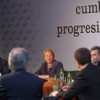
POLITICS: "People Come First" Say Progressive Leaders
Countries must put people first if they are to prevent the economic recession from becoming a social recession, concluded the two-day gathering of self-styled progressive world leaders that ended Saturday in this Chilean resort city.
Q&A: ‘Meltdown Not the Only Crisis in the World’
Muhammad Yunus, who claimed the 2006 Nobel Peace Prize founding Grameen Bank, which has lent out more than six billion dollars to mostly poor women, says the global recession presents a historical opportunity for change.ECONOMY-CHINA: Chance to Reform IMF in EU-US Split?
Differences between the United States and Europe over how to restore global economic growth have given rise to speculations here on whether a failure to agree on a grand strategy at the upcoming G20 summit might create room for China to assert its national agenda.
Q&A: "Women Need a Bigger Voice at the G20 Summit"
Activists are calling for an economic bailout plan for women and demanding that their voices be heard at the decision-making table ahead of the G20 summit of the world's biggest economies in London on Apr. 2.FINANCE: Major Banks Grease Wheels for Corrupt Regimes
Some of the world's leading banks facilitate corruption in the poorest countries, charges a new report by Global Witness, an independent watchdog group.WORLD-ECONOMY: Not The End of Neoliberalism Yet
The economist and author Prof Patrick Bond warns that the optimism about the dawn of a post-neoliberal era is premature and that ‘‘a more dangerous and painful’’ period may be ahead before any real change to the current global economic regime will be possible.
ECONOMY: Scepticism Greets G20 Attempt to Make History
Leaders of the world's 20 biggest economies emerged from weekend crisis talks with an apparent sense of historical accomplishment but key audiences seemed sceptical.ECONOMY: Emerging G20 Consensus on Solutions to Crisis
For now, a consensus seems to prevail in the Group of 20 (G20) major industrialised and emerging nations, whose finance ministers and central bank presidents ended their 10th annual meeting Sunday, which took on a high profile due to the global financial crisis.« Previous Page


The Week with IPS

NEXT STOP - SDGs
Tracking global progress towards a sustainable world
Tracking global progress towards a sustainable world
