
Sunday, October 4, 2026



News and Views from the Global South

Organic Coffee Tasting Better All the Time
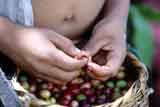
- Coffee grown without the use of chemical inputs is giving the indigenous Lencas reason to be optimistic, as their organic harvest fetches higher prices in a depressed market. The aim is to cultivate crops “in harmony with nature.”
-
More than 100,000 families making their living in the broader Honduran coffee industry exported 3.4 million quintals (45 kilos each) in 2002, and this year face a 30-percent decline in production, Ulises Sevilla, an expert from the state-run Honduran Coffee Institute (IHCAFE), told Tierramérica.
But in the Marcala mountains, 64 Lenca Indians are keeping hopes alive for a better life by growing organic coffee, meaning they do not use any chemical fertilizer or pesticide inputs.
They are just a small group within the larger Honduran population dedicated to the production of coffee, the country's second leading export, after bananas.
On their small parcels of land, the Lencas have planted special coffees that have captured the attention of the international market with their high quality and exotic flavors, with aromas of mint, pepper, citrus and chocolate.
“We decided to try another form of cultivation and we have been reunited once again with the earth and its riches,” coffee-grower Demetrio Benítez told Tierramérica.
“We stopped using chemicals and have staked our bets on organic farming, which is none other than planting crops as God has mandated, in harmony with nature,” he explained.
For fertilizers, the Lencas apply poultry manure and 'bocashy', a mix of coffee plant pulp, manure, molasses, leavening and other ingredients, with good results in improving soils and boosting yields.
Throughout a 145-hectare plantation, they have incorporated other plants that provide much-needed shade for the coffee and which themselves mean parallel production throughout the growing season.
Growing organic coffee in the shade improves the plant's vigor, as well as the quality and taste of the bean it produces, experts from the Costa Rica-based Tropical Agriculture Research and Higher Education Center (CATIE for its Spanish initials), explained to Tierramérica.
Furthermore, shade-grown organic coffee also protects the soil and provides habitat and food for wildlife, according to CATIE.
Due to a continued surplus of coffee worldwide, international prices plunged in the past decade from 120 dollars to 50 dollars per quintal, its lowest level.
But the catastrophes that Honduran coffee-growers have had to confront are not limited to rock-bottom prices. In 1998 Hurricane Mitch devastated much of the country, destroying plantations and worsening soil erosion and fragility, noted IHCAFE expert Sevilla.
He added that the crisis led many farmers to abandon their lands. There are areas where “the coffee beans have been dumped and the coffee-growers are desperate,” due to the low prices, which usually do not even cover production costs.
In this context, organic coffee serves as “a survival mechanism,” though it is still a very small part of the market and does not show signs of rapid expansion, Sevilla said.
In his opinion, the environmentally-friendly coffee could potentially produce “a boom, but the process is complicated.”
Coffee grown using the usual commercial methods brings in 174 million dollars a year for Honduras.
According to official figures, the country annually exports to the United States some 10,000 sacks (69-kilos each) of organic coffee, grown on 30 small cooperatives.
Although limited, the experience is “encouraging because we exported the first consignments of organic coffee at profit of 23 dollars” per 69-kilo sack, which sells on the international market at 55 dollars each, says Rodolfo Peñalba, of the non-governmental Foundation for Rural Entrepreneurial Development (FUNDER), which provides technical and financial support to the Lenca farmers.
And because the quality of the bean has been maintained, the growers calculate that this year they will see a 26-dollar profit per sack of coffee, adds Peñalba.
Central American farmers with conventional coffee plantations generally utilize dangerous chemical pesticides. Furthermore, most removed all the surrounding trees, so the soil is exposed to the sun and rain, reducing soil fertility and contributing to heavy erosion, according to CATIE.
In addition to aggravating the already persistent poverty of rural areas in the region, the coffee crisis could have environmental consequences, as plantations are converted to livestock pastures, warns the research institution.
 Print
|
Print
|




