
Saturday, October 17, 2026



News and Views from the Global South

Chainsaws Threaten Bolivian Nature Preserve
- Residents of the town of Apolo, in northeast Bolivia, are preparing to use chainsaws to open a path through Madidi National Park, while the government and defenders of biodiversity say the route would mostly benefit illegal exports of precious wood.
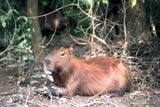
The capybara, the world's biggest rodent, is a resident of Bolivia's Madidi Park - Mauricio Ramos
The effort has been promoted by an alliance of civic groups, farmers associations with highly politicized leaders, truck drivers from the region, and food and consumer goods suppliers.
The creation of this route has been challenged by the government's National Protected Areas Service (SERNAP) because it crosses a central swath of the park and would destroy the headwater areas of rivers and watersheds located in zones with high levels of precipitation.
The populations of Apolo and Ixiamas are 2,123 and 5,625, respectively.
A road in the area could trigger huge landslides and harm the water sources that supply the farmland and towns on the plains, SERNAP representatives told Tierramérica.
Along the road the groups want to build, there are no other human settlements that would benefit from it, and conservation experts fear that illegal loggers would use it to get to valuable trees that are threatened with extinction, such as the 'caoba', big-leaf mahogany (Swietenia macrophylla).
Arturo Bowles, general manager National Chamber of Forestry, which comprises logging companies, told Tierramérica its members respect conservation regulations and that none hold concessions inside the Madidi National Park area.
The government created the park in 1995 at the urging of environmental groups, including Conservation International (CI). It extends across 18,957 square km.
It is set in the provinces of Franz Tamayo and Iturralde, in the northern department of La Paz, and is surrounded by other national parks, like Manuripi Heat, the Apolobamba Integrated Management Natural Area, and the Pilón Lajas Biosphere Reserve. To the west it is bordered by Peru.
It is an area of varied geography, with permanently snowcapped peaks, cloud forests, dry tropical forest, Amazonian rainforest, and savanna or pampas, says CI in a report.
Around a thousand bird species, or 11 percent of the world's total, are found in these parts, as are big mammals like the jaguar (Panthera onca), spectacled bear (Tremarctos ornatus), tapir (Tapirus terrestris), capybara (Hydrochaeris hydrochaeris) and several primate species, according to the international watchdog group.
The Bolivian government has recorded 4,739 plant species. The fate of the park appears to be caught up in the common dilemma of “conservation or development”, but SERNAP director Oscar Loayza assures Tierramérica that it is “an undeniable and non-negotiable duty to protect the nation's natural heritage.”
The reserve is an instrument for “supporting the sustainable development of populations that have lived in the region since time immemorial and of the peoples who historically have been associated with the sustainable use of their natural resources,” he says.
Loayza highlights the successful experience of community participation in the production of high-quality coffee varieties that are competitive on the international market.
Another project associated with conservation is ecotourism at the Chalalán Ecolodge, promoted by the community of San José de Uchupiamonas, in the central part of the park. It does half a million dollars in business annually, paying 30,000 dollars in taxes.
The National Agrarian Reform Institute aims to grant land titles to the indigenous community in an area covering 189,000 hectares in the integrated management and reserve area of the Madidi National Park.
The residents of Apolo and Ixiamas say their road project will not hurt the forest's natural wealth and they demand a transportation route between the two towns. SERNAP says their demand is unjustified because Apolo and Ixiamas produce the same things and engage in little direct trade with each other.
Loayza attributes the project to interests from outside groups, “which have diverse aims that are incompatible with the existence of the Madidi, unlike the populations that have traditionally inhabited the area and have so far kept quiet on the matter.”
Among the indigenous groups that have yet to take a stand on the issue are the Araona, with its 100 members, and the Tacana, who are 5,000 strong.
The Araona live under pressure from loggers and illegal nut gatherers in an area of 92,000 hectares recognized by the government in 1992 as community-held ancestral lands.
The Araona leaders are calling for an expansion of that territory in order to halt the ongoing threat from logging companies and lumber scavengers known as 'cuartoneros'.
The Tacana suffer similar problems but also from the fact that its people are scattered across different territories.
Last week, to prevent the residents of Apolo from breaking off talks with the government, the authorities of La Paz department proposed, with the backing of SERNAP, an alternative route between Apolo and Ixiamas, passing through the towns of Machua, Tres de Mayo, Mamacona and San José de Uchupiamonas — a distance of 190 km.
The dialogue had come to a halt on Jun. 5, when SERNAP issued a technical document stating that Madidi National Park would be endangered by a route through its central area, but now the agency says it is willing to return to the negotiating table.
 Print
|
Print
|




