
Saturday, September 19, 2026



News and Views from the Global South
DEVELOPMENT-AFRICA: In Praise of Grace Under Pressure
Moyiga Nduru
- Images of floods, drought, famine, refugees and malnourished children in Africa have long made the continent appear relentlessly disaster-prone. But, says Francoise Le Goff, these pictures only tell part of the story.
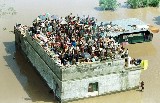
Floods in the Mozambican city of Xai-Xai, in February 2000. (Photo: Karel Prinsloo) Credit: PictureNET Africa
Le Goff, who heads up the federation’s activities in Southern Africa, was not simply paying a compliment to disaster victims. She was also highlighting the need for future relief efforts to recognise their resilience.
“If we cannot understand local capacities and enhance them, we perpetuate the idea that we know best,” said Le Goff, adding “The most important resource for managing disasters is people’s own strategies to cope and adapt.”
“Local knowledge, skills, determination, livelihoods, cooperation and access to resources are all vital factors enabling people to bounce back from disaster,” she noted further.
The Geneva-based federation’s report is entitled ‘2004 World Disaster Report: Focus on Community Resilience’.
Mozambique, Malawi and Zimbabwe – which have experienced severe floods and food shortages during the past five years – were cited as examples of countries where people had demonstrated courage in the face of overwhelming odds.
“During the previous years of food insecurity, we saw them again devising coping mechanisms to supplement what they got from humanitarian agencies. Even as the region grapples with the huge HIV/AIDS statistics, they are still playing an active role in our home-based care programmes,” noted Le Goff.
According to the Joint United Nations Programme on HIV/AIDS, 70 percent of all HIV-positive persons live in sub-Saharan Africa. More than 25 percent of the population in Southern Africa is estimated to have contracted the virus.
The AIDS pandemic has worsened the effects of food insecurity in Southern Africa by incapacitating many subsistence farmers. Poverty and declining healthcare systems have undermined the ability of countries to cope with HIV – while rapid urbanisation has provided ideal conditions for the spread of AIDS.
“Where HIV prevalence is highest, life expectancy will drop below 20 years by 2020. For example, in South Africa life expectancy has gone down from 53.7 years to 47.7 – and the prevalence rate is nearly 22 percent against a population of 44.8 million,” said Le Goff.
The result of this was that citizens were dying at a time of life that should have been their most productive – while the number of children in need of care was spiralling.
“Even as we are talking here someone has been buried today and arrangements are being made for someone’s burial tomorrow. The number of dependants is growing on a daily basis, with South Africa already having 1.1 million orphans. Where does this put us?” Le Goff asked.
Leslie Mondo, secretary-general of the South African Red Cross Society, urged communities to forge partnerships with local authorities, to enhance their ability to cope with this situation.
“By partnering with local municipalities, communities have access to disaster mitigation planning and training,” he noted, adding that more than 600 volunteers had involved themselves in community service this year in South Africa.
According to Mondo, these persons had made more than 13,000 home visits each month.
“Currently we work with nearly 9,000 clients who look to our volunteers for the delivery of food parcels and non-food relief such as blankets and clothing – as well as moral support whilst fighting the emotional turmoil and devastation of losing loved ones,” he said.
“Our current client base is 33 percent HIV-positive…65 percent of our clients are women,” Mondo added.
Le Goff urged the business community to play a greater role in the fight against AIDS, noting that this was in its own best interests: “If businesspeople do not invest in HIV/AIDS prevention, care and support – then they are investing in their downfall.”
However, innovative strategies that that did not simply rely on the distribution of food aid were needed.
“Only a developmental approach, building on local priorities and capacities, can ensure interventions are effective and sustainable,” Le Goff said.
“A multi-dimensional response is needed, supporting livelihoods, irrigation, nutrition, education, clean water and sanitation – as well as disease prevention and care."
 Print
|
Print
|




