Wednesday, September 23, 2026



News and Views from the Global South
DEVELOPMENT: Donor Fatigue Leaves 2.8m People Hungrier in Southern Africa
Moyiga Nduru
- 2004 is ending on a grim note for many in Southern Africa, where emergency food supplies cannot meet their needs.
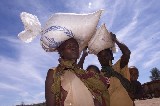
A regional food crisis persists. (Photo: Obed Zilwa) Credit: PictureNET Africa
The WFP launched a 404-million-dollar appeal in October to feed people in Lesotho, Malawi, Mozambique, Swaziland and Zambia. These Southern African countries are amongst states affected most acutely by food shortages that have swept the region during the past two years.
However, only 2.5 percent (about 10 million dollars) of the amount called for has been received. As a result, aid recipients in Southern Africa are surviving on half their normal rations – sometimes less.
“There will be serious health and nutritional repercussions if people have to accept a further reduction in their meagre rations,” said Mike Sackett, WFP Regional Director for Southern Africa, in a press release issued Dec. 22.
“While many of us will be sitting down with our families and friends to celebrate Christmas, millions of men, women and children face a very bleak time because we were unable to meet their basic food needs,” he added.
Richard Lee, a WFP spokesman in South Africa, said the situation in Lesotho, Swaziland and southern Malawi offered particular cause for concern. “The three countries experienced bad harvests, largely due to drought, last year,” he noted Thursday, in an interview with IPS.
“The traditional lean season – from January to March – will be particularly tough as we will have to cut rations even further unless we receive immediate cash donations,” said Sackett. “WFP will run out of food for Lesotho by the end of January and other countries in the region in the following weeks. By the beginning of March we won’t have any cereals left.”
An international agricultural institute that works in Southern Africa has identified the immediate causes of famine in the sub-region as being drought in certain areas, flooding in others – and low levels of crop planting.
In a recent paper entitled ‘Fighting Famine in Southern Africa: Steps Out of the Crisis’, the Washington-based International Food Policy Research Institute (IFPRI) also noted that poverty and inadequate food security policies had made some Southern African countries vulnerable to famine.
“These conditions have combined to result in severe shortfalls in food production and in turn high prices for maize, the staple food of the people,” the paper said. In this context, added the IFPRI, environmental shocks such as drought brought about collapse of systems that were already weak, owing to poor governance.
The HIV pandemic has contributed to food shortages by incapacitating farmers across the region, while political conflict has also worsened matters.
“If governments allow wars, corruption and poor policies to continue, actions to mitigate and prevent famines will fail,” warns the IFPRI. “Policies for mitigating famine lie on a spectrum ranging from immediate relief to recovery to initiating development.”
In the case of Zimbabwe, where about half the citizens depend on some form of food aid, critics maintain that the government-supported seizure of mainly white-owned farms has contributed to food shortages in the country.
Veterans of Zimbabwe’s war of independence, fought in the 1970s, began occupying the farms in 2000 – apparently to protest against racial inequalities in land ownership that date back to the colonial era. It has also been alleged that the farm seizures were orchestrated by government as a ploy to gain votes in the 2000 parliamentary poll.
The country’s prospects for food security in 2005 are not positive, even though officials claim that a bumper crop is expected.
“Given an estimated maize and small grain production of 1 – 1.3 million metric tones, Zimbabwe will have a cereal gap of between 500 – 800,000 metric tones in 2004/05,” says a recent report by the Harare-based Famine Early Warning Systems Network.
Swaziland has also been accused of mismanaging its food security policy. This month there was an outcry when the king of Swaziland, Mswati the third, bought himself a 500,000-dollar luxury sedan, even though a third of the population is estimated to rely on food aid for survival.
On the positive side, Lee said the number of people in need of food aid in Southern Africa is much lower this year than in 2001 and 2002, when the number approached 13 million.
However, growing demands for emergency assistance in Darfur, western Sudan, mean that less food will reach the starving people of Southern Africa, Lee added.
 Print
|
Print
|