
Friday, November 20, 2026



News and Views from the Global South
UZBEKISTAN: Group Warns of Looming Power Struggle
Jonathan Bell
- A recent International Crisis Group (ICG) briefing warns that Uzbekistan’s political and socioeconomic instability remains “a serious risk to itself and [the] region”, and that the international community must brace itself for a civil conflict.
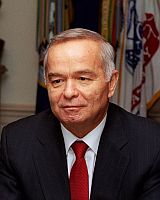
Uzbek President Islam Karimov Credit: US Defence Dept
The large number of possible presidential candidates and an armed underground Islamist movement add uncertainty to predictions of what will happen when Karimov inevitably steps down.
In addition to numerous “powerful political and economic actors outside government,” Karimov’s daughter Gulnura, the National Security Service chief Rustam Inoyatov, Prime Minister Shavkat Mirziyoyev, and the Deputy Prime Minister Rustam Azimov are all possible candidates to be the next ruler, says the ICG.
Some analysts see a possibility for peaceful power transition, pointing to Turkmenistan, where no violence followed the death of former Turkmen President Saparmurat Niyazov, but the ICG says the situation in Uzbekistan is not the same.
For one, the population in Uzbekistan is still resentful of Karimov, unlike the situation in Turkmenistan where the population had largely “made its peace” with Niyazov, and did not seem to require the heavy hand of police agencies like the Ministry of Internal Affairs and the National Security Service – which Karimov is said to rely on – to keep it in check.
Under Karimov, “grinding poverty” is a source of anger for the population of 26 million. The economy is “in extremely poor shape, with gas revenues and gold and cotton exports propping up a regime following an unsustainable path,” says the briefing paper.
“In March 2006 the World Bank stopped making new loans because of concerns the money would be misspent,” says the ICG.
According to the International Monetary Fund (IMF), in 2005, 60 percent of government spending was meant for social programmes, but in reality doctors are paid poverty wages.
In 2005, the government used high-calibre weapons to gun down hundreds of civilian demonstrators in Andijon who were showing their support for 23 local businessmen accused of Islamic radicalism.
In response, the European Union imposed limited sanctions, but in Uzbekistan only small “cosmetic” changes were made, and the repression continued.
While abandoning these sanctions would be “a mistake”, according to Jon Greenwald, vice president of the ICG, “there doesn’t seem to be a great deal of [other] leverage” that can be used on the government.
The “concentration should be to do what [we] can in a humanitarian sense in the country,” he told IPS.
Rachel Denbur, acting executive director of the Europe and Central Asia Division for Human Rights Watch, agreed that the current sanctions are “mild”, but said it was important that the EU “holds firm” and encourages an accountability process to be put in place.
The report speculates that support for Islamic radicalism could grow if the repressive regime, which has imposed severe restrictions on religious freedom, continues on its current path.
Rumours circulated in June that a group thought to be behind a series of bombings and shoot-outs in 2004, the Islamic Jihad Union, was considering launching a renewed jihad against the regime, though some political analysts and human rights activists dismiss the idea.
The government often uses the excuse of the “war on terror” to enforce the religious freedom restrictions, often “visiting” religious activists at home, says the ICG.
Uzbekistan is a former part of the Soviet Union, and has a rapidly growing economy, recording 9.1 percent growth in the first quarter of this year. Despite this, unemployment stands at about 20 percent.
It is the world’s seventh largest producer of gold, the fourth largest producer of cotton, and, relative to the region, produces significant amounts of natural gas, coal, copper, oil, silver and uranium.
Uzbekistan’s relationship with the U.S. has deteriorated notably since the U.S. joined other Western nations in calling for an independent international investigation into the events at Andijon, and as a result the country is now more politically aligned with those who choose not to criticise it on its human rights issues, particularly Russian and China.
The ICG offers a number of suggestions for the international community which it says should be carried out “if sanctions are to be anything more than an irritant”.
First, effective sanctions, says the ICG, need to be tied to specific conditions which Uzbekistan must meet in order for the sanctions to be lifted. Previous EU sanctions did not specify conditions.
Such conditions should include allowing re-registration of NGOs shut down after Andijon, ending the harassment of foreign and independent journalists and human rights activists, and granting the International Committee of the Red Cross (ICRC) unrestricted access to all detentions in the country, says the ICG.
Other goals focus on the Andijon massacre, asking for unhindered access for international observers to Andijon refugees so that their welfare can be determined, and an independent investigation to be carried out.
The ICG recommends further opening of the Uzbek economy, which would entail maintaining a consistent front with Russian and China on reforms “essential for the country’s stability,” and supporting education abroad, as a response to Uzbekistan’s falling education standards.
Andijon showed how ineffective the West has been in effecting change in Uzbekistan and suggests that the best the West can do now is to support basic human rights, and focus on not letting “potential unrest within the country from spilling into the wider region.”
 Print
|




