
Thursday, November 19, 2026



News and Views from the Global South
COP31
COP31 Nears Close as ‘Weak’, ‘Compromised’ Draft Draws Fierce Backlash
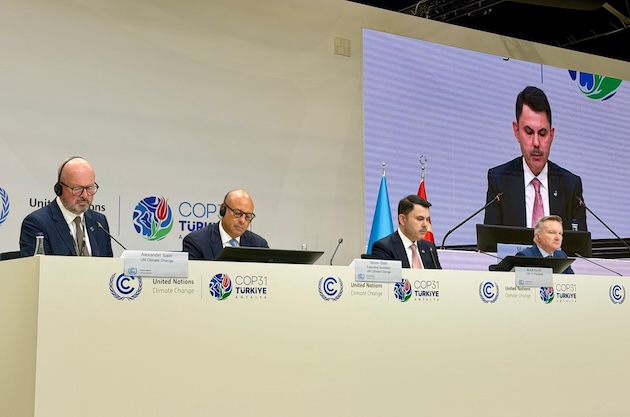
COP31 President Murat Kurum, COP31 President of Negotiations Chris Bowen and UN Climate Change Executive Secretary Simon Stiell address the media after the COP31 Presidency has released the new draft text of the cover decision. Credit: Stella Paul/IPS
- Civil society organisations and delegates from climate-vulnerable countries have sharply criticised the latest draft of the Presidency-led cover decision at the UN climate summit. They accuse negotiators of removing commitments on fossil fuels and failing to provide concrete climate finance, as the talks enter their final hours.
Released by the COP31 Presidency on November 19, the second draft of the cover text removes all direct references to fossil fuels and drops proposed roadmaps for moving away from them. Both had appeared in an earlier version released on November 16.
Instead, the new draft proposes a target to increase electricity’s share of final energy consumption to 35 percent by 2035. It also launches the Antalya Compact for Energy Efficient Buildings and retains unresolved, bracketed language supporting carbon capture, utilisation and storage (CCUS) and carbon dioxide removal (CDR).
Although the draft reaffirms the Paris Agreement’s 1.5°C temperature goal and sets up new dialogues on oceans and mountains, climate advocates say the removal of key commitments marks a major step backwards on cutting emissions and ensuring fairness for countries most affected by climate change.
Accusations Over Fossil Fuel Omissions
Speaking at a press conference after the draft was released, Andreas Sieber, Head of Political Strategy at 350.org, strongly criticised the removal of fossil fuel language and singled out Chris Bowen, COP31 President of Negotiations and Australia’s Climate Change and Energy Minister.
“The COP President, Bowen, seems to be some kind of spineless fossil fuel bro, after what we’ve seen in the latest cover decision draft,” Sieber said, pointing to the economic ties between the summit’s co-hosts.
“He cut out, and it seems to be quite conveniently, any reference to fossil fuels. We know that Australia is one of the top fossil fuel exporters in the world. They’re currently number two in coal exports, about to become number one. If there’s one thing that connects these two presidencies… it’s the coal trade between Australia and Turkey.”
Sieber said the coal traded between the two countries since the Paris Agreement represents four times Ethiopia’s annual carbon dioxide emissions. Ethiopia is due to host COP32.
He also called for the removal of language promoting carbon capture technologies, specifically demanding that paragraph 36(h) be “killed.” If countries cannot agree on fossil fuel phase-out roadmaps through the formal negotiations, he urged the presidency to continue pushing for them outside the negotiating rooms.
Stalled Negotiations and Distractions
Other climate advocates warned that the Presidency’s cover text is diverting attention from the formal negotiations, particularly discussions on how to protect workers and communities as countries move away from fossil fuels.
Natasha Greene, an advisor and specialist in international climate diplomacy and energy transition at E3G Australia, pointed to the absence of a mechanism to coordinate a fair transition away from fossil fuels.
“There will be a fight also to advance the just transition mechanism. It hasn’t been mentioned in the cover decision text, but it was a priority for those who wanted to say, yes, we need to look to ban fossil fuels,” Greene said.
She added that progress on the mechanism was “being stalled by negotiating tactics from the European Union, from Australia, and from other countries that don’t want to codify obligations around just transition and internationalise them.”
Carla Daniela Maass Wolfenson of Ecuador’s Sacred Head Waters Alliance also questioned the process behind the cover decision.
“We came here not to discuss this text,” she said, arguing that the cover decision had effectively created a parallel negotiating process. In her view, this was taking attention away from the formal discussions on emissions cuts, just transition and climate finance.
Vulnerable Nations Await Concrete Finance
On adaptation, the November 19 draft launches the Antalya-to-Addis Ababa Roadmap for Adaptation and Resilience Finance. However, it does not set a specific funding target or baseline year for tripling adaptation finance.
For delegates from countries facing conflict and severe climate impacts, the absence of clear financial commitments has serious consequences for people already struggling to cope with multiple crises.
Samer Kalbouneh, head of the Palestinian delegation, stressed the urgent need for financial and technological support to rebuild Gaza’s shattered infrastructure.
“Eighty percent of our productive land is now unproductive because of the war. We are completely dependent for energy on Israel and our water supply systems are broken,” Kalbouneh told IPS.
“What we aim for at this moment is to stress the importance of letting the environmental finance continue, from developed countries to fragile and more affected countries like Palestine, and especially in Gaza,” he added.
Fadumo Abdilahi, gender focal point for the Somali delegation, described how women in her country face overlapping crises, including drought, flooding and violence by the extremist group Al-Shabaab. At the same time, many women continue to support their families and local economies through small businesses and subsistence farming.
“Year after year, we come to the COP, hoping that things will change, that vulnerable communities like us will get finance that will help women become more climate resilient,” Abdilahi told IPS.
Official Defence and Final Push
At a press conference shortly after the draft was released, COP31 officials leading the negotiations defended the process, maintaining that the complex talks were still focused on delivering action.
Minister Chris Bowen described the summit as the “COP of implementation and acceleration”. He emphasised the need for concrete plans to drive an “irreversible global transition towards low greenhouse gas emissions” and keep the 1.5°C goal within reach.
UNFCCC Executive Secretary Simon Stiell acknowledged that addressing the many issues being negotiated across different rooms was “very complex.” However, he stressed that “these are crucial days ahead for climate cooperation. And we have no time to lose.”
Despite the strong criticism of the latest draft, some observers believe there is still time to secure a stronger outcome before the negotiations end.
Greene of E3G said the language on moving away from fossil fuels could still make it back into the final text in the remaining hours.
“They have the diplomatic skill to pull this through,” she said.
IPS UN Bureau Report



 Print
|




