Wednesday, August 26, 2026



News and Views from the Global South
FINANCE: New IMF Boss Caught Between North and South
Abid Aslam
- Dominique Strauss-Kahn started his first day as managing director of the International Monetary Fund (IMF) Thursday amid contention over how the agency is governed and what role it fulfils.
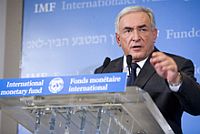
Dominique Strauss-Kahn Credit:
The new boss also is under pressure from large shareholders to preserve their power over the institution and to do their bidding on issues such as China’s exchange rate policy while at the same time trimming costs and cutting staff.
Strauss-Kahn has acknowledged the immensity of the task ahead.
“What might be at stake today is the very existence of the IMF as the major institution providing financial stability to the world,” he said in a September job interview.
Governance changes are under way and are to be completed next year. These are aimed at reflecting a distribution of economic power today that is very different from the Western-dominated world in which the IMF was born 63 years ago.
China, South Korea, Mexico, and Turkey have increased their shares in the IMF. Plans to give other under-represented economies a greater say are being discussed.
Developing countries have assailed current proposals as “disappointing and unacceptable”.
Members of the Group of 24 (G24) developing countries, in a recent statement, demanded “sizeable” increases in the voting shares of emerging economies and measures to ensure that these do not come at the expense of smaller developing countries.
Such calls unsettle the likes of France and Britain, which fear falling below China on the shareholding totem pole. The Asian country has the world’s fourth-largest economy after the United States, Germany, and Japan.
European countries wield a collective 30 percent of votes in the fund and are reluctant to cede power.
The United States holds a 17 percent stake and remains the largest of the fund’s 185 shareholders. U.S. officials have said Washington will not relinquish its effective veto over the agency.
For his part, Strauss-Kahn has voiced support for so-called double majority voting on major decisions.
Under current rules, proposals put to the IMF executive board must win a majority of votes based on governments’ shareholding. Developing countries resent the arrangement, under which Africa wields less than 5 percent of votes.
Under a double majority system, proposals also would have to win approval from a majority of IMF members, regardless of their shareholding. Proponents say the system would restore balance to the existing way of tallying votes.
While many developing countries favour a ”one country, one vote” arrangement, however, Strauss-Kahn backs giving an equal vote to each of the agency’s executive directors, who represent shareholders on the IMF executive board. This version, sometimes called ”one seat, one vote”, would grant Africa two votes out of 24 compared to one U.S. vote and eight for Europeans. Under ”one country, one vote”, Africa would wield 45 of 185 votes, or three times the proportion of its seats on the board.
More is at stake than political turf, said officials from the G24, which is made up of India, Brazil, and other African, Asian, and Latin American countries. China is an observer.
“An institution and its policy advice would no longer be credible if the institution is managed by the richest only,” said Oscar Tangelson, deputy economy minister of Argentina, which chaired the G24 at last month’s IMF annual meeting.
Also in the balance is the IMF’s financial health. The fund is endowed with shareholders’ capital, most of it from wealthy members, but it owes its operational income to borrowers who service their debts.
Outstanding loans have dwindled as developing countries seek alternative sources of financing. This has pushed the IMF into the red and wealthy shareholders have demanded that it cut costs, including by jettisoning some of its 2,600-plus staff positions.
Asian and Latin American countries that borrowed from the fund during the financial firestorms of a decade ago have repaid all or most of their loans and have amassed foreign exchange reserves in hopes they will not have to turn to the fund, which requires austere budgets and economic liberalisation in exchange for emergency assistance, the next time trouble strikes.
Additionally, poor countries have begun to borrow from elsewhere. In Africa, Chinese financial institutions have backed government-owned and private businesses from Nigeria to Angola. Beijing reportedly is weighing a 5.5-billion-dollar loan for infrastructure in the Democratic Republic of Congo, or former Zaire.
Strauss-Kahn has suggested that where loans are not wanted, the fund could assert its relevance by providing “ruthless truth-telling.”
“As countries are reluctant to cede any control over their economic policies, the IMF must have as instruments the power of analysis and persuasion,” he said.
Rich and poor countries alike support the idea that the IMF should bolster its monitoring of members’ economies and the global financial system to help ensure stability. They fall out, however, over who needs to be monitored.
The G24 is urging the IMF to bolster “the fund’s surveillance of advanced economies, putting as much focus in evaluating their vulnerabilities as it does in emerging market economies.”
Evenhandedness demands this but perhaps more to the point, Argentina’s Tangelson told journalists, the credit troubles roiling financial markets and sapping growth in advanced economies were unleashed not in the developing world but in the United States. Likewise, U.S. budget deficits and public debt must feature prominently in any credible monitoring of “imbalances” that could upset the global apple cart.
The IMF has issued numerous warnings over the U.S. economy but Washington traditionally has regarded the multilateral institution as its instrument and has ignored the fund’s economists.
 Print
|
Print
|