
Friday, October 23, 2026



News and Views from the Global South
ITALY: Voting for a Job
Sabina Zaccaro
- Employment is of top concern to Italian voters in the general elections that began Sunday, and could sway a third of floating voters undecided till the last.
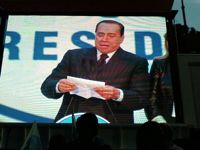
Prime Ministerial candidate Silvio Berlusconi addressing a rally in Rome. Credit: Sabina Zaccaro
Recent statistics by Istat, the national statistics agency, indicate that 6.1 percent of Italy’s population of working age (in a total population of 58 million) are unemployed, and that 2,282,000 workers – 13.2 percent of the work force – has temporary contracts. Some economists say the real numbers are higher, between 3.5 million and 10 million, depending on the kind of contract.
The average monthly salary of temporary workers is around 600 euros. Their contracts do not provide for holidays, health insurance or maternity leave.
Silvio Berlusconi, leader of the centre-right conservative movement People of Liberty, says people’s discontent will give his group victory.
When asked by IPS why he is confident of winning, Berlusconi told IPS that “Italians will be able to make a distinction between who has been able to govern and who didn’t.”
The centre-left government has left a terrible heritage, he said, “such as the zero-rate growth, the high cost of living for families, the incredible tax pressure, a growing criminality rate, and the tragedy of rubbish in Naples. Is that enough? There would be even more…”
According to polls, the highest number of sceptics are among the centre-left, disillusioned by the outgoing centre-left government led by Romano Prodi. Many who were his supporters had expected more decisive reform of the labour system. Prodi’s government was “more engaged with cutting public deficit than with social and labour reforms,” said a party faithful.
Prodi cut Italy’s budget deficit – once the highest in the 27-nation European Union – to below the European Union’s limit of 3 percent of gross domestic product. But improvement of public finances was achieved partly through an unpopular tax increase.
“It’s very easy to explain why I will vote for him,” said Sara Di Giovanni, 27, at Berlusconi’s final rally in Rome last Thursday. “If I had to choose someone to entrust with my savings – very few savings, considering all the taxes paid in these last two years – I would feel more confident with Silvio Berlusconi, politician and entrepreneur, who has showed a deeper respect for people’s money than the centre-left did.”
According to Di Giovanni, Prodi and his centre-left government “promised a growth that never came; they just reduced our salaries through an implausible tax burden.”
Centre-left groups seem to be aware of the centrality of the labour issue. Walter Veltroni, leader of the centre-left reformist Democratic Party and main opponent of Berlusconi as prime ministerial candidate, has proposed a set of protection measures for people with precarious jobs, and introduction of a minimum wage of 1,000 euros.
Veltroni says resolution of labour issues is the joint responsibility of entrepreneurs and the working class. For that reason, he picked both representatives of worker movements and renowned entrepreneurs as candidates.
Smaller parties of the extreme left, former partners in Prodi’s coalition, and now merged into the Rainbow Left, also inevitably see social issues and labour policy as key factors for the country’s future.
Rosa Rinaldi, under secretary for the Labour Ministry in Prodi’s government, now running as Senate candidate for the Rainbow Left, told IPS that jobs are at the heart of her group’s policy.
“We propose reform of the current law regulating labour, in order to safeguard precarious workers, something we didn’t manage to complete during Prodi’s government,” she said.
Rinaldi said her group proposes a social income for “all the precarious young registered at the employment office, to help them cover the vacant period between one job and another.”
Some 47 million Italians are on the lists for the 61,225 voting stations across the country, open from 8am to 10pm Sunday, and from 7am to 3pm Monday, Apr. 14.
Voters are electing a new upper and lower house of the national parliament by selecting from lists headed by 32 candidates for prime minister, of whom only Berlusconi and Veltroni have a realistic chance of winning.
The latest opinion poll, conducted before a two-week blackout on election opinion surveys took effect, gave the centre-right group headed by Silvio Berlusconi a 7 to 9 percentage point advantage over Walter Veltroni’s Democratic Party.
In all 47.3 million are eligible to vote for the lower house, or Chamber of Deputies, which has 630 seats, and 43.2 million can vote for the Senate, the upper house, which has 315 elected members and seven honorary lifetime members. The minimum voting age is 18 for the first and 25 for the second.
A further 2.9 million Italians living abroad were eligible to elect 12 members of the lower house, and 2.5 million to elect members to fill six Senate seats. Close to 42 percent of them cast their votes last week.
 Print
|
Print
|




