
Saturday, October 10, 2026



News and Views from the Global South
Q&A: 'India Is Not Competing With Any Country in Africa'
Interview with Anand Sharma, India's minister of state for external affairs
- As a senior politician associated with the movement against apartheid, it was natural for India’s minister of state for external affairs Anand Sharma to play a key role in the Apr. 7-9 India-Africa Forum Summit.
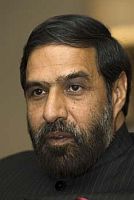
Anand Sharma, India's Minister of State for External Affairs Credit: Paranjoy Guha Thakurta/IPS
IPS: It is being said that the 2006 Beijing summit of African leaders was bigger than this one and that India is competing with China to engage with the countries of Africa.
Anand Sharma: Those who make such an unfair comparison are ignorant about the deep, time-tested ties between Africa and India. (Mohandas Karamchand) Gandhi, the father of the Indian nation, became politically aware while in South Africa. India’s first prime minister (Jawaharlal) Nehru had, as early as 1946, talked about the need for India to help anti-colonial movements in Africa and take up the issue of racial discrimination. Right through the 1950s and the 1960s, India supported the emergence of new nation-states in Africa. Gandhi and Nehru did not think of competing with anyone. India went to the United Nations on the issue of apartheid in South Africa. India has not suddenly learnt about the economic potential of Africa. Even during the mid-1960s when India was confronted with monumental challenges of development, when we were short of food, when we were much poorer, we started the ITEC (Indian Technical and Economic Cooperation) programme for countries in sub-Saharan Africa. All we had to offer were our skills and development experiences. Since then, tens of thousands of African students have come to India to study and be trained.
We do not have to embark on a new journey to discover Africa. The peoples of Africa are aware that what India has to offer is not the same as what others have to offer. We believe in capacity building and developing Africa’s human resources. Prime Minister Manmohan Singh has announced the establishment of an India-Africa Volunteer Corps to focus on improvements in health care, informal education and empowerment of women. In the case of natural resources, we believe our collaborations must be mutually beneficial.
IPS: What, according to you, are the unique features of this summit?
AS: First and foremost, those who were invited to represent their countries or their regional economic groupings were not pre-selected by us but by the Africa Union (AU). It was the AU that worked out the structure and the format. The idea of this summit was first mooted in 2006 and it crystallised during the December 2006 visit of Prof. Alpha Konare, chairman of the AU Commission.
AU ensured that all regions of Africa are represented. The five founding countries of NEPAD (or the New Partnership for Africa’s Development) – South Africa, Nigeria, Senegal, Algeria and Egypt – were represented together with Ethiopia, whose representative currently chairs the NEPAD Implementation Committee. We also have representation from eight Regional Economic Communities.
The meeting of foreign ministers discussed in detail the Framework of Cooperation and the Delhi Declaration. In Africa and in India, we are of the considered view that this summit will impart a new dimension and momentum to the partnership that is already there and evolving between Africa and India in the true spirit of South-South cooperation.
IPS: Could you spell out the concrete achievements of this summit, the specific gains that have been made?
AS: An important focus was building the capacity and the skills of people. This, in turn, has been linked to agriculture and food security, in particular, to crop diversification, water management and building institutions for agricultural research.
Next is economic cooperation. Two-way trade between India and Africa exceeds 30 billion US dollars a year at present. Trade has increased six-fold in the last five years and the potential to grow further is enormous. Trade will get an additional fillip with Tuesday’s announcement by India’s Prime Minister that India will now have a duty-free tariff preference scheme for exports from 50 least developed countries, 34 of which are in Africa.
A lot of emphasis is being placed on education and information and communications technology. The Pan-African E-Network Project is being fully rolled out. All the dignitaries present have acknowledged with deep appreciation this contribution that India has made for Africa’s development. The project is fully funded by India and is our gift to the people of Africa. The project has a dedicated satellite. It will connect the whole of Sub-Saharan Africa and help bridge the digital divide.
For us, this is a truly revolutionary initiative. The network will link the major universities of Africa and India and also connect major hospitals identified in different regions of Africa with super-specialty hospitals in India. Work on the project has made considerable progress and many universities and super-specialty hospitals in India and Africa are already linked.
IPS: Uganda’s President Yoweri Kaguta Museveni said during the summit that one of the mistakes that many African countries committed was paying inadequate attention to the development of private enterprises. What is the role the Indian private sector can play in Africa?
AS: It is important to note that privately-owned Indian companies have been following ethical and correct business practices in their African operations. Investments made by private Indian firms in Africa, be these in the areas of information technology, pharmaceuticals or agriculture, have enabled young men and women in the countries of operation. Local people have been trained in India as well in their own countries, their incomes have gone up, infrastructure has been improved. I believe that in every project, four-fifths or more of the persons employed and engaged as well as the managerial staff are of local origin.
IPS: On global issues, in what way can India and Africa collaborate?
A: India and Africa are in agreement that multilateral organisations are in urgent need of reform. One is referring not only to the United Nations but also the Bretton Woods institutions like the World Bank and the IMF. India and Africa agree in principle that the membership of the U.N. Security Council should be expanded, both in terms of permanent and non-permanent members.
We are in agreement on climate change, particularly on the principle of common but differentiated responsibilities so that the process of development of developing countries is not interrupted and there is transfer of resources and clean technology. India and Africa also have common positions on agriculture in the Doha development round of the WTO. The interests of Asia, Africa and Latin America converge on agriculture, particularly with respect to trade-distorting subsidies.
 Print
|
Print
|



Pictures for this story
This story includes downloadable print-quality images -- Copyright IPS, to be used exclusively with this story.


