
Thursday, October 1, 2026



News and Views from the Global South
CHINA: Quake Highlights Urban Privilege
Antoaneta Bezlova
- 1970 – The height of the Cultural Revolution. A severe quake ripples through rural China’s Yunnan province in the south. The response from the communist leadership in far away Beijing arrives swiftly – tens of thousands of little Red Books with quotations from chairman Mao Zedong and as many badges with his image. The rescue efforts are complete with thousands of letters of sympathy from the capital.
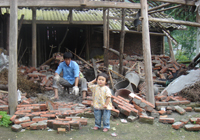
Picking up the pieces after the quake in Bailu town, Sichuan Province. Credit: Antoaneta Bezlova/IPS
China’s latest earthquake in Sichuan province – its most severe in more than 30 years, which has left nearly 90,000 people dead or missing and five million homeless – has thrown an unflattering light on the widening wealth gap between booming cities and less well-off rural areas particularly because the current leadership has vowed to redress that division. The most visible damage in the provincial capital of Chengdu was done to the obsolete and long abandoned building of the former Soviet Union consulate. By contrast, the small towns and villages outside of Chengdu were flattened.
"We have a saying here – nothing could destroy Chengdu – no heat or cold, nor quake or storm," says Zhang Jianhong, a bookseller in the city’s hip entertainment area Kuan Xiangzi. "We are the [provincial] capital after all," Zhang adds proudly.
Such confidence – shared by many in this Chinese city – is partly based on reality. Chengdu is located in the flat Sichuan basin and the earth layers beneath are very rigid and strong. When the May 12 quake struck, the temblor occurred on the border of Sichuan basin, destroying the villages and towns around Chengdu where the flat terrain gradually changes to mountains.
But Chengdu residents’ belief in their invincibility is also grounded in a sense of entitlement that – as urban dwellers – they are cared for better than their rural cousins. Since the early years of communist rule in China, the state undertook to provide for those living in the cities, often at the expense of the country’s vast peasantry.
In the tiny town of Bailu, a two-hour drive from the provincial capital, peasants say they often use coal cinders mixed with water instead of mortar when building their houses. Their earnings are just a fraction of the income of an average person in prosperous Chengdu.
Sun Jie, who lives on a mountain hill in Bailu, earns 400 RMB (59 dollars) a month picking and selling ‘huanglian’, or Chinese goldthread – a root used in Chinese traditional medicine for treating inflammations.
"It used to cost 75 yuan per kilo but now prices have fallen to 42 yuan and one can’t make much from it," Sun, 28, says. "One either has to work in the mines or trade medicinal plants – there is nothing else here. My mother has lived here all her life and doesn’t want to leave the land. I have to look after her. So we scrap by."
Bailu – a scenic cluster of houses hidden in the mountains – has seen its fortunes change many times. A French missionary fell in love with its beauty in 1908 and built a theological seminary on top of the hills overlooking the village. Locals these days call the white classical building and its chapel Bailu’s Notre Dame. Newlywed couples from Chengdu and beyond have driven here for romantic photo opportunities.
"My parents told me that when the French lived here many in the village worked for the seminary – cutting wood, cooking and tending the land," says Sun’s mother. "But these days are long gone and now even the seminary was destroyed by the earthquake. The government has closed many of the coalmines because it says they are illegal. So many people are leaving."
City and country people in Sichuan have different memories of past disasters as well. Several Chengdu people admitted having never heard from their parents that there was a famine during the Great Leap Forward in the late 1950s. "May be the food situation was tight but there was no famine. Not in the city," said Jia Youping, a legal worker.
But in small towns from Anren, southwest of Chengdu, to Bailu, in the northwest, many rural people said they grew up with the stories of terrible hunger and deprivation from the time of the famine. "Many people died," said Lao Wu in Anren, "Only the strongest and the luckiest survived."
Years of rapid economic growth have changed the fortunes of millions of Chinese people dramatically, but the overwhelming majority of the population is still rural and has gained far less than the wealthy urbanities. Some two- thirds of China’s 1.3 billion people still live outside major urban centres.
At 4,140 yuan (600 dollars) a person, rural income in China in 2007 was a third of what city people earned. Last year the Chinese parliament passed a landmark law enshrining the right of urban dwellers to purchase and own their properties. Peasants by contrast, continue to lease their plots of land from the state and have little recourse when local officials take it away for redevelopment.
The Chinese government has won praise for its speedy reaction to the disaster and its all-out mobilisation to provide shelter, food, water and prevent the outbreak of epidemics. But some say the effort is face-saving and stems from guilt over the different standards of building and safety enforced in Chinese cities and villages. The discrepancy has made rural residents more vulnerable to disasters.
"It is always like that. When a disaster strikes, the ‘laobaixing’ [ordinary people] suffer but the Communist party takes credit," says Zeng Xiaodong, who works in a pharmaceutical factory in Pengzhou.
Pengzhou, some 60 kilometres west of Chengdu, has absorbed many of the polluting industries that the provincial capital expelled under the central government’s directives for environmentally friendly development of major cities. But even as those factories looked to hire their workforce among the local peasants, the accommodations they provided were often shoddy and hastily built.
In perhaps the strongest indictment of China’s gulf between town and country, some 7,000 schoolrooms collapsed after the earthquake burying 10,000 children and teachers. Bereaved parents insist the schools collapsed because they were shoddily built by corrupt officials.
As they pick up among the rubble, local people worry about how the government’s plans for post-disaster reconstruction will affect their lives. Because they were treated differently from city people before the disaster struck, peasants in Sichuan worry that they will be underprivileged again.
Beijing has allocated 70 billion yuan (10 billion dollars) for the rebuilding of the quake-hit regions and Premier Wen Jiabao has promised that more than half will be spent on the reconstruction and repair of farmers’ homes.
But the urban-rural division is visible even in the new building plans. In the tourist city of Dujiangyan – home to a U.N. Educational, Scientific and Cultural Organisation (UNESCO) world heritage site and many cultural attractions – local households who lost their homes in the disaster were given a choice between a subsidy of 140,000 RMB or property rights to a 70 square metres of new housing when construction is completed in three years. But in Bailu peasants were offered just 5 square metres per person if they agreed to resettle in government-designated housing. "We don’t want to go because our place together with the land is around 200 square metres," says young mother Lu Mei, "But we have little choice because the land belongs to the government."
 Print
|
Print
|



Pictures for this story
This story includes downloadable print-quality images -- Copyright IPS, to be used exclusively with this story.


