
Thursday, October 1, 2026



News and Views from the Global South
MALAYSIA: Proposal to Liberalise Campuses Weak – Students
Baradan Kuppusamy
- For nearly four decades undergraduates in this country were banned from owning loud hailers – a powerful symbol of dissent in the 1970s.
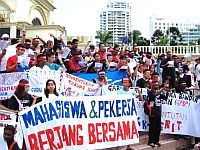
Students defy repressive laws to express solidarity with workers. Credit: Baradan Kuppusamy/IPS
For one thing the campuses have grown in number from just three in 1970 – when the restrictive laws were passed – to over 300 public and private institutions, hosting an undergraduate population running into hundreds of thousands.
And, for another, government policy aimed at turning Malaysia into an international education hub has attracted students from many developing countries, giving the campuses a multi-cultural character that grates against the old, draconian laws.
Students are now forming groups and non-government organisations (NGOs) that oppose a regime that compares poorly with the dynamic environment found in the campuses of neighbouring countries like Thailand, Indonesia and the Philippines.
It is seen that in today’s world of Internet and instant mobile communication a law that bans loud hailers is a major embarrassment. In early August, the government announced plans to amend the laws that will hopefully unshackle undergraduates and unleash a new force in a society emerging from long years of oppressive rule.
Students complain of an atmosphere of fear over campuses. "They are like a police department on campus and no one dares cross them," a third-year student leader said referring to the dreaded Students Affairs Division (SAD) and asking not to be named for fear of punitive action.
While political leaders and human rights activists are hopeful of major changes soon, undergraduates and student leaders remain skeptical, saying that promises made in the past withered away because of strong opposition from the political establishment.
Under the current proposal the University and University Colleges Act, 1971 or AUKU is to be amended to allow greater freedom of association and expression for university students.
As of now an undergraduate is banned from having dealings with any society, political party, trade union or organisations without advanced written approval from the vice-chancellor.
If the student contravenes these restrictions, it is considered an offence that is punishable, on conviction, by a fine or a prison term. The student is automatically suspended or dismissed from the university without any recourse for continuing his studies.
The proposed changes say that:
– undergraduates may join any organisation or NGO without prior permission;
– offences under the act are no longer criminal in nature;
– students detained or jail can continue studies from detention centres;
– vice-chancellor will not be a political appointee;
– faculty deans are to be selected after consultation with staff.
The amendments have been tabled in parliament and are due for debate before becoming law, if approved. Students and civil rights activists while welcoming the proposals say in the core area where freedom and student activism really counts, i.e. political participation, the government has refused to relax the tough conditions.
Undergraduates are banned from making political statements, joining political parties and involving themselves in political activities.
"They are allowing greater freedom but where it really counts – political freedom and expression – they are still fearful that undergraduates will become an anti-establishment force," said former student leader S. Arulchelvam, who is now secretary general of the Socialist Party of Malaysia.
"They fear undergraduates would form a formidable political movement that would challenge the status quo," he told IPS.
While each campus has its own student body, usually docile and apolitical, the Malaysia Youth and Students Democratic Movement or DEMA, an independent student body that seeks to be an umbrella organisation for all undergraduates, has been vocal in championing student activism despite harassment and even arrests.
"Our stand is that the university law should be abolished and replaced with a new university act that protects undergraduate basic rights," said Ong Jing Cheng, DEMA’s secretary for international affairs.
"Undergraduates should be consulted during the drafting process," he told IPS. "The university law has been used to curb student activism ever since it was enacted in 1971 to curb freedom of expression and freedom of association."
"We don’t want to be cheated by cosmetic changes of the law," Ong said. "All proposed changes must be fully made public so that everyone can give crucial feedback."
A former academic turn politician Koh Tsu Koon welcomed the proposed amendments to the university law, saying it was a giant step in the right direction and long overdue.
"However, the time has come for the authorities to allow students to participate in political activities," he told local newspapers, lending his prestige to promote student activism.
Former student activist-turned-opposition lawmaker Charles Santiago criticised the proposed changes as "cosmetic" and demanded that authorities repeal all laws that curb freedom of expression and assembly.
"Universities must promote independent thinking and to process and create new knowledge and clamping down on the student freedom will only defeat the purpose of setting up universities in the first place," he said in a statement.
"Dissent is an integral process of democracy and should not be curbed," he said. "It is common knowledge that political motivation is behind the creation of the University and University Colleges Act and aimed at suppressing the growth of a vigorous student movement.’’
 Print
|
Print
|



Pictures for this story
This story includes downloadable print-quality images -- Copyright IPS, to be used exclusively with this story.


