
Sunday, October 18, 2026



News and Views from the Global South
Survivors of Peru’s Armed Conflict Still Waiting
- Venisia Ávalos, a 65-year-old indigenous woman from Peru’s highlands region of Ayacucho, looks for her son’s name among a labyrinth formed by thousands of small grey stones.
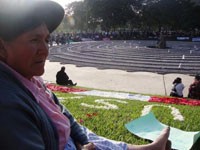
One of the mothers from Ayacucho at the “El Ojo que Llora” Memorial, demanding compensation for her lost loved one. Credit: Milagros Salazar/IPS
Each one of the fist-sized stones carries the name of a victim of the country’s armed conflict between government forces and left-wing guerrillas. “Here’s my son, here he is!” she cries, bursting into tears. Her son disappeared 30 years ago, and she never found his remains – not even a garment he was wearing that day, not a single trace. Just this small stone, today.
Ávalos came to Lima from Ayacucho in Peru’s south-central highlands to take part in the activities for the commemoration of the 10th anniversary of the presentation of the Truth and Reconciliation Commission (CVR) report. The CVR investigated the human rights crimes committed during the government’s 1980-2000 counterinsurgency war against the Sendero Luminoso (Shining Path) and Tupac Amaru Revolutionary Movement (MRTA) guerrillas.
The CVR estimated that 69,000 civilians – mainly Quechua-speaking indigenous people – were killed by the guerrillas or the state security forces. The Commission held the Maoist Shining Path responsible for just over half of the killings.
Ávalos is not alone here. Dozens of mothers and other relatives of victims from the regions hardest hit by the violence reached the capital on Wednesday Aug 28 to continue to press for two chief demands: comprehensive – in other words, not just monetary – reparations and a thorough search for the remains of the victims of forced disappearance.
These two aspects are enormous debts that the state has so far failed to address in a satisfactory manner, according to a resolution recently published by the Defensoría del Pueblo, or ombudsman’s office. As of March, the government had paid individual reparations to just 37 percent of the 78,000 people registered to receive compensation, while only 33 percent of the collective or community reparations had been paid, according to official figures.
In the search for the victims of forced disappearance, the work has moved even more slowly. As of April, 2,418 bodies had been recovered from clandestine burial sites, 1,371 of which had been identified and returned to the families.
“Given that not much over 2,000 bodies have been recovered in 10 years, at this pace it would take around 80 years in the best of cases to recover the 16,000 victims that the state estimates are in the burial sites – which is an underestimate,” states the book “Los muertos de Ayacucho” (Ayacucho’s Dead), by the non-governmental Human Rights Commission (COMISEDH).
Ayacucho, one of the poorest and most remote, rural and heavily indigenous parts of the country, accounted for a full 47 percent of the 69,000 victims. One of the places where the families searching for missing loved ones gathered Wednesday was the “El Ojo que Llora” (The Crying Eye) Memorial, where Ávalos found the stone bearing the name of her son, Rigoberto Huamaní Ávalos.
The memorial has a labyrinth of thousands of smooth stones, each bearing the name, age and year of death of a victim. In the middle of the labyrinth is a sculpture, with a small stone in the form of an eye at the centre, which continuously trickles water, reflecting the grief of the families who want to find out what happened to their loved ones.
“Classmates of my son are now teachers, which he could have been too,” Ávalos told IPS. “They have families, and my son could have had one too.”
Rigoberto was her firstborn. In 1983, the security forces hauled him away from his school along with his teacher and several classmates, says Ávalos, who is furious at what she sees as the pittance she was given in compensation: 10,000 soles (3,600 dollars).
“That’s what my son is worth?” asks the grieving mother, who is a member of the National Association of Families of the Kidnapped, Detained and Disappeared of Peru (ANFASEP), founded 30 years ago in Ayacucho. The CVR was created in response to demands of the women grouped in ANFASEP. The families are calling for the government to pay higher individual reparations, of 39,000 soles (13,900 dollars) per victim, instead of 10,000.
Isabel Coral, who was executive secretary of the government’s High-Level Multisectoral Commission (CMAN), told IPS that the higher amount was based on an agreement reached directly with Peruvian President Ollanta Humala, who took office in July 2011.
“I explained to Humala that the violence had been so atrocious for these people, who had been deprived of all possible strategies for getting back on their feet and moving ahead on their own, that integral, effective reparations were urgently needed,” she said.
Coral said she had agreed to draft the chapter on compensation in Humala’s government programme in exchange for his compliance with higher payments to the survivors if he was elected. But today “there is no political will,” she complained, saying the government had not stuck to its promises and had instead been paying out small amounts of money “in trickles”.
In the massacre of Lucanamarca, in Ayacucho, Ervenciana Huancahuari lost her mother, her husband, and a sister. Some of her other sisters lost their husbands too. She is 64 years old, and has only received 5,000 soles. In accordance with the law on reparations, she will receive the other half of the money when she turns 65.
The money received by Huancahuari has already been distributed among her five children. But the 1,000 soles (357 dollars) that each received is long gone. And she didn’t keep any for herself. “My (dead) mother was a cow? Was she a bull, for us to be paid 5,000 soles?” she asks IPS.
 Print
|
Print
|




