
Wednesday, October 21, 2026



News and Views from the Global South
Civilian Casualties Grow Amid Russian and Ukrainian Drone Strikes
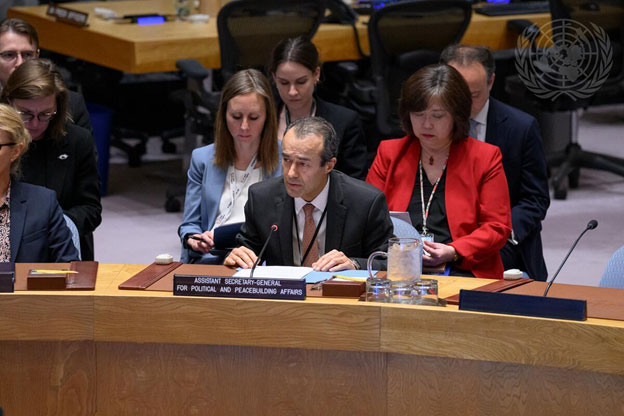
Khaled Khiari, UN Assistant Secretary-General for Middle East, Europe, the Americas, Asia and the Pacific, Department of Political and Peacebuilding Affairs and Peace Operations, addresses the Security Council meeting on maintenance of peace and security of Ukraine. Credit: UN Photo/Loey Felipe
- Four years after the start of the Russo-Ukrainian War, 2026 has marked a significant escalation in hostilities, with intensified bombardments from both sides causing immense destruction across the region, complicating humanitarian operations, and deepening an already severe humanitarian crisis. As exchanges of attacks have intensified in recent days, the United Nations (UN) warns that women and girls will be disproportionately impacted as violence disrupts access to basic, lifesaving services.
Last week on May 13, Russian forces launched a massive barrage of approximately 800 drones, targeting western regions of Ukraine, including areas that surround the Hungarian border. Local authorities informed the UN’s country office in Ukraine that the attacks resulted in multiple civilian casualties and extensive damage to critical infrastructure, including energy facilities and railway hubs. Significant destruction was reported in the Rivne, Volyn, and Ivano-Frankivsk regions, where several sites came under fire.
This attack triggered what UN Ukraine described as “one of the most intense and prolonged attacks of the war to date,” with continuous hostilities from Russian forces reported across the country for nearly 24 hours. Violence intensified the following day in Kyiv, where drone and missile strikes targeted major residential neighborhoods and key civilian infrastructure.
Ukrainian authorities reported that at least 140 Ukrainians were killed, including six children, with figures expected to rise as rescue operations continue. Officials also stated that a high-rise residential building in Kyiv’s Darnytskyi district sustained significant damage following a direct strike, leaving numerous residents trapped beneath the rubble.
Approximately 24 civilians were killed and 48 others were injured in the strike, including three children who were found dead. UN Ukraine reported that emergency teams carried out search-and-rescue operations and extinguished fires despite immense risks, as strikes continued to land. That same day, the Office for the Coordination of Humanitarian Affairs (OCHA) reported that a “clearly marked” UN vehicle was struck twice in Kherson City while delivering aid to vulnerable communities.
“Families should always feel safe,” said Bernadette Castel-Hollingsworth, the Office of the United Nations High Commissioner of Refugees’ (UNHCR) Representative in Ukraine. “Mothers should not be waiting to know if their children are alive under the rubble after these missile attacks,” she continued, stressing that attacks that target civilians are a violation of humanitarian law.
According to the UN Human Rights Monitoring Mission in Ukraine (HRMMU) , civilian casualties in Ukraine over the first four months of 2026 were higher than any four-month period recorded in any of the last three years. The Mission found that this is primarily due to a massive rise in the use of long-range weapons, which carry a far greater capacity for destruction and civilian harm, especially when used in densely populated urban areas.
HRMMU found that in April of this year, at least 84 civilians were killed and 628 others were injured as a direct result of long-range weapons use, accounting for approximately 43 percent of the total civilian casualties recorded during that period.
“I deplore the resumption of these large-scale attacks which have resulted in civilian casualties across the country,” said the UN High Commissioner for Human Rights Volker Türk on May 14. “Attacks by long-range weapons are one of the leading causes of civilian casualties in Ukraine. Their expanded use in populated areas will only increase the already mounting toll on civilians,” Turk added, urging for an immediate de-escalation of hostilities.
Ukrainian women and girls have been severely and disproportionately impacted by the war, with the first three months of 2026 marking the deadliest winter for women and girls since the full-scale Russian invasion in 2022. According to figures from UN Women, approximately 199 women and girls were killed between January and March of this year. This follows a 27 percent increase in casualties among women between 2025 and 2024.
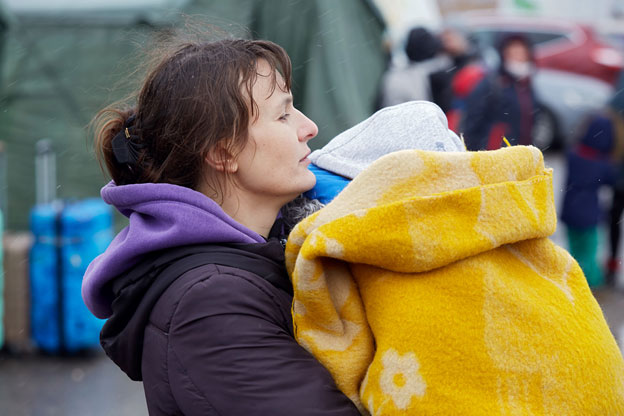
More than four years into the Russian invasion, women and girls in Ukraine are facing immense stress under the threats of war and subsequent attacks on energy infrastructure. Credit: UN Women/Aurel Obreja
During a press briefing at the Palais des Nations in Geneva on May 12, UN Women’s Representative in Ukraine Sabine Friezer Gunes informed reporters that attacks on energy infrastructure have devastated mental and physical wellbeing for women across Ukraine, particularly those in caregiving roles. Gunes noted that many of these women are struggling to manage increasing household responsibilities, growing financial pressures, and shrinking access to essential resources, such as reliable electricity.
“Women are significantly more likely than men to report having no backup energy supply during disruptions – 73 per cent of women say that they have no alternative energy sources,” said Gunes. “Nearly eight in ten women’s organisations in Ukraine told UN Women that funding reductions are seriously affecting their work, including some organisations reporting having to reduce the number of women and girls supported by their services. Official donor assistance to support women has reduced, and inequalities in Ukraine are increasing.”
Over the weekend, on May 17, Ukraine launched one of its largest long-range drone offensives against Russia in over a year, mainly targeting Moscow. This attack, described by reporters as retaliation for the missile and drone strikes in Kyiv, killed at least three people and injured 12 others, while local authorities reported damage to several unspecified infrastructure and numerous high-rise buildings.
“Our responses to Russia’s prolongation of the war and attacks on our cities and communities are entirely justified,” said Ukrainian President Volodymyr Zelenskyy in a statement shared to X (formerly Twitter). “This time, Ukrainian long-distance sanctions have reached the Moscow region, and we are clearly telling the Russians: their state must end its war.”
Nigel Gould Davies, a senior fellow for Russia and Eurasia at the International Institute for Strategic Studies, warned that Ukraine’s retaliatory strikes against Russia will only work to exacerbate regional tensions going forward.
“There is no ongoing peace process to disrupt. What (the attack) is more likely to do is add to the darkening cloud of anxiety over Russia, which has developed palpably over the last three or four months,” said Davies. “The fact that Ukraine is reminding the Moscow population that it is vulnerable to these attacks is likely to intensify the mix of concerns now. I see no prospect, though, in the shorter term, that even these factors together will induce Russia to consider the compromises that will be necessary for peace negotiations.”
IPS UN Bureau Report


 Print
|
Print
|




