
Tuesday, October 13, 2026



News and Views from the Global South
Opinion
Iran War Deepens Activist Dangers
Credit: Rizwan Tabassum/AFP
- Narges Mohammadi, awarded the Nobel Peace Prize for her human rights activism in Iran, has been allowed to go home. After guards found her unconscious in her cell, the apparent victim of a heart attack, she was granted temporary release from prison and transferred to a hospital. However, she still faces the threat of being taken back to jail once her condition has improved.
Mohammadi has been repeatedly imprisoned for criticising the theocratic regime, demanding women’s rights, advocating for prison reform and campaigning against the death penalty. Over her lifetime she’s been sentenced to a total of 44 years. She’s already spent more than a decade behind bars, including 161 days in solitary confinement, and has also been sentenced to 154 lashes. In February she was handed a further seven-and-a-half-year sentence. From prison – where she experienced cardiac and blood pressure problems and severe weight loss – she has documented systematic rights violations against political prisoners, including sexual and physical abuse of women detainees, torture and extensive use of solitary confinement.
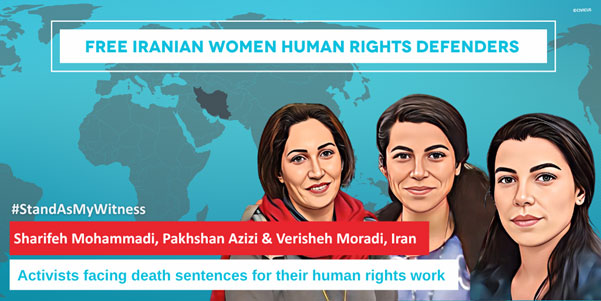
Mohammadi’s case is one among many. While her ordeal has rightly drawn international attention, others more distant from the spotlight are in danger. Three more women human rights activists – Pakhshan Azizi, Sharifeh Mohammadi and Varisheh Moradi – are on death row at imminent risk of execution. The dangers they and countless others face have grown sharply since the current war began.
Repression tightens
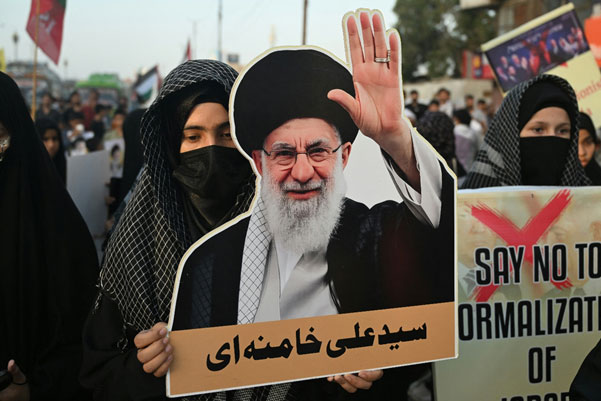
Israeli Prime Minister Benjamin Netanyahu has made clear he wants regime change in Iran. On 1 March, an Israeli strike killed Supreme Leader Ali Khamenei. But if the intention was to topple the regime, it didn’t happen. Iran’s ruling theocratic structures run deep, with multiple layers of planned succession. Khamenei’s son Mojtaba Khamenei, injured in the same attack, was quickly named his replacement, despite Iran’s official ideology formally rejecting hereditary succession.
While clerical leaders have been killed, Iran’s coercive apparatus has gained in its day-to-day power, hardening the theocracy into something closer to a military dictatorship, with the Basij, the paramilitary volunteer force long deployed to crush public dissent, now front and centre.
Israeli and US hopes that Iranians would rise up against the regime have been disappointed. Iran has seen successive mass protest waves, each crushed with large-scale lethal violence. They include the Green Movement that demanded democracy in 2009 and 2010 and the Woman, Life, Freedom protests that demanded women’s rights in 2022 and 2023. The latest uprising came in December 2025 and January 2026, triggered by economic collapse, forging a movement that united broad sections of society to demand an end to the theocratic regime. The state suppressed it with shocking brutality, killing thousands and detaining tens of thousands.
By February, the uprising had been crushed. The Israeli-US intervention was unlikely to reignite a meaningful mass protest movement. If anything, for some Iranians the war has stoked patriotism and more intense enmity towards Israel and the USA. The anticipated revolt simply hasn’t happened.
Much of Iran’s vast diaspora has rallied in support of the war as a means of toppling the regime. But while the diaspora is united in demanding change, its array of ethnic minority organisations, Islamist factions, leftists, monarchists and republicans is bitterly divided over what should come next. Reza Pahlavi, son of the last shah, enjoys some support but others are wary about monarchical nostalgia and his close ties to Israel and the USA. The most credible potential unifying figures inside Iran are imprisoned or otherwise silenced.
Instead of losing control, the regime has tightened its repression. Even as Iran’s leaders wage a social media propaganda war abroad, at home they’ve imposed a near-total internet shutdown, including a block on VPN services. The blackout has caused immense economic harm, disrupting businesses and financial transactions and hitting women the hardest. This comes on top of the economic effects of the current US blockade of Iranian ports, sending inflation and unemployment soaring.
Under the cover of war and the internet shutdown, the government has accelerated executions of political prisoners. While precise figures are hard to get, rights groups report close to 200 executions so far this year, most preceded by prolonged torture to extract false confessions. Secret hangings are reportedly being carried out on an almost daily basis. Among those killed are people detained during the January protests. On 4 May, it was reported that three people arrested at protests on 8 and 9 January – Ebrahim Dolatabadinejad, Mohammadreza Miri and Mehdi Rasouli – had been hanged. For families, the suffering doesn’t end there, as authorities reportedly refuse to return bodies and pressure relatives to stay silent.
Local priorities
Democracy and human rights in Iran depend on the regime’s departure. But the latest war isn’t about any of this. For Netanyahu, with an election impending and anger remaining at his corruption charges and Israel’s security failures around the 7 October Hamas attacks, permanent warfare is a political strategy. Donald Trump’s many social media announcements provide little clue of what motivates a president who promised not to mire the USA in foreign wars, but distraction from low popularity ratings and his many appearances in the Epstein files may be a factor.
This war isn’t the way to achieve change. The regime appears entrenched and capable of surviving a longer conflict. Any peace deal would leave it intact, which its rulers would treat as a victory.
Real change will come when protests can grow into a mass movement large enough to withstand the lethal repression the state will inevitably deploy. That can only happen with sustained support that respects the autonomy of local civil society leaders and strengthens their capacity. The immediate priorities must be to protect credible local sources of information amid the information blackout and ensure the safety and security of Iran’s democracy and human rights activists.
Above all, states must press the Iranian government to halt executions and release everyone detained for speaking out, protesting and demanding change, beginning with Narges Mohammadi. Temporary medical release is nowhere near enough. The Iranian regime must let her be free.
Andrew Firmin is CIVICUS Editor-in-Chief, co-director and writer for CIVICUS Lens and co-author of the State of Civil Society Report.
For interviews or more information, please contact research@civicus.org


 Print
|
Print
|




