
Monday, October 19, 2026



News and Views from the Global South
Opinion
U.S. Midwest Flooding Is a Growing Threat to Agriculture
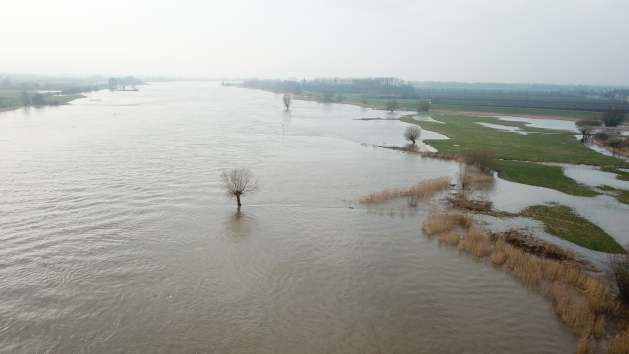
The consequences of flooding extend far beyond damaged roads and infrastructure. They reach America’s farmlands, the soul of America’s food supply. Credit: Shutterstock
- Across the U.S. Midwest, from Illinois to Indiana to Ohio, severe storms and heavy rains caused devastating flooding, extensive damage to infrastructure, and the displacement of hundreds of thousands of people. The historic scale and severity of flooding led to the issuance of disaster proclamations for the States of Illinois and Indiana.
Often underestimated and overlooked are the devastating and economically costly consequences of flooding for agriculture, crop production, agroecosystems, and, most importantly, America’s Midwest region’s critical infrastructure: its farmlands which lead the nation in the production of major crops, including corn and soybeans, collectively contributing to the United States agriculture sector that is valued at $1.5 trillion.
Five reasons stand out as to why policymakers must pay attention to intensifying flooding events in the Midwest and their consequences for Midwestern agriculture.
First, the U.S. Midwest region is central and backbone of the American Nation’s food and energy systems. In 2024, Illinois, Iowa, and Minnesota alone produced more than half of the nation’s corn and soybeans. Furthermore, the importance of Midwest grown crops like corn extends beyond food and livestock feed. Data evidence shows that over 40% of U.S. grown corn has been used for ethanol production. When flooding disrupts Midwestern agriculture, the consequenses can reach beyond our food system and into America’s energy systems.
Second, flooding not only threatens crop production, but it also negatively impacts soil, soil functions, quality and countless number soil dwelling species including earthworms, and beneficial soil microbes, which are foundational ingredients to resilient agricultural production and functioning agroecosystems. These consequenses can persist long after flooding waters have receded, potentially affecting crop growth and productivity in subsequent seasons.
Third, flooding imposes costs on the insurance industry and other stakeholders supporting Midwest agriculture. From 1989 to 2020, excess moisture was the fastest-growing cause of loss reported to the USDA Risk Management Agency, increasing in 97 percent of the counties reporting, while total inflation-adjusted crop insurance indemnities rose 374 percent.
Of the $21.94 billion in crop and rangeland losses in 2023, nearly $10 billion was not covered by RMA programs, and excessive precipitation, flooding, and hurricanes accounted for $3.99 billion of the total. These costs also affect the businesses that transport crops: when flooding disrupts roads, rails, and rivers serving local grain elevators, those elevators pay farmers about 24 cents less per bushel for corn and 32 cents less per bushel for soybeans.
Fourth, our models are most confident that spring precipitation will increase by ~25-50% by the late century. However, single-day extreme precipitation events and excess summer precipitation are less predictable; one such event was the recent flash flooding across the Midwestern corridor this August.
This is especially concerning given that crops are in the reproductive stage and close to harvest, when farmers have already incurred the costs of this season’s crops and crops may have been affected by wet soil earlier in the season.
Waterlogging at reproductive stages has been estimated globally to reduce yields by 41.9 percent, compared with 34.8 percent at vegetative stages. Fields already stressed by wet soils earlier in the season may be damaged by both events. The loss in crop yields could be catastrophic for an already vulnerable sector.
Fifth, current policies are not keeping pace with the changing timing of flooding events. Although the United States Department of Agriculture has put in place several Federal programs to assist farmers, including prevented planting coverage, disaster and conservation assistance, and crop insurance, and continues to update these programs, many of these work best for flooding that happens early in the growing season rather than for flooding that devastates established crops later in the growing season.
The recent flooding events occurred in August, when crops including corn and soybeans are well established, and there is an urgent need for policymakers to reassess existing policies to ensure that farmers are shielded from production losses, income disruptions, and other economic costs that arise when flooding occurs late in the season.
American policymakers cannot afford to overlook or underestimate the extensive, devastating impacts of flooding on agriculture and the stakeholders who support the agricultural sector.
The consequences of flooding extend far beyond damaged roads and infrastructure. They reach America’s farmlands, the soul of America’s food supply, a sector already affected by rising fuel costs and fertilizer shortages, and may be compounded by supply-chain disruptions caused by flooding, as in 2019.
Policymakers must seize the opportunity to re-examine whether existing policies and recent investments, including the $700 million pilot program to support regenerative agriculture practices, can help the Midwest region and its farmlands meet the challenges brought about by increasing flooding and other severe weather events. Where policies fall short, policy makers must create new ones. Time is of essence.
Esther Ngumbi, PhD, is an Associate Professor in the Department of Entomology at the University of Illinois Urbana Champaign.
Christy Gibson, PhD, is an Illinois Distinguished Postdoctoral Scholar in the Department of Crop Sciences at the University of Illinois Urbana-Champaign, where she studies how floods and droughts reshape farming systems and the ecosystems that sustain them
 Print
|
Print
|




