
Friday, November 20, 2026



News and Views from the Global South
Escalating Violence, Displacement, and Access Constraints Mount for Yemen’s Children
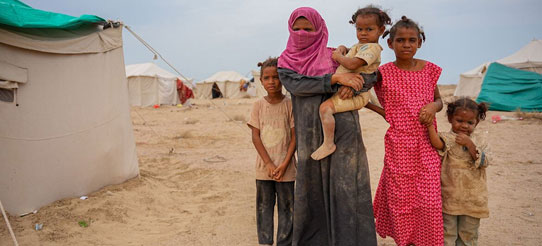
Al-Firdaws camp in Yemen's Aden Governate is hosting families displaced by the recent intensification of fighting. Credit: UNICEF/Mahmoud Alfilastini
- Over the past two months, the humanitarian situation in Yemen has deteriorated significantly following the eruption of hostilities between Houthi forces and the Yemeni troops backed by the Saudi-led coalition on September 3. Marked by persistent attacks on key infrastructure and densely populated areas—particularly in Taiz and Lahj—civilians continue to struggle amid heightened insecurity and mass displacement, with children bearing the brunt of the crisis.
On November 18, the United Nations Children’s Fund (UNICEF) reported that at least 64 children have been killed and 64 others injured since September 3, warning that casualties are projected to soar as fighting escalates in Taiz and Lahj.
At least 7 schools and 28 health facilities, including five supported by UNICEF, have sustained damage since the wake of hostilities. On November 2, an attack on the UNICEF-supported Al-Suqyah Health Center in Lahj—which serves roughly 1,700 civilians—killed five people, including three health personnel.
Ongoing disruptions to essential services and accelerating displacement have prompted UN experts to call for an immediate end to hostilities, unimpeded humanitarian access, and compliance with international humanitarian law. During a press briefing at the UN Headquarters on November 19, Farhan Haq, Deputy Spokesperson for the Secretary-General, told reporters that conditions are “getting worse by the day.”
“The rising number of children killed and injured in Yemen is devastating. It must stop,” said UNICEF Executive Director Catherine Russell. “Behind every number is a child whose life has been cut short or changed forever…Children must be protected, including their access to essential services such as healthcare, education, safe water, and food.”
Figures from the International Organization for Migration (IOM) show that roughly 350,000 individuals have been uprooted from their homes between June 7 and November 16, with UNICEF reporting that this includes approximately 174,000 children. More than 18,000 of those civilians were forced to flee in the last week alone, according to Haq, with nearly two-thirds coming from Taiz.
Many families have been displaced multiple times, often residing in host communities whose resources are already severely strained. The majority of these families currently reside in damaged buildings that serve as makeshift shelters, where they face limited access to food, water, healthcare, and protection services.
UNICEF has expressed particular concern over the humanitarian situation in Taiz City, underscoring persistent access constraints. The main road for humanitarian aid deliveries from Aden is closed, and alternative routes remain unreliable, depriving more than 800,000 civilians of basic services.
Water production has been slashed by nearly 50 percent, while food and fuel prices have nearly doubled. Continued shortages of electricity, fuel, medicines, and oxygen jeopardize lifesaving emergency healthcare interventions, including maternal and newborn care.
Across the most severely impacted regions, UNICEF has recorded over 1,160 school closures or disruptions to learning, affecting more than 500,000 students. Since the escalation, UNICEF and its partners have found that approximately one-third of all children recently screened showed signs of acute malnutrition.
Widespread hunger—compounded by overcrowded and unsanitary displacement shelters, a shortage of latrines, and limited access to safe water- has significantly raised the risk of disease.
Earlier this month, UN Under-Secretary-General for Humanitarian Affairs and Emergency Relief Coordinator Tom Fletcher informed reporters that he is coordinating with Yemen’s Foreign Minister, Dr. Afrah Abdulaziz Al-Zouba, to restore humanitarian aid access. As of November 2, the UN and its partners had reached nearly 260,000 displaced civilians in Yemen with lifesaving support, though the vast scale of needs continues to outpace available resources.
“We have food and medicine ready to move,” said Fletcher. “Our asks are clear. Open the roads and let them through. Civilians cannot be held hostage by the fighting.”
In response, UNICEF has announced plans to expand its emergency response efforts to reach up to 560,000 people, positioning mobile health and nutrition teams at displacement sites and in vulnerable communities across Aden, Lahj, Taiz, Marib, and Abyan. UNICEF and its partners will also mobilize support for water and sanitation, as well as psychosocial care and case management for children, particularly those who were separated from their families.
IPS UN Bureau Report



 Print
|




