Sunday, August 30, 2026



News and Views from the Global South

Healthy Recovery Arrives on Horseback
- Tierramérica visited a ranch in the outskirts of the Uruguayan capital where people who suffer emotional problems, addiction, autism or Down syndrome benefit from therapeutic horseback riding.
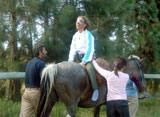
Dr. Nieves guides an equine therapy patient -
The interaction with the large animal acts as a source of multiple simulation for Matilde. Guiding her is an expert in psychomotricity, one of the seven children of Nieves and his wife, educator Ana María Reyes. This calm human-equine experience takes place at a rented ranch, just 30 minutes by car from bustling downtown Montevideo.
Therapeutic riding “is based on taking advantage of the horse's natural qualities to work towards integral rehabilitation of the individual, who is a psycho-social carrier of one or multiple disabilities, to harmonically integrate health, education and equitation,” states a brochure written by the late Carlos Barboza, a doctor and co-founder with Nieves of the venture through the non-governmental National Assocation of Equestrian Rehabilitation (ANRE).
“There are very few pathologies that do not benefit from play with the horse. The relationship with this animal creates links with the multidisciplinary team, acts as a multiple stimulator, in motor and three-dimensional and repetitive movements,” Barboza wrote.
Nieves explained to Tierramérica the progress achieved with equine therapy in people with a broad range of physical, psychological or social pathologies, as he receives his first patients on a Sunday morning, bathed in the austral autumn sun.
The horseback ride can last an hour, and even includes incursions into the neighboring organic vegetable farm. The time spent with the horse also involves other contact, such as brushing the animal and preparing the bridle and saddle.
“We work with three basic themes: education, health and social emergence,” Nieves explains, while his wife begins working with Matilde.
The girl's mother and younger brother join in, helping break tensions and participating in what is Matilde's obvious progress.
“It is believed that an individual, in riding the horse, makes as many as 1,800 adjustments, while it also generates psychological stimuli,” says the specialist.
The therapy is multidisciplinary, involving medical doctors, physiatrists, educators, psychologists, occupational therapists and pediatricians.
The patients include people with amputations, muscular dystrophy, brain damage, blindness, deafness, autism, Down syndrome, emotional disturbances, addiction and dozens of other pathologies.
In addition are youths who have been expelled from the school system, and young people fired from jobs because of Uruguay's deep economic crisis, says Nieves.
The physiatrist says he is always learning, and he keeps in close contact with the experts leading long-term interdisciplinary therapies in Cuba, and equine therapy efforts in Brazil, France and Spain, among other countries, as well as exchanges involving Chileans, Peruvians and Mexicans.
The origins of therapeutic riding date back centuries, but 70 years ago it saw a systematic rebirth in northern Europe, while the pioneers in the Americas have been the Brazilians, who have some 200 centers for equine therapy.
Nieves trusts that a world congress in Brazil in August will help develop the system with a social focus in the country and the region.
This doctor, paradoxically, was initiated in equine therapy in the midst of a crowded housing complex of some 70,000 people in a populous Montevideo neighborhood.
“That environment was not appropriate, and so six years ago we moved to the country,” he explains, adding that the ranch “has magical properties.”
Both he and his wife say that working with horses has changed the whole family's life. “It opened up for us the whole world of occupational therapy,” for example.
The final objective of the equine therapy experience is to move from the assistance-based health system, which predominates in Uruguay and throughout most of Latin America, to a more integrated, inclusive and socializing health system.
“It is definitely the search for change of this model in order to incorporate rehabilitation,” often sidelined because it implies social reinsertion, only possible by providing the person with employment or education opportunities in the case of the youngest ones, says Nieves.
Another goal is to disseminate farm schools throughout the country that include people with disabilities, unemployed youth or high school dropouts, through a project presented to the government of President Tabaré Vázquez just after his inauguration in March 2005 and soon to be finalized.
It would involve making best use of some 300 inactive rural schools and another 700 underused facilities to develop educational farms. “It is time to unite these centers across the country,” says Nieves.
The starting point was the alliance between ANRE and the Cuban Association for Animal Protection, a non-governmental organization that operates with the go-ahead of the Ministry of Foreign Cooperation. The next step is to establish country-to-country agreements, which are already in the works.
 Print
|
Print
|