Saturday, August 8, 2026



News and Views from the Global South

Nobody Is Predicting Cleaner Air for Santiago
- Santiago prepares for a winter predicted to be at least as harsh as last year in terms of air pollution.
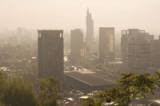
The dangerous haze that envelopes Santiago. - Photo Stock
“Every year, the students in the municipal school where I work come with many headaches and respiratory problems. As a result, they are constantly missing class so their performance suffers,” González, 51, told Tierramérica.
In 2008, the school had to suspend its physical education classes three times due to city decrees of a “state of pre-emergency.”
The teachers and families also suffer from the pollution, especially the elderly population, says González, who is preparing for the upcoming “grey” season.
In recent weeks, three officials linked to the Santiago air pollution agency PPDA have resigned.
On Mar. 3, “air manager” Marcelo Mena quit. He had lasted two months as the national advisor for fighting air pollution. His post was created to prevent the repetition of mistakes made in 2008 in predicting smog severity.
Mena charged that there had been “resistance” in the public apparatus against his work, particularly coming from the metropolitan region's environmental commission, CONAMA. Following Mena out the door were the director and the head of air pollution reduction, Alejandro Smythe and Marcelo Fernández, respectively.
According to Environment Minister Ana Lya Uriarte, the situation is the result only of “a reorganization of regional teams.” But environmental groups, lawmakers and experts are talking about a “crisis of environmental institutions” and “negative public signals.”
“We will be extremely rigorous in declaring critical events (environmental alerts, pre-emergencies and emergencies) as necessary. At no time will we ignore that our main focus is the health of the population,” said Jorge Lagos, the interim replacement for Smythe.
But this year they will not implement the proposals formulated in 2008 by a specialized panel convened by the government itself, which had suggested new instruments for measuring air pollution, among other initiatives.
With a population of 6.4 million, Santiago has serious problems with natural air flow because it is surrounded by mountains.
The main sources of air pollution are vehicles, including an inefficient public transportation system, and industries. But in recent years, the use of wood-burning stoves has increased, and limits on natural gas imports from Argentina has meant more combustion of petroleum — and more contaminating emissions.
Last year, between April and August (the southern hemisphere winter), the authorities reported 20 critical episodes: 14 alerts and six pre-emergencies. In 2007 there were 22 alerts and an equal number of pre-emergencies. Those were the worst two years since 2002, when there were 17 alerts and seven pre-emergencies declared.
An alert is activated when a daily average of 200 micrograms or more of particulate matter (smaller than 10 micrometers in diameter, PM10) are found in one cubic meter of air. A pre-emergency is when the concentration reaches 300 micrograms of PM10 per cubic meter.
In 2008, the most severe episode was recorded July 1 in Cerro Navia, with 444 micrograms per cubic meter of air.
The World Health Organization (WHO) recommends that the daily concentration of PM10 should not surpass 50 micrograms per cubic meter, because particulates and other contaminants cause and exacerbate respiratory infections, heart problems and lung cancer.
According to a Chilean Health Ministry study, in 2007 air pollution was responsible for more than 100,000 years of life lost in this country due to premature death or disability, and was the fourth leading health risk, after alcoholism, excessive weight, and high blood pressure.
Despite the progress made between 1997 and 2008, the steps taken so far have not been enough to meet the pollution abatement goals set for 2011. That is what motivated a second update of the PPDA plan in 2008.
But the new initiatives have yet to be implemented because the decree is under review of the national Comptroller General. Another unknown is when regulations will be approved for limits on fine particle matter suspended in the air — less than 2.5 micrometers in diameter.
But the environmentalists say the new PPDA lacks the necessary reforms, and needs to put the brakes on urban sprawl, improve public transportation and provide incentives to companies to move to less densely populated regions of the country.
Most likely this year the people of Santiago will once again will be at the whims of weather conditions in the capital, Paola Vasconi, of the non-governmental Terram Foundation, said in comments to Tierramérica.
The head of the weather and climate department of the Meteorological Directorate, Jorge Carrasco, explained that it is impossible to make forecasts now, but he did provide some broad-stroke guidelines.
Until May, Chile will continue to feel the effects of the cyclical oceanic-climate phenomenon known as La Niña (the cool phase of El Niño), which likely will mean less precipitation in the metropolitan region.
“This is related with greater atmospheric stability and less ventilation” of the Santiago valley, said Carrasco, though he stressed that these are only probabilities. In June, La Niña will give way to a neutral phase — and the uncertainty will be even greater.
 Print
|
Print
|