Wednesday, August 26, 2026



News and Views from the Global South
CUBA-US: Cubans Face Odyssey to See Loved Ones
Dalia Acosta
- It has become even more difficult for Cubans to visit their family members in the United States, costing around 1,000 dollars and taking several months of paperwork for the lucky ones who are granted an entrance visa.
In the past, thousands of Cuban families separated by the Florida Strait fell victim to the politicization of the emigration process, which impeded communication between Cubans residing in the United States and their families on the island.
Until the late 1970s, most families refused to keep in touch due to political differences. However, that began to change in the 1980s, as telephone communications were unblocked, blocked, and unblocked again, flights between the two countries suffered the same fate, but visits and phone communications became possible overall.
But while such problems were overcome, Cuban families are now suffering the inclusion of this socialist Caribbean island nation on a list of countries that according to Washington ”sponsor terrorism.”
The U.S. State Department’s latest list of countries that fall into that category, released in May, ranks Cuba alongside Iran, Iraq, Libya, North Korea, Sudan and Syria.
But that accusation – which is categorically denied by Havana – has nothing to do with the life of Teresa Díaz, a 68-year-old woman who travelled to the capital from her hometown, Camagüey, 570 kms away, to try to arrange her travel plans.
Díaz’s odyssey began when she showed up at the U.S. Interests Section in Havana and spent nearly 200 dollars to get an interview. It ended when she was denied an entrance visa. ”I won’t be able to travel, but at least I’m done with all this,” she remarked as she left the office.
Another older woman, aged 74, standing nearby was luckier. But after passing her interview in the Interests Section, she now has to wait around eight weeks for U.S. officials to return her passport, after which she will have to continue the paperwork for her trip in the Cuban migration offices.
Since Aug 1, when Washington put stiffer new security measures into effect, it has become much more complicated and costly for a Cuban mother to visit her children in the United States.
The new measures extended the already lengthy visa application form. And once applicants are approved by the Interests Section in Havana, each application must be sent to Washington for final clearance.
Applicants were charged 65 dollars for the interview, whether or not they were granted an entrance visa. However, that fee shot up to 100 dollars as of Friday.
But just to obtain an interview without having to wait for days can cost 70 dollars or more.
”A year ago, when my sister flew to Miami, they were granting visas to almost all elderly applicants. Now, of a total of 100 people who enter daily, 20 to 30 are given visas at the most. If you look around you, almost all of the people there are old,” Díaz told IPS.
Between 2,000 and 2,500 people a month apply for an entrance visa at the U.S. Interests Section. Many of them are over 60, and simply want to spend some time with their sons and daughters, grandchildren or siblings.
The new complications affect all family members of the more than one million Cubans who live in exile in the United States, many of whom are U.S. citizens. But they have made it especially difficult for people who live outside of Havana.
Díaz, who came to the capital with a niece, had to rent a room that cost 10 dollars a day. But when they arrived at the U.S. Interests Section, they found that she would not be granted an interview until Dec 4.
”We couldn’t stay here till then, so my niece ended up paying a ‘colero’ (turn-keeper) 70 dollars for a place in line that day. Later that afternoon, the cost went up to 100 dollars, so at least we saved some money there,” she said.
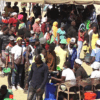
”Coleros” stand in line for people outside the Interests Section. ”They give out 100 ‘turns’ a day, and I believe there are as many coleros as there are turns,” said a 45-year-old man who, after spending several days observing how things worked, decided that the only possibility was to ”buy” a turn.
The coleros generally live near the Interests Section, and most of them take out a passport to justify their presence there. ”Every once in a while, the police show up to ‘organise’ the line, and mess things up for us,” a young female turn-keeper told IPS.
But the periods during which the police organise the queues tend to be short-lived, and officers can frequently be heard to say that they are there to control the flow of people into the Interests Section, not to organise the line.
Business is ”excellent” these days, said the young colero interviewed by IPS. She added that ”people were in a hurry to get an interview before the fee went up on Nov 1, and because they were afraid things would become even more complex.
”I have been doing this for over two years, and I have sold turns for as much as 150 dollars. I don’t raise the prices, people offer me more every day,” she commented.
Others hang around the Interests Section charging a dollar or 20 Cuban pesos to fill out the four-page application form, which can be a real headache for many elderly people.
Applicants must answer more than 50 questions, including whether they have been in prison, have sold or used drugs, have been a pimp or prostitute, or have tried to enter the United States to carry out terrorist or subversive activities.
They must list the countries they have visited in the past 10 years, name their current employer as well as their last two employers, list all of the educational institutions they have attended or are attending, and provide details about their relatives in both countries.
They are also asked whether they have any skill or special training in firearms, explosives, or nuclear, biological or chemical weapons, and whether they have been in an armed conflict ”as a participant or victim.”
Those who pass the interview must then wait two months to get their passports back before applying for permission from local authorities to leave Cuba, which costs another 150 dollars and takes several weeks.
While they are waiting, they can line up their letter of invitation, a legally certified document required by the Cuban migration office before permission can be granted to leave the country. Certifying the letter costs 140 to 160 dollars, depending on whether it is written in Cuba or the United States.
”The letter can only be written by a U.S. citizen or resident. If it is written in the United States, it can take a while to reach Cuba, which means some people prefer to pay a U.S. citizen living here 50 dollars for the favour,” explained Magda González, a Havana lawyer.
The ticket from Havana to Miami, which costs 300 dollars, can only be purchased once all of the paperwork is complete.
All told, it costs Cubans about 1,000 dollars for a trip that takes less than one hour.
But Cuban residents cannot reserve seats on flights, and must travel when space becomes available. ”You know the date when you start the paperwork, but you never know when the entire process is going to end,” said González. ”It is impossible to plan when you are going to travel.”
 Print
|
Print
|
CUBA-US: Cubans Face Odyssey to See Loved Ones
Dalia Acosta
- It has become even more difficult for Cubans to visit their family members in the United States, costing around 1,000 dollars and taking several months of paperwork for the lucky ones who are granted an entrance visa.
(more…)
Print
|