
Wednesday, November 11, 2026



News and Views from the Global South
RIGHTS: Sowing Peace in Southern Thailand
Marwaan Macan-Markaar
- In the shimmering paddy fields and leafy rubber plantations that stretch across a 400 sq km area, a new crop is struggling to take root-peace.
Credit:
Some 700 Thai soldiers are engaged in this ‘hearts-and-minds’ operation, trading their uniforms and weapons for farming implements and helping out the Malay-Muslim villagers as they sow their rice fields and tap rubber trees.
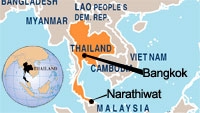
”I tell my troops they have to reach out to the community,” says Col. Songwit Noonpackdee, who was assigned to southern Narathiwat province, early November last year, to address the deep distrust with which the Muslims viewed the Thai military, the police and the government.
The reality on the ground that confronted the 40-year-old colonel when he started out was bitter. Only days before, 78 Muslim boys and men from the small town of Tak Bai had died of suffocation while in military custody.
Since January last year over 1,000 people have been killed on either side of this emerging conflict spread over the three southern provinces of Narathiwat, Yala and Pattani, all of which have predominantly Malay-Muslim populations.
The only way to overcome the prevailing mistrust is to ”build a sustainable peace” through ”strong civic action,” says Songwit, who belongs to Thailand’s majority Buddhist community. ”The troops have to be trained for this”.
Bonds are already visible in Muslim villages like Lubo Sama, a community of some 200 families that live off farming, rubber tapping and fish breeding.
After dark, on a Friday, for instance, the colonel feels secure walking about the narrow streets and closely clustered homes accepting, with an air of familiarity, the greetings of Muslim men and women.
Some of the villagers even admit that hardly any of their youth have left to join the suspected Malay-Muslim separatists that the Thai government accuses of being behind the 20-month-old conflict.
”No one has gone from our village to fight,” says Rusuewa Maseng, a community leader. ”It is safe in our village but I cannot say what happens outside”.
But this village appears to be less of a challenge for the Thai government than the over 350 villages Bangkok identified, in February, as ”red zones” for ”separatist activity” in the south. That is, if the torching of Lubo Sama’s school by suspected insurgents on Jan. 4 last year, is not counted.
The army’s initiatives are winning praise from sections of Thai society committed to resolving the conflict through cooperation rather than might. ”It is good that there are efforts to work with the people as part of the hearts and minds campaign,” says Jaran Ditapichai, a commissioner on Thailand’s national human rights body.
Ditapichai, however, concedes that it will take some time before the initiatives bear fruit. ”At the moment, the Thai government and the Thai people do not see a light at the end of the tunnel,” he said in an IPS interview.
To strengthen the hearts and minds programme, the country’s recently-appointed National Reconciliation Committee (NRC) is urging the government of Prime Minister Thaksin Shinawatra to establish community peace initiatives in the troubled south.
”In the past, one of the main obstacles to peace has been the refusal of local people to cooperate with the government because they did not trust them,” Paisarn Promyong, an NRC member, was quoted in Wednesday’s ‘Thai Day’ newspaper, as saying.
Yet, even those Malay-Muslims who are willing to openly cooperate with Bangkok, harbour reservations about the extent to which the troops and the government can be trusted because of a long record of discrimination.
One senior educationist revealed this while talking with Thai officials about the escalating violence here while whispering asides to journalists he can confide in. ”It is not just about separatism now. It is something more,” he said.
This long-time resident of the Malay-Muslim south knows only too well the effects of Bangkok’s policies of discrimination that start with a four-decade-old ban on the use of the Yawi language in all state-run schools.
Apart from religion, Yawi, the Malay dialect that the Malay-Muslims here speak, marks them out as a distinct ethnic community among Thailand’s 64 million people-95 percent of whom are Buddhist and speak Thai.
Combined with economic neglect and a non-sympathetic bureaucracy, linguistic and cultural discrimination, that stretch back decades, have been at the root of separatist movements by the Malay-Muslims.
The goal of these failed rebellions is the restoration of the defunct Muslim kingdom of Pattani, which included the three southern provinces annexed in 1902 by Siam, as Thailand was formerly known.
It is to prevent a new and more violent phase of separatism developing that Songwit has commanded his troops to follow strict principles of non-retaliation. ”We do not take revenge when soldiers are attacked”.
Equally important is the civic action ”to win over at the village level” the local communities by lending a hand with the paddy farming and rubber tapping-in an innovative labour of peace.
 Print
|




