Friday, August 28, 2026



News and Views from the Global South
Consequences of Inaction: UN Security Council Pressed to Act Before Hunger Becomes Famine
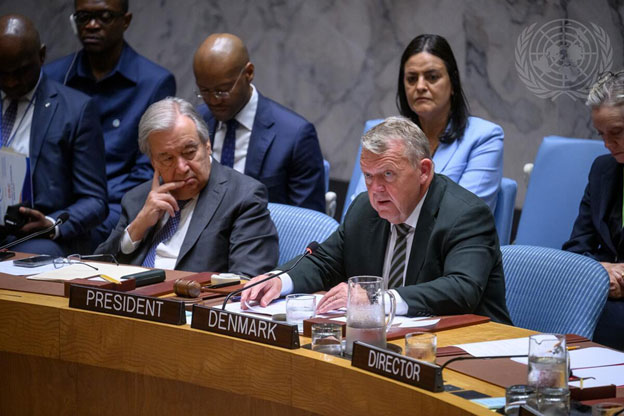
Lars Løkke Rasmussen (right), Minister for Foreign Affairs of Denmark and President of the Security Council for the month of August, addresses the Security Council meeting entitled ‘Food Under Fire: The Security Council's Role in Mitigating Global and Local Food Crises’, under the agenda item of maintenance of international peace and security. Credit: UN Photo/Loey Felipe
- Across the board, UN officials and humanitarian organizations urged the Security Council to act before the consequences of food insecurity and famines hit, during a high-level open debate on Tuesday, August 25. More than 80 representatives took part in Tuesday’s conversation on conflict-related food insecurity under the theme “Food under fire: the Security Council’s role in mitigating global and local food crises”.
In 2018, the Security Council unanimously adopted resolution 2417, which strongly condemned the use of starvation of civilians as a method of warfare, as well as the unlawful denial of humanitarian access. Resolution 2417 solidified the link between armed conflict and food insecurity. Most importantly, the resolution stated the Security Council’s willingness to consider adopting sanctions against individuals or entities deliberately obstructing the delivery and distribution of humanitarian assistance. The resolution was a landmark achievement that, for the first time, treated hunger not as a result of war but as a humanitarian security threat that the Security Council is obligated to protect.
Eight years after resolution 2417 was passed, 2025 marked the highest year on record of global acute hunger, with more than 266 million people facing acute food insecurity and, for the first time this century, two famines simultaneously confirmed in Sudan and Gaza. On Tuesday, August 25, representative after representative discussed how resolution 2417 has gone largely unused.
UN Secretary-General António Guterres opened Tuesday’s session reminding the members of the sanction provisions in the resolution, stating: “This council expressed its willingness to consider information on the unlawful denial of humanitarian access and take appropriate steps, including sanction measures.” Guterres explicitly called on the Security Council “to make every effort to ensure accountability”.
Denmark’s Minister of Foreign Affairs, Lars Løkke Rasmussen, presided over the session and candidly stated how “resolution 2417 [is] a powerful tool, but its potential remains untapped, particularly when it comes to early warning.” Testament to that fact is how the resolution’s original text cited 74 million people worldwide facing conflict-induced hunger, a figure that has now doubled to 147 million people.
During Tuesday’s session, the representatives present, notably the elected members of the Security Council, narrowed in on the same point, that being that the famines occurring worldwide are completely preventable.
While discussing the famines in Sudan and Gaza, Dace Melbārde, Latvia’s Vice Minister for Foreign Affairs, called the dual crises proof that “these famines are not natural disasters. They are man-made, and they are entirely preventable”. Ms. Melbārde urged the Security Council to “consider targeted sanctions and other appropriate measures against those who deliberately weaponize food and obstruct humanitarian access,” warning that “impunity cannot become another driver of hunger.”
“This is not fate. It is a choice. And when there is a choice, there is culpability,” said Lewis Garsheedah Brown, II, Liberia’s Permanent Representative to the UN. Brown also focused on how the dual famines devastating Sudan and Gaza are not fate or acts of nature, but instead predictable results of the Security Council’s inaction.
Carl Skau, the Acting Executive Director of the World Food Programme (WFP), admitted institutional failure when it came to acting on the warning signs of Sudan’s famine. Examining Sudan’s Darfur region, Mr. Skau said: “We all saw the atrocities in al-Fashir coming, but the international community, including this Council, failed to act on those warnings.” Mr. Skau went on to say that “waiting for famine to be declared is a total failure of duty”. The famine in Sudan was compared to the crisis in 2017 and 2022 in Somalia, where early implemented Security Council-backed action helped to avert catastrophic famine.

Perrine Benoist, Co-CEO, Action Against Hunger and Member of the Global Coalition Against Conflict and Hunger (Rule 39), addresses the Security Council meeting. Credit: UN Photo/Loey Felipe
Also during Tuesday’s session, Dr. Perrine Benoist, Co-CEO of Action Against Hunger, presented figures that highlighted the level of inaction the Security Council has taken despite the universal adoption of resolution 2417. Dr. Benoist detailed how there have been more than 9,300 incidents where conflict-related violence impacted food systems in over 45 countries. These incidents include more than 3,200 bombings of markets, agricultural land and water systems.
“Time and again, its provisions have been violated by parties to conflict, while implementation by the members of this Council has fallen far short of what the resolution demands,” Dr. Benoist said of resolution 2417.
However, despite the emphasis placed on strengthening and acting on resolution 2417, not every representative agreed to the scale of the action on Tuesday. Ambassador Vassily A. Nebenzia of the Russian Federation rejected the calls from other representatives to broaden the resolution’s application. Mr. Nebenzia argued that “resolution 2417 does not need an expanded interpretation or new mechanisms. It requires country-interest application where conflict does indeed create hunger.”
For the millions living through the famines in Sudan and Gaza and the tens of millions the WFP warned could be pushed into food insecurity, the consequences of the Security Council’s inaction are not abstract.
“We cannot wait for famine or catastrophic conditions to be formally confirmed,” said Guterres. “I call on this Council to act when the warning lights are flashing.”
IPS UN Bureau Report


 Print
|
Print
|