Monday, October 5, 2026



News and Views from the Global South
ENVIRONMENT: Scramble for Resources Driving Sudan Conflicts
Mithre J. Sandrasagra
- A U.N. Environment Programme (UNEP) report released here this week emphasises strong linkages between environmental stresses and the ongoing conflict in Sudan.
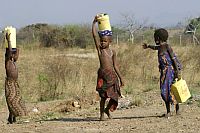
Children of the Ambororo nomadic tribe in south Darfur carry water in plastic containers for their families. Credit: UN Photo/Tim McKulka
"We must address the root causes of the conflict, which are poverty and environmental degradation," Abdalmahmood Abdalhaleem Mohamad, Sudan's Ambassador to the U.N., told IPS.
"Unless this is tackled they will relapse to conflict," Mohamad said. "It is not people killing each other for no reason. Political reasons came later. The conflict has been there for a long time. Gradual degradation of the environment competing over dwindling resources," he continued.
The 354-page "Sudan: Post-Conflict Environmental Assessment" points to environmental impacts of population displacement and under-investment in sustainable development, plus competition over oil and gas reserves, Nile water, timber, and agricultural land as root causes in the "instigation and perpetuation of conflict in Sudan."
"Seventy-five percent of the country is at peace, there are stable oil revenues coming in and there is good recognition of environment issues at the local level," said Andrew Morton of UNEP's Post-Conflict and Disaster Management Branch. "This is an excellent opportunity to integrate concepts of sustainable development in Sudan," he stressed.
The assessment, which was requested and carried out in cooperation with the new Government of National Unity and the Government of Southern Sudan, and sponsored by Sweden and Britain, makes several recommendations. These include climate adaptation measures, capacity building of national and local government in environmental affairs and the integration of environmental factors in all U.N. peacekeeping, relief and development projects.
The total cost of this report's recommendations is estimated at 120 million dollars over three to five years. UNEP stressed that all these funds could come through various Sudanese ministries.
"Since the price of oil fluctuates, we would like the door for international assistance to be open," a Sudanese delegate told delegates, U.N. staff and journalists at the UNEP presentation here.
Sudan's boom in oil and gas exports pushed its GDP in 2005 to 85.5 billion dollars.
During his presentation, Morton was quick to point out that though the report is called a "post-conflict" assessment, "it is a picture of Sudan in 2006".
The conflict is ongoing. Since it began in February 2003, when members of the region's ethnic African tribes took up arms against what they saw as decades of neglect and discrimination by the Arab-dominated government in Khartoum, the people of Darfur, Sudan have been subject to government-sponsored displacement, rape and murder.
The violence sponsored by the Sudanese government and perpetrated by its Janjaweed militias has claimed at least 400,000 lives, displaced 2.5 million people and left more than 3.5 million men, women and children struggling to survive amid violence and starvation, according to the U.N.
On Jul. 31, the U.N. Security Council, with Khartoum's consent, agreed to deploy a peacekeeping force of up to 26,000 military and police personnel in Darfur known by the acronym UNAMID.
UNAMID will be equipped with resources to protect civilians and humanitarian workers, and to oversee implementation of a peace agreement.
In July and August, Khartoum told international aid agency staffers that Darfur's 2.2 million internally displaced persons (IDPs) were beginning to return home voluntarily. However, the land where many IDPs' villages are has degraded, according to UNEP.
So what is the solution for the long-tern return of IDPs?
"The U.N. will be committing a big mistake if the U.N. continues to feed them endlessly. End the conflict, integrate them," Mohamad said. "Don't give them a fish to eat, teach them how to fish."
"We don't want to take them and give them everything, because they will develop a syndrome of dependency," Mohamad stressed.
According to Human Rights Watch (HRW), the situation in Darfur is transforming from a highly destructive armed conflict between rebels and the government into a violent scramble for power and resources involving government forces, pro-government militia, various rebel and former rebel factions, and bandits.
The scramble for resources is a historic problem in Sudan, stresses the UNEP report.
There is mounting evidence of long-term regional climate change in several parts of the country. This is marked by decline in rainfall in the states of Kordofan and Darfur states.
In northern Darfur, for example, precipitation has fallen by a third in the past 80 years, according to UNEP figures.
The scale of climate change recorded in Northern Darfur is almost unprecedented, and its impacts are closely linked to conflict in the region, as desertification has added significantly to the stress on traditional agricultural and pastoral livelihoods.
In addition, "forecast climate change is expected to further reduce food production due to declining rainfall and increased variability, particularly in the Sahel belt. A drop in crop yields of up to 70 percent is forecast for the most vulnerable areas," says the report.
The Sahel belt is home to several million Sudanese.
"There is a migration which involves millions of people gradually moving south which leads to conflict," Morton said, stressing that "this had nothing to do with Darfur."
While the tensions and conflicts in Darfur are currently in the headlines, the report warns that other parts of the Sudan could see resumptions of historical clashes driven in part by declines in environmental services.
The most serious concerns to UNEP are land degradation, desertification and the spread of deserts southwards by an average of 100 kms over the past four decades.
These are linked with factors including overgrazing of fragile soils by a livestock population that has exploded from close to 27 million animals to around 135 million in 2006.
In the Nuba mountains region in Southern Kordofan, for example, the indigenous Nuba tribe expressed concern over the damaging of trees and other vegetation due to the recent presence of the camel-herding Shanabla tribe. Like many pastoralist communities, the Shanabla have been forced to migrate south in search of adequate grazing land lost in the north to agricultural expansion and drought. Some Nuba warned of "restarting the war" if this damage did not cease, according to UNEP.
Many sensitive areas are also experiencing a "deforestation crisis" which has led to a loss of almost 12 percent of Sudan's forest cover in just 15 years. Some areas are expected to undergo a total loss of forest cover within the next decade.
Sudan, however, has natural resources that it needs to exploit, Morton told IPS.
"There are very valuable hardwood timbers in Sudan, particularly mahogany. At the moment they are being burnt to clear land for agriculture, they are being lost without getting any economic gain out of them because there are no roads to the market. If sold, one tree could create five years' income," Morton said.
"There are substantive water resources through the Nile," he added, "yet there is little irrigation done in central and southern Sudan, so there are options there for agricultural development."
 Print
|
Print
|