
Tuesday, October 13, 2026



News and Views from the Global South
RIGHTS-MALAYSIA: Ethnic Indians on the Warpath
Baradan Kuppusamy
- Malaysia’s Hindus – mostly Tamil descendents of 19th century labourers – on Sunday ignored warnings by Prime Minister Abdul Badawi and braved tear gas and police batons to protest alleged official discrimination and demand a fair share of the national wealth.
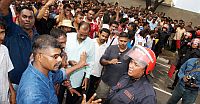
Police confront ethnic Indians protesting against alleged discrimination at Sunday's mass rally Credit: Baradan Kuppusamy/IPS
Commuters, shoppers and workers ran helter-skelter as teargas canisters rained on the protestors and filled the air with chemicals. Malaysiakini.com, an independent online news provider, put the number of protestors at 20,000, while other estimates said upto 50,000 people had turned up.
Many were turned away or arrested as they came into the city from the interior, said the organiser of Hindu Rights Action Force or HINDRAF, that was formed in 2005 to fight for Hindu rights.
Many protestors waved the Malaysian flag and carried pictures of Indian independence leader Mahatma Gandhi hung around their necks to signify non-violent protest.
They also carried banners urging the authorities to let them voice their grievances peaceably. “We only want to tell you our problems… don’t treat us like animals,” one banner said.
But their cry for understanding and moderation went unheeded.
“By protesting in large numbers we have shown that we are not cowed,” said lawyer P. Uthayakumar, a key leader in HINDRAF. “The government cannot ignore us anymore. We are a force to reckon with,” he told IPS between dodging tear gas canisters. He added that HINDRAF will step up its protest to fight for justice, mostly for poorly paid labourers in factories and giant plantation companies who are forced to compete with at least three million foreign workers for low-paying jobs.
An economic slowdown, rising food and fuel prices and competition for jobs has hurt the Indians harder than other races, including the majority Malays and the Chinese who control much of the business.
It took police nearly six hours to regain control of the city centre with luxury businesses reporting millions of dollars worth of losses due to the protest driving shoppers away.
Police fired dozens of rounds of tear gas, baton charged the demonstrators and used water cannons laced with chemicals, but the demonstrators played a cat and mouse game to keep the police at bay. Scores of protestors were injured and many were arrested.
Opposition lawmakers condemned the excessive use of force against people who only want to voice their grievances in a peaceful manner.
“This excessive use of power is completely unjustified,” said opposition leader Lim Kit Siang in a statement. “I hold Prime Minister Abdullah Badawi personally responsible for the injuries people suffered. The people will show their rejection of violence in the upcoming polls.”
The protestors are demanding business licenses, jobs, scholarships to the universities and privileges reserved exclusively for native Malays.
Their plan was to embarrass the Malaysian government by presenting a memorandum to the British High Commission here urging the British government to intervene on their behalf with the Malaysian authorities.
Police closed off all the approaches to the commission in the diplomatic enclave of Ampang preventing the protestors from reaching there.
“The British brought our forefathers here 150 years ago. They exploited us and left us to the mercy of a Muslim majority government,” said opposition lawmaker Kulasegaran Murugesan who took part in the protest.
“They have failed to look after our welfare,” he told IPS. “We have a right to voice our grievances.”
Ahead of the rally, on Friday, police had arrested three members of HINDRAF on sedition charges based on laws dating back to the colonial era.
Ethnic Indians, who make up about eight percent of the population of 26 million, complain that majority Malays, using unchecked political power, have kept for themselves employment, education and business opportunities.
“We have been deprived …we want our fair share,” Uthayakumar said. “Not only are we deprived but our temples are destroyed, our schools neglected and our people suffer from terrible neglect.”
Officials ignore such arguments saying all communities get a fair share. But the complaints have found a receptive audience among the long suffering Tamil masses.
“I own a lorry but I have to pay Malaysian Ringgit 400 (119 US dollars) to rent a driving permit from Malay permit-holders to do business,” said Selvarajah Ramakrishnan, 46, father of a 10-month-old baby.
“I have been applying for a driving permit for 15 years and have not got one,” he told IPS, adding there were many Indians facing such neglect. “How am I going to feed my family …what kind of a future my daughter has? Why I have to suffer discrimination in my own country?”
While agreeing that Tamil grievances run deep, opposition lawmakers and civil rights activist are also worried by the exclusively religious and ethnic character of Hindraf and its leaders.
Opposition icon Anwar Ibrahim described the protest as an important “safety valve” to let off anger over long simmering Tamil grievances and urged the government to allow free expression to air them.
However Anwar too expressed concern at the exclusive approach of Hindraf and urged its leaders to consider a more balanced and inclusive approach when addressing Tamil grievances.
He said grouses should be directed at the corrupt coalition government led by Badawi that is guilty of serious abuses of power and continues to neglect the plight, not only of Indians, but also all other ethnic groups.
“Blaming Malays for the plight of Tamils is not correct and is not constructive to achieving the change we all desire. We should demand justice for all Malaysians who need it,” Anwar said.
Malay Muslims, about 60 percent of the population, were the most backward economically at independence in 1957 but, through a ‘Malays-first’ policy, have advanced on many fronts and today form a sizeable middle-class. The Chinese, who first arrived as labourers to work the tin mines, now form 25 percent of the population and control some 60 percent of the economy.
At the core of the racial divide is the New Economic Policy or NEP which was originally designed to eradicate poverty, irrespective of race, create wealth and ensure economic equality. But, in implementation, Malays benefited over other races – including in preferential employment, education, scholarships, business, access to cheaper housing and assisted savings.
Whatever the case, a newly awakened Tamil minority will add to Badawi’s woes as he faces a general election widely expected in March.
Many of the protestors have vowed to vote for the opposition unless their grievances are addressed.
 Print
|
Print
|




