Languages
Friday, September 25, 2026



News and Views from the Global South
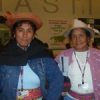
CLIMATE CHANGE: Portraits from the Summit
Among the thousands of people who have flocked to the Danish capital this week for the climate change summit and dozens of parallel activities are activists of all ages and stripes and representatives of the business community. TerraViva caught up to some of them to find out why they are here and what they hope to achieve.
CLIMATE CHANGE: East Europe, Developed or Developing?
The European Union is presenting itself as a united front during negotiations in the Copenhagen climate change conference. But East European countries insist that they are developing nations and prefer to limit their aid and emissions commitments.CLIMATE CHANGE: Europe Makes Shy Commitments
"Decision-makers should stop thinking in realpolitik terms and acknowledge that we are out of time,’’ says Magda Stoczkiewicz, director of Friends of the Earth (FoE) in Europe.
CLIMATE CHANGE: Willingly or Not, We Must Prepare for Geoengineering
So what do we do if COP15 does not bring adequate emission reduction targets or if the targets are not implemented by countries? What if we are faced with an ecological crisis in the next 15-20 years?
CLIMATE CHANGE: Brazil Defends Biofuels
Being the world’s largest producer and exporter of ethanol it is natural for the Brazilian government and its partners to push biofuels as the only real alternative for a world trying wean itself away from fossil fuels that contribute to global warming.
CLIMATE CHANGE: Beware of Carbon Trading Trap Warn Activists
As the climate change summit in the Danish capital moves into a second day, environmental groups warn that by pushing carbon offsetting and trade, governments of developed countries are bypassing their responsibility to significantly reduce domestic emissions and provide aid to developing countries.ROMANIA: Business Crowds Out Bucharest Life
Competing with the destruction caused by former Romanian dictator Nicolae Ceausescu’s ‘systematisation’ plans might be hard. But an official report says that "the aggression on Bucharest’s architectural heritage, documented since 1989, exceeds Ceausescu’s acts.’’EASTERN EUROPE: Loans Make the Middle Class Poor
Low-income Eastern Europeans contracting easy consumer loans in the mid- 2000s are now falling below poverty lines.BULGARIA: Migrants Denied Even Medicine
Hasun Albaadzh, an asylum-seeker from Syria, died Oct. 6 at the Busmantsi detention centre on the outskirts of Bulgarian capital Sofia. He had been held at Busmantsi for 34 months - considerably more than the maximum legal period of detention - and had been denied proper medical care.ROMANIA: Government Collapse Deepens Economic Woes
Romania is heading for a week of massive protests by state employees. With the governing coalition collapsing last Friday, the new minority government will have a hard time navigating between the demands of the protesters and the austerity measures demanded by its international creditors.EASTERN EUROPE: Fair Trade Takes Off
Fair trade is becoming popular in Central and Eastern Europe, as activist groups raise awareness of the region's responsibility towards the rest of the world, and open an increasing number of fair trade shops and cafes.EASTERN EUROPE: Disabled Seek to Move In From the Margins
At 37, Dimo Kokorkov, a carpenter from Stara Zagora in central Bulgaria is "broken-hearted". Dimo says this to describe his sense of deep injustice after being systematically abused in prison because of his disabilities.EUROPE: Easterly Wind Picks Up
The natural conditions in Romania and Bulgaria make these countries some of the best placed in Europe for producing wind energy. Interest in investing in wind power is high in both countries, but legislative ambiguity and the limited capacity of national electricity grids are delaying the building of new wind parks.EUROPE: Small Farmers Lost in Transition
"Our country would have gone through the economic crisis much smoother had we invested more in agriculture over the past 20 years, and had we not wasted so many resources on consumption," Romanian President Traian Basescu declared Aug. 7. That remark has drawn attention to serious questions whether countries like Romania are wasting their potential for agriculture.
Q&A: 'Time to De-Grow'
Serge Latouche, professor emeritus of economic science at the University of Paris-Sud, is one of the main proponents of "the society of de-growth".
RIGHTS-BULGARIA: Two Women Take on Defence Ministry
Two young women are suing Bulgaria's Ministry of Defence over gender discrimination in the mainly ceremonial, National Guard - a case that could go a long way in changing patriarchal social norms.EDUCATION: Not This Romanian Way
One of three students in Romania studies at Spiru Haret University, the largest private university in the country. But more than 100,000 students, recent and older graduates, could be left without their diplomas because the authorities dispute the quality of education provided by the institution.ALBANIA: Short on Homework for Joining EU
Membership of the EU will be the principal target of the re-elected government in Albania.
WOMEN: Dubai, New Destination on Trafficking Map
On May 26, the U.S.-based Center for Investigative Reporting published ‘The Price of Sex’, a vast multi-media project by photojournalist Mimi Chakarova who spent nearly seven years doggedly unraveling the web of sex trafficking.ALBANIA: Poll Brings Old Recipes, New Expectations
The Jun. 28 general election in Albania is being seen as a crucial test in the country's evolution towards a democratic future. The two main parties that have dominated the post-communist period both have ambitious agendas whose top priority is European integration.
ROMANIA: Volunteers Promote Green Living
A network of volunteers from Romania has managed to plant more than 100,000 trees and collect 70 tonnes of trash in just one year, filling in gaps in the working of state institutions, and showing that there is potential for civic engagement among Romanian youth.« Previous Page — Next Page »


The Week with IPS

NEXT STOP - SDGs
Tracking global progress towards a sustainable world
Tracking global progress towards a sustainable world
