
Monday, October 12, 2026



News and Views from the Global South
CLIMATE CHANGE: Portraits from the Summit
Daniela Estrada and Claudia Ciobanu* - IPS/TerraViva
- Among the thousands of people who have flocked to the Danish capital this week for the climate change summit and dozens of parallel activities are activists of all ages and stripes and representatives of the business community. TerraViva caught up to some of them to find out why they are here and what they hope to achieve.
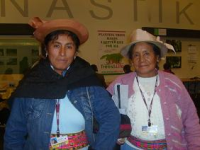
Irma Luz Poma Canchumani, a Quechua woman from Peru, and her mother, at Klimaforum09. Credit: Daniela Estrada/IPS
Eleven-year-old María Colares and her mother made the trip from the northern Brazilian city of Espíritu Santo to teach Danish children about the Amazon, the world’s largest tropical rainforest, which is shared by Brazil and seven other South American countries.
“I came here to give talks in schools about how to take care of the Amazon,” María told TerraViva at Klimaforum, the main civil society meeting held simultaneously with the Dec. 7-18 15th Conference of Parties (COP15) to the United Nations Framework Convention on Climate Change.
“Danish children are really nice and very interested. They ask me what Brazil is like, and what the Amazon is like,” said Colares, who with her mother founded the organisation Keep Amazon Alive a month ago, in conjunction with Denmark’s Casa Latinoamericana (Latin America House).
“The Amazon is the lungs of the world. If we destroy the Amazon we won’t have any more fruit, just deserts,” said the girl, who suggested European schoolchildren take a trip to Brazil to see with their own eyes how the Amazon is being deforested by logging and burning.
Keeping tabs on the carbon market
Irma Lubrecht runs the IR-ON consultancy firm in the Netherlands, giving advice on climate change to certification companies and private developers.
“I have been in the climate change business for 10 years. I am in Copenhagen to see how the carbon market is developing,” she told TerraViva.
“I just want to see what is the future of Kyoto, and if there is a future, because I am pretty sure the project-based mechanisms will not continue for a long time.”
Lubrecht advises about the feasibility of Clean Development Mechanism (CDM) projects and gives trainings on CDM and JI (Joint Implementation), two of the main mechanisms established by the Kyoto Protocol through which governments and businesses in countries which have to reduce emissions can invest in emission-reduction projects in developing countries and gain carbon credits in return.
“The way it is going now, CDM cannot continue,” she believes. “It is too small, it costs too much money and involves too many people. And the bureaucratic mechanism behind it produces too many delays.”
“When CDM was born, we thought it was going to save the world. Now, there is so much bias, so much opposition against it,” said Lubrecht.
“In my opinion, it is more efficient to have national emission targets which become stricter and stricter every year and also national emissions trading schemes. And I am very much in favour of personal limits to emitting GhG (greenhouse gases): you get a personal card at the beginning of the year and each time you put gas in your car or book a trip to Turkey, you get charged. People have to understand that we each have to be energy efficient.”
Attuned to Pachamama
“We came to Copenhagen to bring harmony to the whole world,” Irma Luz Poma Canchumani, a Quechua woman from Peru, told TerraViva. Her village participated with others in five countries – Canada, Cameroon, Kenya, Panama and the Philippines – in making a documentary produced by the British organisation InsightShare, which was shown at Klimaforum.
“In the video (called ‘Conversations with the Earth’) you can see reality. We did not come to accuse, we came to show that Pachamama (Mother Earth) is life, that water is life, not money. We want to show how we live,” said Poma, who travelled to Copenhagen with her mother, funded by InsightShare.
They live in the town of Cochas Grande, where they say the climate is already changing. “For example, the water is disappearing. It comes from the snow and ice on the Huaytapallana mountain, which is gradually losing its ice cap. We need rain at seed time (for potatoes, maize, wheat, barley and beans) and there isn’t any,” she said.
“We want to infuse harmony and make the whole world aware that we must care for Pachamama, because Pachamama gives us life. You may have a lot of money, but what are you going to eat? Money?” asked María, who has also visited the Bella Center, where the official COP15 negotiations are taking place.
Checking up on CO2 and energy policies
Peter Sprengers is a carbon business analyst with the Norwegian firm Statkraft, Europe’s largest renewable energy company. Statkraft invests in hydro and wind power and in the novel osmotic power (the energy retrieved from the difference in salt concentration between sea water and river water).
“I came to Copenhagen to get a feeling about what is going to happen with CO2 and energy policies, because it has a huge impact on our business,” Sprengers told TerraViva.
“We are also trading in the carbon market. We are using CDM, developing projects in South Africa and in other countries in the world, and we get credits for them, so developments in the carbon market and the changing of the rules is very important for us,” he added.
Sprengers said he did not come to Copenhagen to lobby or to make an impact because he does not think he can have an impact. “The main decision-makers are the U.S. and China at the moment,” he thinks.
“I fear that the carbon market is becoming more and more complex,” said Sprengers. “What we were hoping for a few years ago was a global CO2 market, so all countries trade under one regime, but now it looks like it’s becoming more fragmented with different regimes in place
“You have CDM and JI, but in the future there will be more new mechanisms. It is becoming so complicated that no one understands how it works.”
Saving tropical forests
British singer and activist Misty Oldland is rushing around Klimaforum asking people at the crowded and colourful parallel summit to mime the letters and words in the phrase “CO2 Cut”, to film them and upload the videos to the YouTube website.
“I support tropical forest conservation. (Here in Copenhagen) I’m meeting people concerned with this issue. All my work is about raising consciousness and fighting for tropical forest conservation,” the 43-year-old activist told TerraViva, after filming indigenous people from South America.
Oldland, who came to Copenhagen with a friend and has also visited the COP 15 at the Bella Center, is a volunteer with the Inga Foundation, a British NGO dedicated to reducing forest clearance by the slash and burn techniques often used by poor farmers.
According to the activist, in Latin America the Inga Foundation is teaching Honduran small farmers a number of more productive, sustainable agricultural practices.
Networking
Nathan Rotkliffe is a legal council with London-based Carbon Trade Exchange. His company is aiming to develop a global platform for carbon trading in an end-to-end electronic process, initially for voluntary carbon markets.
Rotkliffe told TerraViva his company is hoping to launch the trading platform in February 2010 and that it will help ensure full transparency on the international carbon market.
“For now, we are not moving into the regulated sector because of its fragmentation, but we intend to do so in the future,” Rotkliffe said.
Even though his company works on developing an electronic platform for global trade, Rotkliffe thinks that, if an agreement is reached in Copenhagen, ETS (the European Unions’ Emissions Trading Mechanism) will no longer be the only regulated system, but more will emerge, for example in the US.
“I am here in Copenhagen to try to gather as much information as possible and to network with people,” he commented to TerraViva. “Everyone here wants something to happen, everyone hopes for progress, but it would be hard for me to influence negotiations since I am not at the political level.”
As for reaching out to political leaders, Rotkliffe said that “each night we are attending a climate event at the Nasa Club in central Copenhagen, where speakers come from the private sector and from the governments. It’s on every night, it costs 15 euros to get in, there are 5-6 speakers, a Q&A session and then everyone has a few drinks and talks.”
Sharing experiences
Although the airline lost his luggage en route to Copenhagen, Víctor Saravia, head of the San Marcos Ocotepeque Ecological Association which works in western Honduras, is still enthusiastic about the prospect of sharing experiences in the Danish capital.
“We want to share at Copenhagen, because we believe we have a valuable and interesting process, well worth making known to other Latin American countries,” Saravia told TerraViva in the midst of the hustle and bustle at Klimaforum.
The Ecological Association promotes sustainable management of protected areas and river microbasins, and develops projects on food security, basic sanitation, alternative energies and political empowerment.
One of its main projects is the protection of cloud forests, by means of multi-sector alliances, to ensure water supply in the area.
“Water is the leitmotiv, the catalyst of the social participation process, and the focus where the municipal governments, the communities and their water management boards, and international cooperation agencies all meet,” Saravia told TerraViva.
* These interviews appeared in the IPS TerraViva online daily published for the COP15 at Copenhagen.
 Print
|
Print
|



Pictures for this story
This story includes downloadable print-quality images -- Copyright IPS, to be used exclusively with this story.
- María Colares, 11, came to Copenhagen with her mother from Brazil. Credit: Daniela Estrada/IPS
- Irma Luz Poma Canchumani, a Quechua woman from Peru, and her mother at Klimaforum09. Credit: Daniela Estrada/IPS
- Irma Lubrecht runs IR-ON consultancy firm from the Netherlands. Credit: Claudia Ciobanu/IPS.
- Peter Sprengers with Norwegian renewable energy firm Statkraft. Credit: Claudia Ciobanu/IPS.
- Nathan Rotkliffe, with London-based Carbon Trade Exchange. Credit: Claudia Ciobanu/IPS.


