Languages
Saturday, November 21, 2026



News and Views from the Global South

Q&A: 'A United Europe Can Do More for Development'
"We want to build a more united Europe for development," says Stefano Manservisi, European Union director-general for development policies and its relations with African, Caribbean and Pacific states. "If we are united, we can do more."POLITICS-DRC: A President and a General Face Off
Instability continues to loom large in eastern Democratic Republic of Congo (DRC), with President Joseph Kabila having demanded that renegade General Laurent Nkunda disarm and reintegrate his approximately 5,000 troops into the national army.MIDEAST-US: New Scholars Group Seen as Close to White House
A small group of Middle East and African studies scholars in the United States has announced the creation of a new professional association to change the direction of scholarship in the field.
Q&A: “The U.S. Has Its Own Toilet Problem”
Come Nov. 21, the United Nations will formally launch the "Ínternational Year of Sanitation, 2008", with the primary goal of finding ways to provide toilet facilities to some 2.6 billion people worldwide who lack proper sanitation.IRAQ: A Tale of One City, Now Two
The separation of religious groups in the face of sectarian violence has brought some semblance of relative calm to Baghdad. But many Iraqis see this as the uncertain consequence of a divide and rule policy.MIDEAST: All Not Quite Aboard for Annapolis
U.S. Secretary of State Condoleezza Rice has again paid a visit to the Middle East, held meetings with Israeli Prime Minister Ehud Olmert and Palestinian President Mahmoud Abbas, spoken about the seriousness of the two sides in their efforts to revive the peace process, but has again left the region without issuing invitations to a planned U.S.-led peace summit in Annapolis, Maryland.DEATH PENALTY-MOROCCO: King Seen as Final Arbiter in Long-Running Debate
The months-long political impasse over death penalty abolition in Morocco can only be finally broken by King Mohamed VI, according to a leading rights campaigner.PHILIPPINES: Water Privatisation – Boon or MNC Conspiracy?
Supporters call it a model for the future. But critics say it is a conspiracy by multilateral financial institutions to privatise water supplies and open the floodgates for multinational corporations (MNCs) to reap profits from Asia's poor.RIGHTS-UAE: Labour Reforms to Reach Domestic Workers
After years of criticism and pressure by local and international human rights organisations, the United Arab Emirates (UAE) has set up a taskforce to draft a law that will define and regulate the relationship between domestic workers and their sponsors.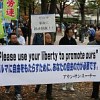
RIGHTS-JAPAN: Cut Aid to Burma Say Demonstrators
About 1,300 Burmese expatriates rallied in the capital’s Yoyogi Park on Sunday afternoon, appealing to the international community to put pressure on the Japanese government to cut aid to their military-ruled country.DEATH PENALTY-JAPAN: Dissenting Judge Breaks 40-Year Silence
Norimichi Kumamoto says he still feels "tremendous anger" and cannot maintain his silence any longer. In 1968, he was one of three judges who sentenced a boxer to death on charges of murdering a family of four, although at the time he was convinced the man was innocent.
Q&A: "TB and XDR-TB Are Not an African Problem Only"
In a world where countless humanitarian causes clamour for action and funding, raising money to combat tuberculosis (TB) can prove a challenge.
RIGHTS-MALAYSIA: Rally Defies Police Ban to Demand Poll Reforms
Tens of thousands of people defied riot police, water cannon and pouring rain to march through the capital city, on Saturday, to demand electoral and other reforms and deliver a strong rebuff to Prime Minister Abdullah Badawi.Ecobreves – MEXICO: Mangroves in Danger
Before year end, Mexican lawmakers could pass a bill that would dismantle protection of mangrove forests, a type of ecosystem that today covers a total of 650,000 hectares -- 306,000 less than in 1993.Ecobreves – ARGENTINA: 50 Projects for Achieving the MDGs
Some 50 projects of public policy and of civil society actions aimed at achieving the Millennium Development Goals (MDGs) in Argentina were presented at a course for promoting the goals, adopted in 2000 by the United Nations.Ecobreves – BRAZIL: Sugarcane Expansion Rejected
The population of the Brazilian town of Uberaba, in the eastern state of Minas Gerais, has mobilized against the expansion of sugarcane fields.Ecobreves – HONDURAS: Mining Companies Accused of Pressuring Lawmakers
The Honduran Civic Alliance for Mining Law Reforms has accused mining companies operating here of putting pressure on Congress to postpone approval of legislative changes.MIGRATION: Dialing for Dollars
Western Union Co., the biggest money transfer firm in the world, plans to offer a new system that gives migrant workers the opportunity to send money from country to country with their mobile phones.
RIGHTS-US: Case Crumbles Against Officer Who Refused Iraq
First Lt. Ehren Watada, the first commissioned officer to refuse deployment to Iraq, won what his backers are calling a "huge victory" in court Thursday.
Q&A: 'Don't Think of Migrants in Numbers Alone''
The clash among cultures is not the inevitable destiny of our times, says Predrag Matvejevic. Intellectuals and politicians must both do their bit "to foster the concrete utopia of the alliance of civilisations."SPAIN: Biofuels – Good for Business, Bad for the Poor, Say Activists
Making fuels from plants is strongly supported by the business community in Spain, but equally strongly criticised by environmental organisations because of its negative impact on food production.« Previous Page — Next Page »


The Week with IPS

NEXT STOP - SDGs
Tracking global progress towards a sustainable world
Tracking global progress towards a sustainable world
