Languages
Sunday, October 4, 2026



News and Views from the Global South

Airwaves Cut Distances in Rural Peru
The Onda Rural communication for development initiative in Peru has come up with a range of strategies to get information out to remote villages, to help them with decision-making on questions like climate change adaptation or disaster preparedness.
Airwaves Cut Distances in Rural Peru
The Onda Rural communication for development initiative in Peru has come up with a range of strategies to get information out to remote villages, to help them with decision-making on questions like climate change adaptation or disaster preparedness.Native Peruvians See Loopholes in Prior Consultation Law
Indigenous communities in Peru have a long list of comments and objections to the proposed regulations for the law governing prior consultation on initiatives affecting their territories.PERU: Weak Environmental Impact Studies for Mines
The stiff local opposition to the Conga gold mining project in the northern Peruvian highlands region of Cajamarca revived a long-postponed debate in this country, on the weakness of environmental impact studies in the mining industry.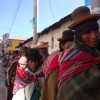
Lessons from the Andes on Budgeting to Close the Gender Gap
Three countries in South America's Andean region, Bolivia, Ecuador and Peru, have a great deal to teach and share with those meeting in Busan, South Korean this week to discuss, among other things, how to make sure that development aid incorporates a gender focus in order to be effective.
PERU: Campesinas Protect Traditional Diversity of Food Crops
Dina Apomayta is heir to the 3,500-year legacy of the Andean cultures of Tiwanaku and Lupaca, which venerated the land. And she and many other rural women in Peru continue to nurture the agricultural biodiversity that has been handed down from generation to generation.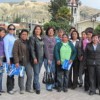
PERU: Councilwomen Fight Climate Change in Land of Melting Glaciers
Some symbolic acts are powerful reflections of a broader struggle. In March some 300 women planted trees in the Santa River basin in northwest Peru to demonstrate their determination to preserve the environment and help adapt to climate change.
New Scientific Network on Climate Change Adaptation
In Central America the temperature is rising and forests are taking longer to grow, while farther south, the Amazon rainforests have yet to feel the effects of global warming. This is just one example of how climate change is manifested differently in different parts of the region.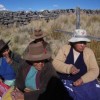
RIGHTS-PERU: Following the Clues in Exhumation of Massacre Victims
The daylight is fading, but Francisca Huanca's hopes are growing brighter. "Yes, they're his sneakers, he liked to play football," she says with tears in her eyes. She has just caught a glimpse of the remains of her husband, nearly three decades after he was murdered in the biggest massacre committed by the Maoist Shining Path guerrillas in Peru's highlands.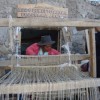
PERU: Indigenous Women Weave New Community Ties
Fuchsia, green and turquoise yarn shuttles swiftly across the wooden loom Dora Huancahuari has learned to use. Together with other craftswomen, she has started a small weaving business which is helping to rebuild their lives in this remote, poverty-stricken Andean community torn by Peru's history of armed conflict.PERU: Dam Project Temporarily Suspended to Calm Protests
The outgoing government of Peruvian President Alan García has suspended construction of the Inambari hydroelectric complex, part of an energy deal with Brazil. But activists say the move is merely aimed at calming tempers among local people opposed to the dam, while handing the problem on to García's successor, president-elect Ollanta Humala.
ELECTIONS-PERU: Leftist Winner Promises “Growth with Social Inclusion”
For the first time in the democratic history of Peru, a left-wing candidate has won the presidency. With the support of an overwhelming majority of voters in the provinces, retired lieutenant colonel Ollanta Humala defeated his right-wing rival Keiko Fujimori, whose strongest backing was in the capital, in Sunday's runoff.ELECTIONS-PERU: Partisan Media Distort Information
Attacks, fear and disinformation are widespread in news coverage of Peru's election campaign, with the leading media outlets taking the side of rightwing Keiko Fujimori in her contest against Ollanta Humala for the presidency.
PERU: No Easy Choice for Women in Presidential Runoff
In other circumstances, many women in Peru would be celebrating the possibility of a female president for the first time in the history of their country, or the alternative: the triumph of a candidate who promises to improve things for the poor. But both candidates taking part in the Jun. 5 runoff draw heavy opposition or awaken serious doubts among women's groups.PERU: Native Birds Under Threat from Illegal Logging
Unique species of native birds live in the transition zone in Peru between the Andes mountains and the Amazon rainforest, where illegal deforestation is destroying their habitat.
PERU: Guardians of the Dry Forest
Half-shouting over the roar of the old truck we are riding in, Peruvian farmer Pablo Escudero points to a green wall that rises up in the distance and says, "That’s our ‘rain caller’, the place we have fought so hard to create, which will be our legacy to our children."
PERU: Endangered Monkey Survives in Tiny Private Paradise
A conservation area covering a mere 23.5 hectares has become a refuge for a unique and endangered animal species in the northeastern Peruvian region of San Martín: the Andean titi monkey. This wilderness preserve was created by a local woman who singlehandedly set out to re-establish a small area of native forest.
PERU: Local Gov’ts Fail to Prioritise Equality for Women
Legally, each of Peru's 25 administrative regions must have a plan for promoting equal opportunities for women. But over the last year, only 10 regions have actually allocated resources to the task of overcoming gender inequity, while another 10 have not even drawn up the compulsory equal opportunities plan.
Endangered Monkey Survives in Tiny Private Paradise
A young forest planted by a woman from the Peruvian Amazon has provided a home for 40 specimens of a highly endangered monkey species with very few places left to live.
PERU: Rural Girls Face Barriers to Education
"My classmates from Utupampa had to walk an hour to get to school," said Yasmín Sena, a young woman from a village in Peru's highlands. "That community is way up in the mountains; no cars can go there."
Water Evaporates in Peru’s For-Export Crops
As freshwater disappears from the super-populated Peruvian coast, the most water-intensive crops are expanding unabated as highly profitable exports. Observers warn about the harm this is causing and demand greater responsibility from the government and all involved.« Previous Page — Next Page »


The Week with IPS

NEXT STOP - SDGs
Tracking global progress towards a sustainable world
Tracking global progress towards a sustainable world
