Languages
Monday, November 9, 2026



News and Views from the Global South
Education
POLITICS-US: Fortress Mentality Undermines Security, Experts Say
Post-Sep. 11 immigration rules that make it harder for young foreigners to study in the United States are doing more harm to national security than good, a panel of experts said Monday, because they have only deepened the divide between Western culture and the Muslim and Arab communities.EDUCATION: Literacy Campaign Takes Aim at Over One Million Venezuelans
Over one million illiterate Venezuelans are the focus of Mission Robinson, a literacy drive launched by the government of Hugo Chávez, with support from Cuba and the participation of at least 50,000 volunteers.EDUCATION-NEPAL: Politics Keeps Children Away from School
More than 1.5 million children in Nepal are having what promises to be a long break, although school vacation is over.EDUCATION: Secondary Schools, the Weakest Link in Africa
Ugandan Joshua Byabashaija has no idea what he will be doing after completing his secondary school in five months.EDUCATION-LATAM: Teachers on Strike, in Struggle to Survive
Teachers have been going on strike in many countries of Latin America - a symptom of one of the worst crises facing the educational systems of a region where teachers earn salaries on which they can barely survive.PHILIPPINES: Teaching through Mobile Technology Debuts in Schools
When classes begin this month, students in the fifth and sixth grades from selected public and private schools in the Philippines will not just be leafing through pages of their textbooks or listening to their teachers' lectures on science.EDUCATION-MOROCCO: New War on Terror of Ignorance
"The extremists have been taking advantage of my brother's ignorance," says Karim Benkhayi, a 22-year-old student. "Had he gone to school, he would not have been so vulnerable to the religious fanatics."IRAQ: Anti-Muslim Attacks Penetrate U.S. ‘Hallowed Halls of Ivy’
Since U.S. forces attacked Iraq in March, college campuses nationwide have seen backlashes against both Muslim students and anti-war activists. At Yale University alone, students claim seven instances of violence have occurred on what are normally the sheltered grounds of educational privilege.RIGHTS-AFRICA: More Money Needed to Achieve Free Education
2015 is the date set for universal, free primary education for all children of Africa, a goal now 12 years in the future that has been agreed upon by the world's finance and development ministers.IRAQ: Holocaust Colours German Jews’ View of the War
In no other city in the world is the horror of war more keenly felt than in Berlin, where Adolf Hitler's tyrannical reign led to the city being laid waste by allied bombs in World War II 58 years ago.EDUCATION-PAKISTAN: Model Religious Schools Aim for Modernity
There was a time when young Kanwal Nisar's aspiration of becoming a lawyer would have raised eyebrows in this Pakistani city.BRAZIL: Keeping Schools Open on Weekends, an Antidote to Violence
Keeping schools open over the weekends to provide recreational spaces and offer cultural and sports activities has significantly reduced acts of violence and vandalism by students in two Brazilian states.DEVELOPMENT-INDIA: IT Hub Works on Education for Its Children
India's southern state of Karnataka is known more for its capital city and global information technology hub, Bangalore, than for its 1.5 million children who are not in schools.EDUCATION-SOUTH AFRICA: Shattering Gender Stereotyping
If her school blazer is anything to go by, 17-year-old Charmaine Mahaya is an achiever. Her blazer is decorated from the lapel to the bottom seam with a series of badges symbolising academic and sporting success at her Johannesburg semi-public school.ENVIRONMENT: Saving Climate is Saving Money
Forget conscience and concern. The biggest companies are told in a new report they will save money if they take account of climate change.EDUCATION-BURKINA FASO: UNICEF Boosts School Enrolment
The UN Children's Fund (UNICEF) is helping poor children in Burkina Faso to enrol in school.EDUCATION-NIGERIA: Another Wasted Year for University Students
Dupe Olutuye is worried that she may spend this year at home if the striking lecturers at Nigeria's 24 universities refused to return to work.EDUCATION-KENYA: Massive Enrolment as Gov’t Abolishes School Fees
Kihumbuini Primary School, like thousands of others around Kenya, experienced a massive influx of children when school fees were abolished last month. The number of students rose from 600 to 1,000 overnight.CHILE: Inequity in Education, Health the Result of Privatisation
The highest proportion of rejected university applicants this year in Chile was found among graduates of public high schools - one of the clearest indications of the inequalities generated by the partial privatisation of the country's educational system.EDUCATION-COTE D’IVOIRE: Belligerents Recruit Child Soldiers
‘Fatherland TV', a rebel-run television, shows how new recruits, some as young as 13, go through the rigours of military training in northern Cote d'Ivoire.EDUCATION: Combatting Violence in the Schools
Violence is growing in schools in many countries around the world, although in different forms and to varying degrees, said experts at the World Education Forum, which ends Wednesday in the southern Brazilian city of Porto Alegre.« Previous Page — Next Page »





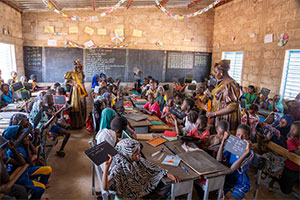 Two teachers work in a classroom in Forces Vives School in Dori, Burkina Faso. Credit: UNICEF/UNI978361
Safe and uninterrupted education is a fundamental right for all children. Education is paramount to global development, as it has been proven that investing in education – especially for girls and children – contributes significantly to economic growth and prosperity. Although more than 1 billion children go to school, many are subjected to conditions that are not conducive to a proper learning environment, including makeshift facilities, a lack of supplies, violence in classrooms, inadequate sanitation, untrained instructors, and widespread school closures. Since 2015, there have been immense gains in education with an increase of 109 million children in school. However, as of 2023, 272 million children are still out of school.
High poverty levels in developing countries also impede children’s access to a proper education. For example, from the early to mid 2000s, Sub-Saharan African nations witnessed a dramatic decline in trained teachers due to inadequate funding in the education sector. Furthermore, major cuts to United States international aid threaten an estimated 23 million additional children's access to education, as USAID‑funded school programmes across Africa and Asia face closure.
Various other factors contribute to the decline of education, notably hunger, which has increased as conflict and climate change interfere with global food production and dissemination. Meanwhile, certain social and cultural practices also impede children’s access to education, with gender inequality, discrimination, child labour, and child marriages preventing millions of children from attending school. Economic conditions such as the inaccessibility of higher education also affect disenfranchised communities across the world. In extreme situations, such as warfare where educational facilities are destroyed in their totality, notably in Gaza and Sudan, entire generations of children might grow up without access to education. Rebuilding educational infrastructure is a long and arduous process, especially when violence persists across generations, and this significantly stunts the development of societal prosperity and stability.
IPS is dedicated to telling the shocking truths about worldwide education through impassioned opinion pieces and comprehensive articles, highlighting global issues that impede worldwide education and the courses of action being taken by organizations such as UNICEF and Education Cannot Wait.

The Week with IPS

NEXT STOP - SDGs
Tracking global progress towards a sustainable world
Tracking global progress towards a sustainable world
