Languages
Saturday, November 21, 2026



News and Views from the Global South
Health
ENVIRONMENT-INDIA: Toilets Integral to Tribal Development
When Gram Vikas, one of India’s largest non-government organisations (NGOs), began work to uplift rural Adivasi (tribal) communities across this eastern Indian state, it started by building toilets.TRADE: Governments (Still) Pondering How to Make Drugs Accessible
The struggle to make medicines affordable to the world’s poor, especially in Africa, is raging on at the highest levels. Last week the European Commission took a landmark decision on generic drugs and next week a high-level intergovernmental meeting will look at ways to prevent patents from blocking access to drugs.SOCIETY-BALKANS: Facing 'Extinction', Nations Seek Babies
A young woman lost her job in a small town in Serbia after she gave birth to a baby boy and was to be absent from work for a year. That sacking shook up a nation.DEVELOPMENT-SOUTH AFRICA: Power Cuts Lead to Sewage Spills
Sewage plants in South Africa’s northern Gauteng Province poured millions of litres of untreated waste into three rivers between the capital, Pretoria, and the commercial centre of Johannesburg earlier this month. National power utility Eskom cut electricity to the treatment plants, which were then unable to process the waste water before it was released into the rivers.SOUTH AFRICA: Flush Still Considered Flash When it Comes to Toilets
Waterless or composting toilets are being touted as a promising solution to many of South Africa's sanitation woes.
DRC: Hospital’s Tale Reveals Missing Children, Brutalised Women
Long after fighting in the Ituri region of the Democratic Republic of Congo (DRC) has largely subsided, civilian populations there continue to face high levels of violence from all sides, according to the global humanitarian group Doctors Without Borders/Médecins Sans Frontières (MSF).EUROPE: Move to Halve Pesticides Use
Members of the European Parliament (MEPs) are seeking that pesticide use be halved within a decade in order to reduce the amount of hazardous chemicals in the environment.
Q&A: 'Women Need Help to Deliver'
The Women Deliver conference held in London last week has reminded a lot of people in the world of healthcare how much more they need to deliver to make pregnancy and childbirth safer for women.
POLITICS-US: Homeless Vets Play the Waiting Game
U.S. Army Specialist James Eggemeyer injured himself before he even set foot in Iraq, jumping out of a C-130 gunship during training at Fort Bragg, North Carolina.
EGYPT: An Environmental Make-Over for an Ancient Industry
Air pollution is so bad in Cairo that living in the sprawling city of 18 million residents is said to be akin to smoking 20 cigarettes a day. According to the World Health Organisation, the average Cairene ingests more than 20 times the acceptable level of air pollution a day.ENVIRONMENT-CHINA: Liao River in Deep Trouble
"When I was young, if we had visitors, we’d go to the river to catch fish with a net. We could catch many big fish of different kinds," recalled septuagenarian Xie, who lives in this village in the north-eastern Chinese province of Liaoning. "At that time, there were big willows on the riverbank, so the villagers could relax under the trees in summer."
HEALTH-US: Soldier’s Death Highlights Medical Staff Shortages
On Sep. 19, Kay McMullen had the last conversation she ever would with her son, Gerald Cassidy, or G.J., as he was known to his family and friends.HEALTH-ASIA: Four Years On Questions Hover on Bird Flu
Four years after the first outbreak of avian flu, experts say many key questions hover around the disease: what kind of contact between fowl and humans leads to its transmission to people, and how effective can poultry vaccination really be.HEALTH: No Woman Should Die Giving Life, Says UNFPA
In this 21st century, when medical science and gender empowerment are rising progressively, "no woman should die giving life", declares Thoraya Ahmed Obaid, executive director of the U.N. Population Fund (UNFPA).LATIN AMERICA: Historic Chance to Get Rid of Hunger
High economic growth rates, political will and laws aimed at ensuring the right to food will not be enough to eradicate hunger in Latin America by 2025, according to the United Nations Food and Agriculture Organisation (FAO), which calls for ongoing investment, improved coordination of programmes and support for family farming.HEALTH-ASIA: Nutrition Is Key to AIDS Treatment Say Experts
People living with HIV and AIDS in two corners of Asia may benefit from a campaign that seeks to broaden public policy responses to the syndrome. Central to this new drive is to make nutrition programmes a part of treatment, say experts.HEALTH: Maternal Mortality Shames Superpower U.S.
Despite its enormous wealth and highly advanced technology, the United States lags far behind other industrialised countries - and even some developing ones - in providing adequate health care to women during pregnancy and childbirth.ENVIRONMENT-EUROPE: Education Ministers Step In
Representatives from 51 countries agreed at a three-day conference in Belgrade this week to undertake new environmental improvements to build sustainable development.
Q&A: "No Cookie-Cutter Solution to Sanitation Crisis"
As the United Nations finalises plans to launch the "International Year of Sanitation 2008" in mid-November, South Korea is leading a global campaign to help resolve one of the world's most neglected health issues.DEVELOPMENT: World Losing Fight Against Hunger
At the midpoint between the Millennium Development Declaration in 2000 and the deadline of 2015, the majority of developing countries are failing to meet two key Millennium Development Goals, according to a report released here Friday by the International Food Policy Research Institute (IFPRI).HEALTH-SWAZILAND: Septic Tanks Preferred to the Latest in Sewage Treatment
Located on the outskirts of Swaziland's commercial hub, the state of the art Manzini Waste Treatment Centre was built to end the city's sewage disposal problems. A World Bank loan was secured by the Ministry of Housing and Urban Development to construct the 16 million dollar facility: a spotless, landscaped plant which has a lifespan of 25 years.« Previous Page — Next Page »


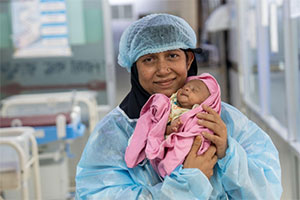 Bangladesh: Sarid, born one month early, receives specialized newborn care and grows stronger every day. Credit: UNICEF/UNI944397/Mojumder
Since the onset of the 2000s, global life expectancy has seen an overall rise, attributed to significant technological and scientific innovations in healthcare. Due to an increased understanding of different conditions as well as a rise in cooperation among healthcare experts around the world, there have been major strides made in ensuring that as few people die from chronic illnesses as possible. Despite the belief that healthcare is a fundamental human right, people from low- or middle-class backgrounds, marginalized groups, and underdeveloped countries have far more limited access to basic healthcare services.
The COVID-19 pandemic showed how marginalized communities are disproportionately affected by health crises, proving that we have much work to do in ensuring that no one dies of terminal conditions. While the global response to the coronavirus saw significant strides in immunization and vaccine development, the global outbreak of mpox in 2022 and its upsurge in parts of Africa in 2024 must remind us to remain vigilant.
Other major disease outbreaks in recent years have been linked to the destruction of infrastructure during warfare. Notably, in 2024, the Gaza Strip witnessed a return of the poliovirus since its eradication in the region 25 years ago. Israel’s blockade on Gaza has resulted in the collapse of the region’s sewage plants and desalination plants, and also destroyed healthcare capacities. The UN stated that this lack of clean water and sanitation would lead to an outbreak of cholera and other deadly infectious diseases. The 2026 OCHA Humanitarian Situation Report confirmed that the over two years of conflict in Gaza has produced a catastrophic health emergency, with millions remaining dependent on relief aid amid tight restrictions and no functioning public health system.
IPS is committed to providing full and comprehensive coverage on healthcare challenges around the world. IPS seeks to address the multifaceted causes of such challenges, including unprecedented pandemics, conflict-driven disease outbreaks, as well as socioeconomic barriers to equal healthcare access. IPS is also dedicated to reporting on innovations in the healthcare industry.

The Week with IPS

NEXT STOP - SDGs
Tracking global progress towards a sustainable world
Tracking global progress towards a sustainable world
