Languages
Wednesday, October 14, 2026



News and Views from the Global South
Financial Crisis
ECONOMY: EU Divided Over Regulation
The global recession has exposed the ideological fissures at the highest level of officialdom in the European Union.
Q&A: Development Cooperation Needs Greater Equity
As the economic meltdown spreads to the far corners of the world, developing nations are increasingly strengthening their social and economic ties, bolstering the growing new concept of South-South cooperation - in trade, investment, transport, health care, education, climate change, communications and disaster reduction.DEVELOPMENT: Swiss Aid Growing Despite Depression
The global economic and financial crisis has raised questions about whether the level of official development aid from the rich world will be maintained in future, at a time when the needs of the developing and emerging countries are growing as a result of the crisis.
ECONOMY-DR CONGO: Joblessness Rises As Global Crisis Hits Mining
It is busy at the gates of Bralima brewery in Lubumbashi, the capital of Katanga province in the Democratic Republic of Congo (DRC). About 60 men are waiting at the doors, hoping for them to open and someone to offer them work. Their numbers have grown since the global economic crisis which has caused the collapse of the local mining industry.LABOUR-JAPAN: Brazilian Japanese Organise Against Joblessness
Rodney Freitas, 24, is happy to see Brazilians of Japanese descent organising themselves at time when Japan’s economy is cooling down and many are in danger of losing jobs or are already unemployed.TRADE: Financial Crisis Makes Liberalisation Less Rosy
With the current economic crisis, questions are being asked about the viability of further liberalisation as envisaged in the Doha Round at the World Trade Organisation (WTO). In particular, the North’s pressure on poor countries to open financial markets may be ‘‘obsolete’’ because of the role of the financial sector in the crisis.ECONOMY-US: Advocacy Groups Fear New Wave of Homeless
Homeless advocates in the United States say if the new Congress and the Barack Obama administration do nothing, many more low-income people already teetering on the brink could end up living on the streets over the next two years.U.S.: Hawks Urge Boosting Military Spending
Despite a shrinking national economy and a record defence budget, U.S. neo-conservatives and other right-wing hawks are mounting a spirited - if misleading - campaign to persuade Congress that the military should get a bigger slice.ECONOMY-CANADA: Conservatives’ Budget Skimps on Stimulus
Canada's reluctance to institute a full stimulus package in the recent federal government budget has international parallels, says Armine Yalnizyan, a senior economist at the Canadian Centre for Policy Alternatives.ECONOMY: Greece Melts More than Most
The financial meltdown has finally visited Greece. European Commission figures leave no space for political manoeuvring by the Greek government, the usual way to deal with EC control and counsel.CARIBBEAN: Major Conglomerate in Line for Bailout
When it opened its doors to the public in 1936, the Colonial Life Insurance Company (CLICO) adopted the motto: "Give a man value, give a man service, and he will support you."FINANCE: From Have Less to Have None?
Despite two decades of phenomenal world economic growth, income inequalities between the richest and poorest have steadily increased - a trend likely to be accentuated as economies across the globe begin to contract, experts say.WORLD SOCIAL FORUM: ‘Stateless Peoples’ Defend Diversity
The immense diversity of peoples was apparent at the World Social Forum (WSF), which ended Sunday in Belém, the capital of the state of Pará in the Brazilian Amazon region.ECONOMY: China Warns Against Protectionism
China is worried that the lingering financial crisis could unleash a spiral of protectionist policies across the globe, which could further dent its trade-dependent economy.INDIA: Meltdown Hits Textile Industry
While the Indian economy has been relatively insulated from the international financial crisis, one particular sector that has been badly hit by the ongoing worldwide recession is the textiles and garments manufacturing industry.
Q&A: Crisis Could Lead to ‘Revolutionary Change’
As the economic crisis bites deeper, a revolutionary outcome may be possible, in the view of French academic Alain Bihr. Everything depends on citizens' capacity for struggle, he told IPS in an interview during events at The Other Davos, in this Swiss city.ECONOMY-JAPAN: Meltdown Prompts ODA Boost To Asia
Japanese Prime Minister Taro Aso told the World Economic Forum (WEF) at the Swiss mountain resort of Davos on Saturday that Japan will provide 17 billion US dollars worth of aid to stimulate Asia’s economies.WORLD ECONOMIC FORUM: Davos Under Fire
One of the few indicators on the rise at this time of economic and financial crisis is the level of repudiation expressed about those responsible for the disaster, and about the institutions sponsoring them.INDIA: ‘Satyam Scam Tip of Corporate Fraud Iceberg’
Three weeks after the Satyam Computer Services promoter-chairman B. Ramalinga Raju confessed that he had cooked the information technology (IT) company's books, the scam continues to send shock-waves through Indian business and industry.WORLD ECONOMIC FORUM: Makers and Shakers of the Post-Crisis World
Of all the questions raised by the global economic crisis, one that is by no means insignificant may be answered this week: How will the pressure groups that influenced the policies that led to the present chaos adapt to the new world situation?ECONOMY-US: Poverty Safety Nets Fraying Nationwide
The global economy is barely showing a pulse, and the world's poor are especially at risk, the International Monetary Fund declared Wednesday.« Previous Page — Next Page »





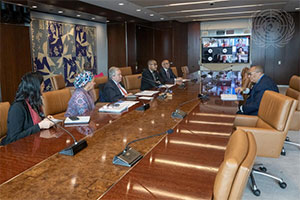 Secretary-General Meets with Members of Debt Expert Group. Credit: UN Photo/Eskinder Debeb
Financial crises are often defined by banking panics, recession, loss of market value, and deflation. Various financial crises at the turn of the 20th century, such as the Asian Crisis of 1997-1998 and the 2007-2008 Global Financial Crisis, have had immense impacts on the world economy. The COVID-19 pandemic also caused a financial crisis when mass lockdowns triggered staggering unemployment rates, a stagnation of economic growth, and led to the 2020 stock market crash. With the Russian invasion of Ukraine, the world has also witnessed a global energy crisis with shortages and increased prices in oil, gas, and electricity markets. According to UNCTAD’s World of Debt 2025, global public debt surpassed $100 trillion in 2024, with developing country debt growing twice as fast as developed economies since 2010. Burdens of debt servicing come with economic slowdowns and demands of austerity from lenders, with some economists arguing that this will lead to a new “lost decade” for the Global South. IPS brings you worldwide coverage of these financial developments and how we should manage these crises.

The Week with IPS

NEXT STOP - SDGs
Tracking global progress towards a sustainable world
Tracking global progress towards a sustainable world
