Languages
Friday, October 23, 2026



News and Views from the Global South
Financial Crisis
ECONOMY-US: Congress Blames Treasury as Foreclosures Mount
A congressional banking leader Tuesday blew hot air and blame at the U.S. treasury secretary about the ongoing home foreclosure crisis, but neither made a commitment to help stressed homeowners.FINANCE: The Poor Will Pay Too
Developing countries are not safe from the damaging effects of the current financial crisis, as had initially been forecast, but so far the impact has not been "dramatic," according to UNCTAD economist Michael Herrmann.ECONOMY: Don’t Bank On Them
Public confidence in Belgian banks has eroded considerably over the past few months. A series of multi-billion euro rescue plans, reports of lavish executive bonuses and investigations into whether shareholders were misled about solvency levels have fuelled fears that the savings of the hard-pressed ordinary citizen are anything but safe.
ECONOMY: Scepticism Greets G20 Attempt to Make History
Leaders of the world's 20 biggest economies emerged from weekend crisis talks with an apparent sense of historical accomplishment but key audiences seemed sceptical.FINANCE-BRAZIL: Payback Time?
This is a good time for all those who resisted the "neoliberal" free market economic model of the past few decades, often as lone voices preaching in the wilderness. Politicians, experts and social activists want to take advantage of the current financial crisis to bury this model once and for all, together with all forms of speculation.
Q&A: "Wanted: A New Global Deal"
A United Nations conference on Financing for Development (FfD) is scheduled to take place in Doha, Qatar, next week against the backdrop of a devastating global economic crisis that has threatened to undermine the basic foundations of Anglo-Saxon capitalism.ECONOMY-US: Weeks After Bank Bailout, No Help for Homeowners
Nearly five weeks after Congress gave the nod to a 700-billion-dollar bailout fund, and as the economy sinks deep into a recession, no definite plan is in sight for struggling U.S. homeowners.DEVELOPMENT: U.N. Seeks Bailout Package for World’s Poorest
The buzzword in the international community these days is "bailout" - the multi-billion-dollar economic rescue packages aimed at helping a rash of faltering investment banks and insurance companies, mostly in the United States and Western Europe.ECONOMY: Crisis Talks to Confront Dueling Demands
Leaders of the world's 20 biggest economies will confront dueling demands for action when they gather here Saturday in the highest-level acknowledgement so far that the global economy is in crisis.HEALTH: Europe Ignoring TB Research
Funding from the European Union's Brussels headquarters for research into tuberculosis stands at about a fifth of what it should be given the EU's enormous wealth, a new study has found.ECONOMY: China May Decide That Charity Begins at Home
Internal concerns are beginning to supersede China’s ambition to play the role of responsible international stakeholder and spearhead demands for the establishment of a new global financial order.DEVELOPMENT: Two Summits to Focus on Financial Crisis
As the financial meltdown continues to spread to the far corners of the globe, over 30 world leaders are scheduled to participate in two key international conferences aimed at seeking short- and long-term solutions to the economic crisis worldwide.ECONOMY: Emerging G20 Consensus on Solutions to Crisis
For now, a consensus seems to prevail in the Group of 20 (G20) major industrialised and emerging nations, whose finance ministers and central bank presidents ended their 10th annual meeting Sunday, which took on a high profile due to the global financial crisis.ECONOMY: G20 in New North-South Battle
Brazilian President Luiz Inacio Lula da Silva called for "a pact between governments to create a new global financial architecture," while stressing the need to open up the global financial bodies controlled by the industrialised world to emerging economies.ECONOMY: Another G20 Takes Centre Stage
The Group of 20 (G20) that will meet this Saturday and Sunday in Brazil could have a more defining role in shaping a new global order than any of the alliances forged in past international negotiations - like the other G20 formed by developing countries in the Doha Round of multilateral trade talks.
US: Don't Be Afraid to Spend, Economists Tell Obama
President-elect Barack Obama will inherit an ailing economy and the way to help right it is to spend - and spend some more, independent economists say.FINANCE: China Cements Partnership with Latin America
China's evolving commercial and political affiliations with Latin America and the Caribbean are once again in the spotlight, with the entrance of China to the Inter-American Development Bank (IDB) in late October.VIETNAM: Good Harvests Don’t Bring Good Sales
Farmers in the Mekong Delta, who produce most of the rice responsible for making this country a top exporter of the staple, are unable to negotiate good prices for their produce.ECONOMY-BRAZIL: Crisis Delays Threat of ‘Venezuelan Disease’
The global financial crisis has corrected the extreme overvaluation of Brazil's local currency, caused by the policies of its Central Bank, thus temporarily chasing away fears of "Dutch disease", which in the developing world could well be called "Venezuelan disease".ECONOMY-US: Congress Gives a Nod to Anxious “Main Street”
U.S. consumers are in no mood to spend, and that calls for action, Congress and the George W. Bush administration said this week.
ECONOMY: Global Crisis Should Spell End of Laissez-Faire Doctrine
The real question to ask about the global financial crisis is whether ‘‘it will go deep enough for the big economies to realise that the market should be controlled more. The philosophy of laissez-faire simply does not work’’.« Previous Page — Next Page »





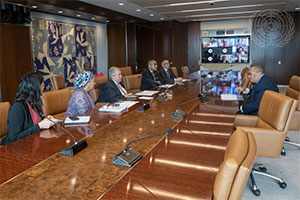 Secretary-General Meets with Members of Debt Expert Group. Credit: UN Photo/Eskinder Debeb
Financial crises are often defined by banking panics, recession, loss of market value, and deflation. Various financial crises at the turn of the 20th century, such as the Asian Crisis of 1997-1998 and the 2007-2008 Global Financial Crisis, have had immense impacts on the world economy. The COVID-19 pandemic also caused a financial crisis when mass lockdowns triggered staggering unemployment rates, a stagnation of economic growth, and led to the 2020 stock market crash. With the Russian invasion of Ukraine, the world has also witnessed a global energy crisis with shortages and increased prices in oil, gas, and electricity markets. According to UNCTAD’s World of Debt 2025, global public debt surpassed $100 trillion in 2024, with developing country debt growing twice as fast as developed economies since 2010. Burdens of debt servicing come with economic slowdowns and demands of austerity from lenders, with some economists arguing that this will lead to a new “lost decade” for the Global South. IPS brings you worldwide coverage of these financial developments and how we should manage these crises.

The Week with IPS

NEXT STOP - SDGs
Tracking global progress towards a sustainable world
Tracking global progress towards a sustainable world
